2 weeks ago
Hubble Reveals Ancient LKH Collision Shaped the Milky Way's Growth
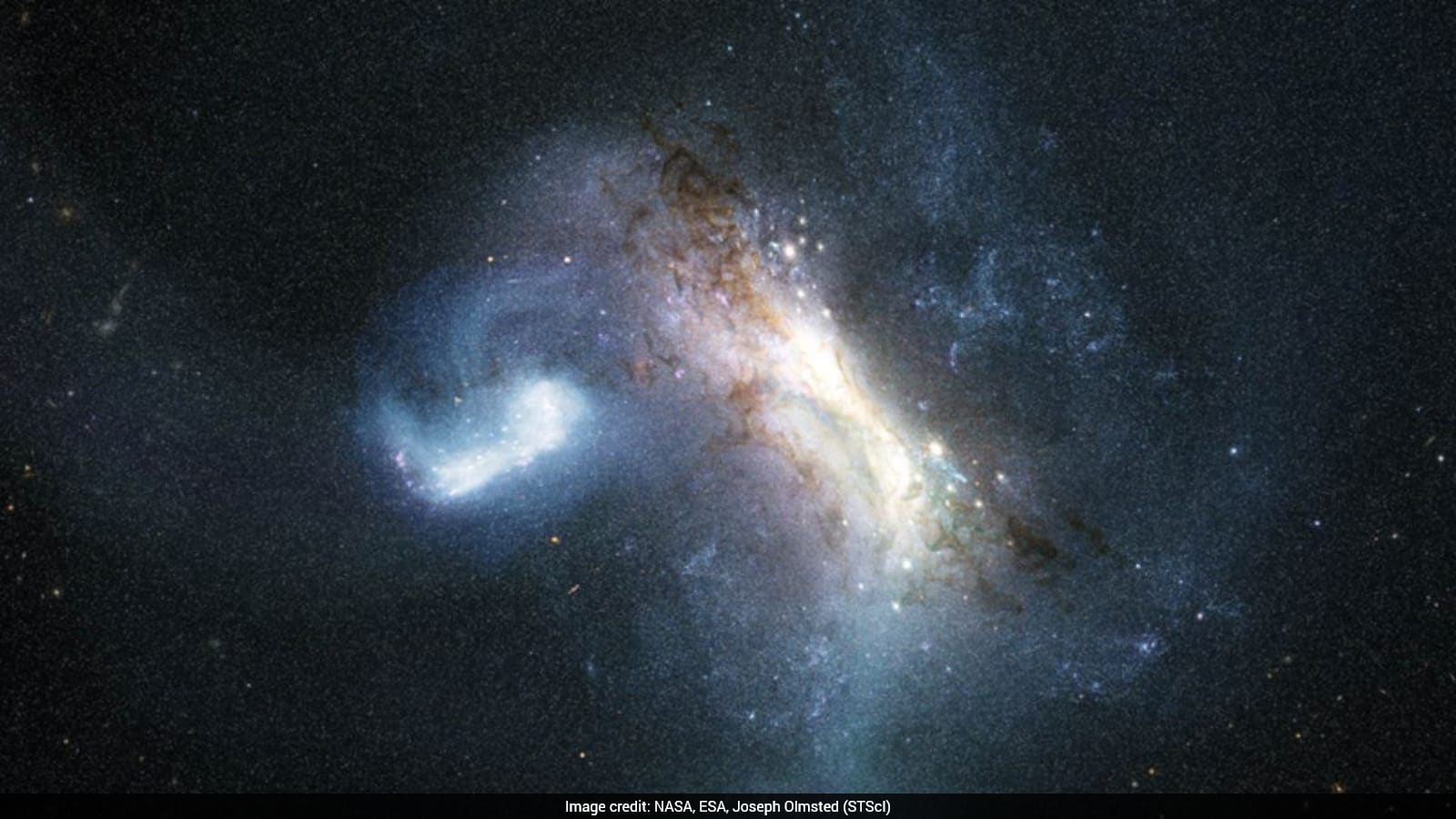
The Milky Way was much smaller when it was young.
About 11.8 billion years ago, it swallowed a smaller galaxy called LKH.
That event helped add stars, gas, and dark matter to the growing Milky Way.
Scientists studied 39 very old groups of stars called globular clusters.
Hubble helped measure their ages and the amounts of heavy elements they contained.
Data from the Gaia mission helped scientists sort the clusters into different groups.
One group came from LKH, while another came from a different merger about 10 billion years ago.
The discovery shows that some of the Milky Way’s earliest stars came from other galaxies.

Hubble data revealed evidence that the Milky Way absorbed the dwarf galaxy LKH 11.8 billion years ago.
The collision occurred about two billion years after the Big Bang, according to NASA.
Researchers analyzed 39 ancient globular clusters within 20,000 light-years of the Milky Way’s core.
The clusters’ ages and metallicity revealed three groups, including clusters originating in LKH.
LKH had a stellar mass equivalent to roughly 500 million Suns when it merged with the young Milky Way.
- Who
- Astronomers using NASA’s Hubble Space Telescope and data from the European Space Agency’s Gaia mission, led by Davide Massari.
- What
- They found evidence that the young Milky Way absorbed the dwarf galaxy LKH, also called Low-energy-Kraken-Heracles.
- Where
- The merger involved the young Milky Way, with researchers examining globular clusters within 20,000 light-years of its core.
- When
- The collision occurred approximately 11.8 billion years ago; the findings were published Monday in Nature Astronomy.
- Why
- To determine how the Milky Way formed and identify the sources of its earliest stars.
Key facts
- Collision date
- Approximately 11.8 billion years ago
- Galaxy absorbed
- LKH, or Low-energy-Kraken-Heracles
- LKH stellar mass
- Roughly 500 million Suns
- Evidence examined
- 39 ancient globular clusters
- Cluster location
- Within 20,000 light-years of the Milky Way’s core
- Other merger identified
- Gaia-Sausage-Enceladus, approximately 10 billion years ago
- Publication
- Nature Astronomy, published Monday
Quotes
Chiara Zerbinati
Co‑author, University of Bologna, Italy
“"Thanks to the high resolution and depth of Hubble imaging, we could measure the age and the metal content of these clusters with unprecedented precision," Zerbinati, co‑author, explained. "Coupled with measurements from Gaia, this made it possible to distinguish a population of globular clusters that are different from the others. These are the clusters that were born in LKH, and they tell us when that galaxy was devoured by ours, and how massive it was."”
 NDTV
NDTV
“"Our home is the Milky Way galaxy, but we do not know how our house was built," said Massari, lead author of the study, adding, "In this paper, we discover where the first significant batch of bricks came from: a dwarf galaxy that we call LKH."”
NDTV
Sources
Related news
Milky Way's Mystery Engine Blasts Record-Breaking Cosmic Particle Energies

Hyderabad-Born Astronomer Behind Study of Mysterious 'Black Hole Star'
NASA Study Links Sun’s Galactic Journey to Earth’s Ancient Climate
MIT Astronomers Discover 'Black Hole Star' in Early Universe
'Black hole star' may explain JWST's mysterious 'little red dots'

Science Quiz Covers Vehicle Communication, Space, Medicine, Missiles and Time
NASA Launches Roman Telescope to Probe Universe’s Mysteries

India's R&D Ecosystem Faces Hurdles On Path To Knowledge Economy

NISAR's Nepal Flood Silence Raises Questions About Disaster Readiness
Next Lunar Eclipse Set for February 2027 Across India, World