3 weeks ago
Milky Way's Mystery Engine Blasts Record-Breaking Cosmic Particle Energies
Imagine a giant invisible machine in space that throws tiny particles called protons at super speeds.
Scientists found such a machine in our Milky Way galaxy.
It is called LHAASO J1912+1014u, and it lives in a part of the sky called the Aquila constellation.
This machine makes protons move faster than any machine humans have ever built.
The protons it shoots have more than one quadrillion electron volts of energy, which is far more than Earth's biggest atom smasher can produce.
At first, scientists thought it was the leftover of an exploded star called a supernova.
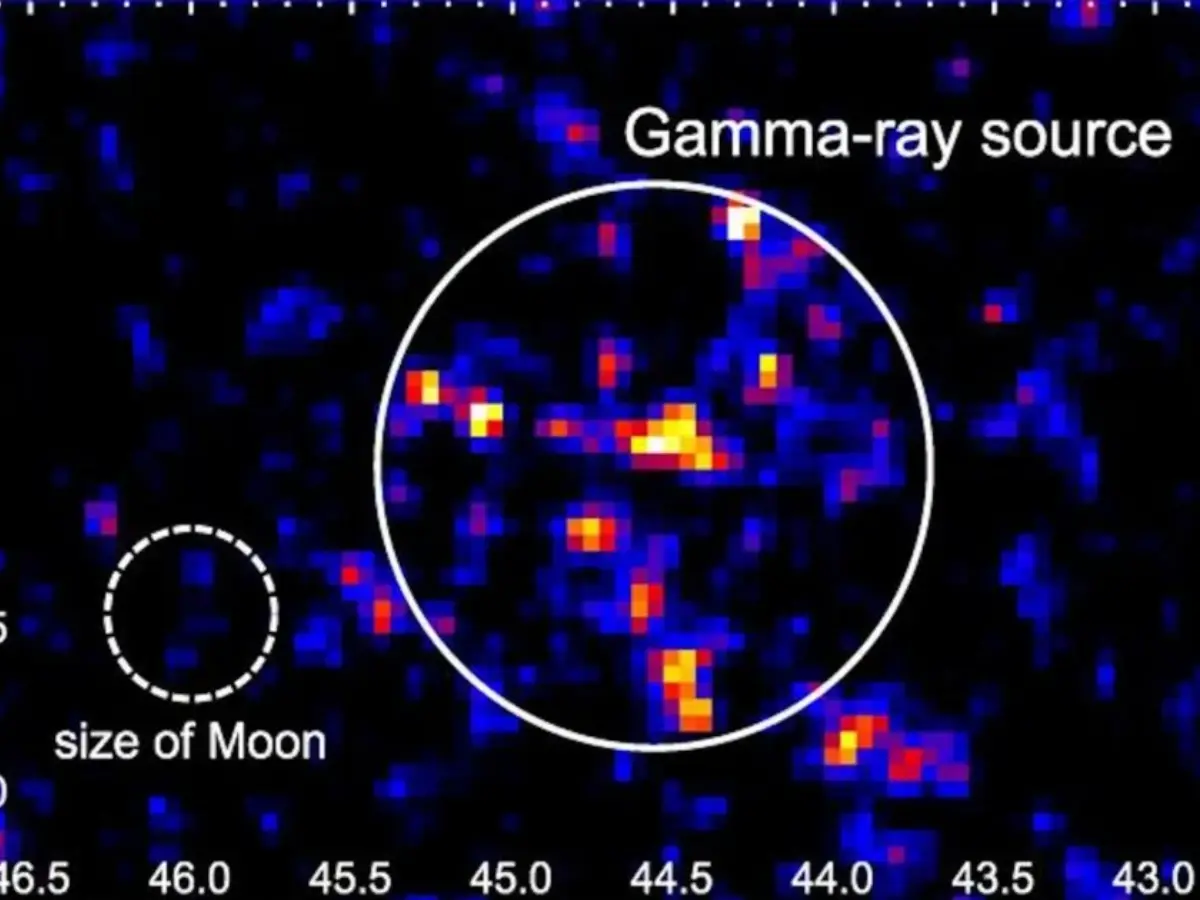
But then they saw special light called gamma rays coming from it.
By using three different telescopes, they figured out the light comes from super-fast protons, not electrons.
This tells us the object is a special kind of space accelerator called a PeVatron.
Scientists hope it can help us understand where very fast particles in space come from.

Scientists discovered a natural particle accelerator in the Milky Way, called LHAASO J1912+1014u, emitting protons with energies exceeding one quadrillion electron volts.
The object, located in the constellation Aquila, is a PeVatron that boosts protons to petaelectronvolt (PeV) energies.
First spotted in 2024 and initially classified as a supernova remnant, it was reclassified after a stream of gamma-ray emissions was observed.
Combined data from NASA's Fermi-LAT, Japan's FUGIN radio telescope, and NASA's Chandra X-ray Observatory showed the emissions come from accelerated protons, not electrons.
The findings, published in The Astrophysical Journal, may help explain the origin of high-energy particles moving through space at nearly the speed of light.
- Who
- Astronomers led by Tsunefumi Mizuno, associate professor at Hiroshima University's Astrophysical Science Center and corresponding author of the study.
- What
- Discovered that LHAASO J1912+1014u is a cosmic-ray proton PeVatron, a natural accelerator blasting protons with energies exceeding one quadrillion electron volts.
- Where
- In the constellation Aquila, within the Milky Way galaxy.
- When
- The object was first spotted in 2024; findings were published in The Astrophysical Journal.
- Why
- To uncover clues about the origin of high-energy particles moving through space at almost the speed of light.
Key facts
- Object name
- LHAASO J1912+1014u
- Type
- Cosmic-ray proton PeVatron (natural particle accelerator)
- Location
- Constellation Aquila, Milky Way
- Particle energy
- Exceeding one quadrillion electron volts (petaelectronvolt / PeV energies)
- Initial classification
- Supernova remnant (2024)
- Observatories used
- NASA's Fermi-LAT, Japan's FUGIN radio telescope, NASA's Chandra X-ray Observatory
- Journal
- The Astrophysical Journal
- Corresponding author
- Tsunefumi Mizuno, Hiroshima University
Quotes
Tsunefumi Mizuno
Associate professor at Hiroshima University’s Astrophysical Science Center and corresponding author of the study
“In this study, three arrows—Fermi-LAT GeV gamma‑ray data, FUGIN radio data and Chandra X‑ray data—are bundled together through a detailed multiwavelength modelling, revealing that our target, LHAASO J1912+1014u, is a cosmic‑ray proton PeVatron.”
 wionews.com
Sources
Related news
'Black hole star' may explain JWST's mysterious 'little red dots'
MIT Astronomers Discover 'Black Hole Star' in Early Universe
Hubble Reveals Ancient LKH Collision Shaped the Milky Way's Growth

Hyderabad-Born Astronomer Behind Study of Mysterious 'Black Hole Star'
Scientists Find First Evidence of Twin Stars Exploding as Supernovas
Mysterious 7-hour gamma-ray burst baffles scientists in 2025
New Analysis Hints at Dark Matter Detection