3 weeks ago
Search for Indianness needs open sky, not parochial Indian theory
People have been trying for a very long time to answer a big question: what makes India, India?
This started more than a hundred years ago, when India was ruled by the British.
After India became independent, leaders kept trying to figure out what being Indian really means.
Recently, some people have tried to bring back an 'Indian way of knowing things.'
The author says this is not new — people have always talked about it.
Most people agree on two things: we should not always look at India through Western eyes, and we should think for ourselves instead of using old colonial ideas.
The author uses poems and old debates to show that ideas travel like clouds and birds — they move from one country to another.
A famous poet named Rabindranath Tagore said that true India is an idea, not just a place on a map.
Mahatma Gandhi agreed that we should be open to good ideas from everywhere, but also know how to say no to bad ones.
At the end, the article says we should keep our minds open like a big sky, so different ideas can come together.

Hilal Ahmed, a political scientist, writes in Telegraph India that the quest to define 'Indianness' has shaped Indian public life for more than a century, beginning with 19th-century British colonialism.
The essay says recent efforts to popularise and re-establish the Indian Knowledge System are part of this ongoing pursuit of a true and unadulterated 'Indian theory of India.'
Ahmed notes two agreed points: the Western knowledge system dominates our political worldview, and 'decolonialisation' is needed to achieve swaraj in the realm of ideas.
He cites Ramdhari Singh Dinkar's poem 'Pakshi aur Badal' ('Birds and Clouds') to argue that ideas travel across borders like birds and clouds, so their origin should not be celebrated over their journeys.
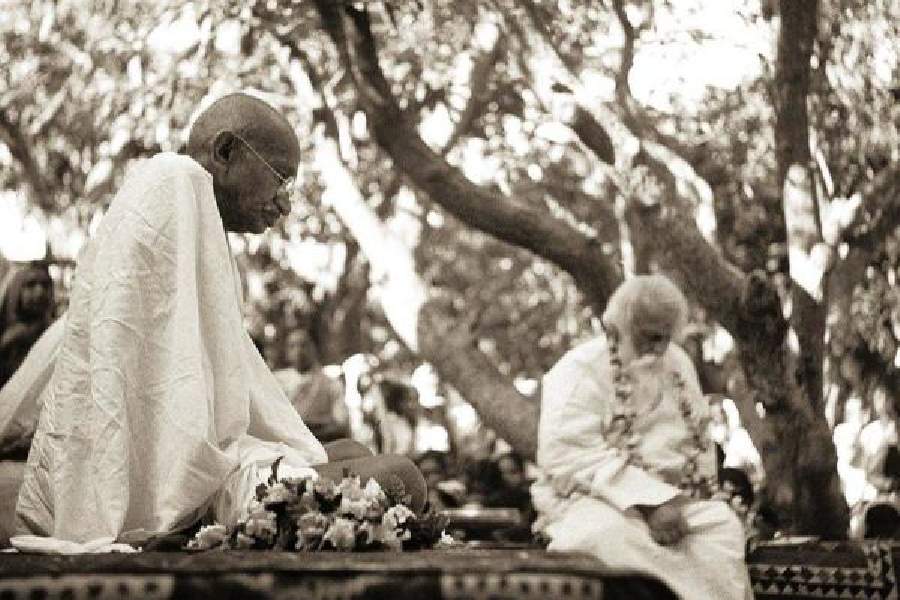
The article revisits the Gandhi-Tagore debate during the Non-cooperation Movement: Tagore called non-cooperation parochial and said true India 'is an idea and not a mere geographical fact,' while Gandhi argued rejection of untruth is as much a duty as acceptance of truth.
- Who
- Hilal Ahmed, a political scientist, writing in Telegraph India and drawing on the ideas of Rabindranath Tagore, M.K. Gandhi and Ramdhari Singh Dinkar.
- What
- An essay arguing that the search for 'Indianness' should remain open to ideas from everywhere instead of being confined to an 'Indian theory of India' or essentialist intellectual nationalism.
- Where
- India (the Republic of India); published by Telegraph India.
- When
- The essay describes a debate spanning more than a century, from 19th-century British colonialism through the post-Independence period and recent Indian Knowledge System initiatives; no publication date is given.
- Why
- To counter the dominance of Western knowledge frameworks and parochial nationalism, and to propose a dialogical, open universalist approach to understanding Indian identity, described as a search for 'punya aakash.'
Authentic Indian Theory of India
Open, Dialogical Universalism
Theorising Indianness
Authentic Indian Theory of India
Indian realities must be theorised authentically from within, escaping Western frameworks; recent Indian Knowledge System efforts continue this centuries-old quest for a true Indianness.
Open, Dialogical Universalism
India is also a geopolitical, postcolonial democratic republic, so insisting on a purely 'Indian' theory is paradoxical; ideas should be followed on their journeys, not celebrated by origin.
Attitude toward Western and colonial ideas
Authentic Indian Theory of India
The Western knowledge system dominates our political worldview, so Indian realities should not be treated merely as a case study; decolonialisation requires swaraj in the realm of ideas.
Open, Dialogical Universalism
One must go beyond rejecting the colonial framework and avoid essentialist, aggressive intellectual nationalism while remaining committed to a non-parochial worldview about Indianness.
The Non-cooperation Movement
Authentic Indian Theory of India
Gandhi: non-cooperation with evil is as much a duty as co-operation with good; rejection is as much an ideal as acceptance, and refusing to be blown off one's feet preserves genuine openness.
Open, Dialogical Universalism
Tagore: non-cooperation is a parochial idea that might encourage negative nationalism; true India is an idea and not a mere geographical fact, and freedom of the sky is of higher value than the shelter of the cocoon.
Key facts
- Author
- Hilal Ahmed
- Author's profession
- Political scientist
- Publication
- Telegraph India
- Central question
- What is 'Indianness'?
- Timeframe discussed
- More than a century, from 19th-century British colonialism to recent Indian Knowledge System efforts
- Key figures cited
- Ramdhari Singh Dinkar, Rabindranath Tagore, M.K. Gandhi
- Historical context
- Gandhi-Tagore debate during the Non-cooperation Movement
- Central metaphor
- Ideas travel like birds and clouds (Dinkar's 'Pakshi aur Badal')
Sources
Related news
Languages of Freedom Book Review Explores India's Political Thought
India's Enduring Answer to Collapse Predictions on 79th Independence Day

Two Gen Zs, One Bharat: Author Urges Rooting in Hindutva

Book Traces India’s Forests Through Literature, Politics, and Ecology
'Dimagi Naxal' remark shows Modi running out of enemies

How Tagore Used Rakhi to Resist Bengal’s Partition

Quit India Movement paved way for Independence, Congress leader says
Independence Day fiction: Jailed satyagraha volunteer's family faces land seizure

Independence Day 2026: Freedom Fighter Quotes Continue to Inspire

From Colonial Neglect, India Built a Healthcare System of Promise