1 hr ago
Study Suggests Black Holes Could Form Planets and Stars
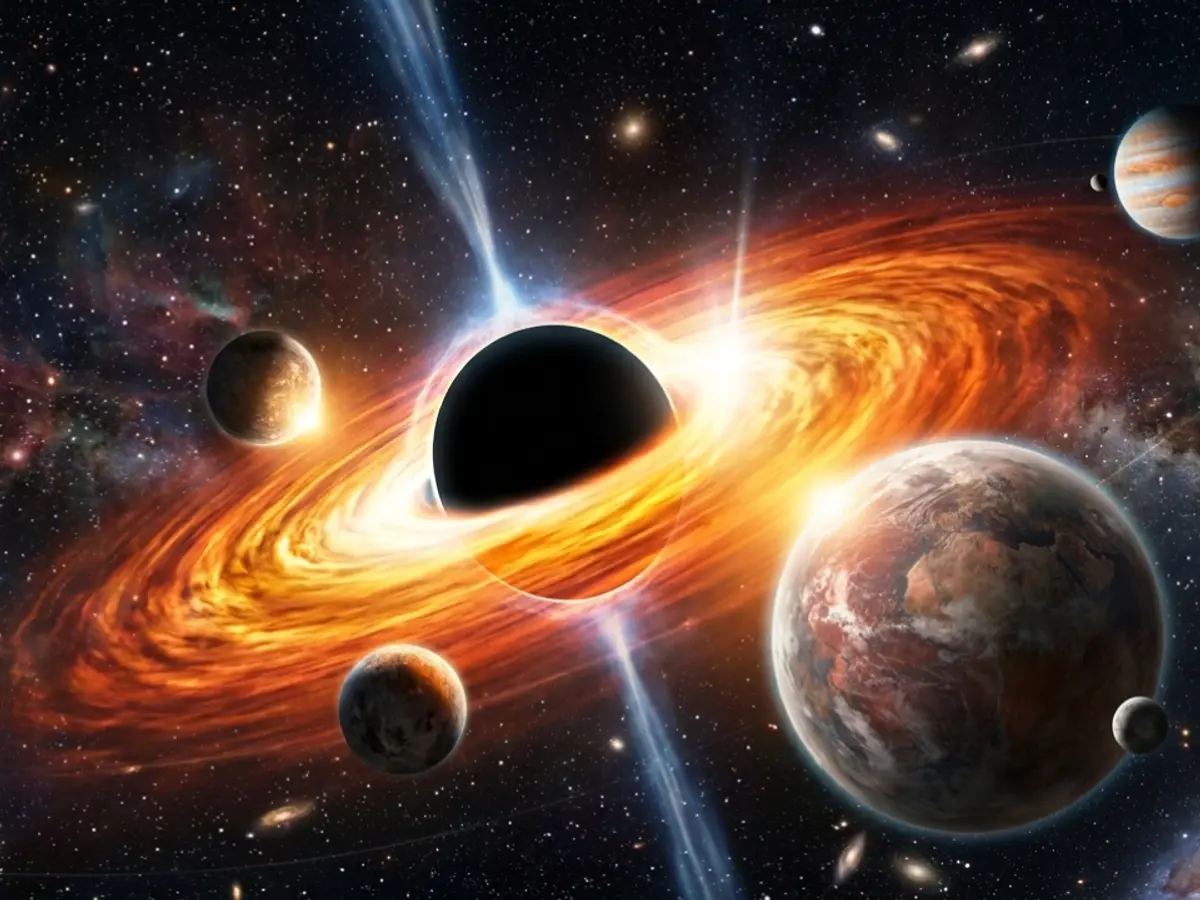
Scientists usually think of black holes as places that swallow nearby matter.
A new study suggests that the gas and dust around some black holes might also help make planets.
The researchers looked at supermassive black holes that are actively pulling in material.
That material can swirl around them in a disk.
Dust grains in the disk might stick together and build larger objects, much as they do around stars.
Computer simulations suggest the newborn planets could be as big as Jupiter and could grow even larger.
Some might become brown dwarfs, and a few might even become stars.
These ideas are theoretical, and the article does not say that such planets have been observed.

A study published in The Astrophysical Journal on June 29, 2026, proposes that planets may form around supermassive black holes.
Researchers focused on active galactic nuclei, where gas and dust gather and swirl around a feeding black hole.
The study says these dusty regions may provide conditions for planet formation similar to disks around stars.
Simulations suggest newly formed planets could be as large as Jupiter and might grow much larger; one black hole could have millions nearby.
Some objects could become brown dwarfs or, potentially, stars, though the study describes these possibilities as theoretical.
- Who
- Researchers, including study co-author astrophysicist Barry McKernan.
- What
- A study suggests dusty disks around actively feeding supermassive black holes could form planets and possibly brown dwarfs or stars.
- Where
- In dusty regions around supermassive black holes, including those at the centers of galaxies.
- When
- The study was published June 29, 2026.
- Why
- The researchers argue that dust and gas around black holes may undergo planet-forming processes similar to those in disks around stars.
Potential for Formation
Theoretical Status
Could black holes host planet formation?
Potential for Formation
The researchers say dusty regions around actively feeding supermassive black holes could support planet-forming processes, with simulations indicating that many planets could form.
Theoretical Status
The proposal is theoretical; the article does not report observations confirming planets around black holes.
What could the objects become?
Potential for Formation
The study suggests some objects could grow into brown dwarfs or even stars.
Theoretical Status
These are presented as possible outcomes, not as confirmed objects or measured results.
Key facts
- Publication
- The Astrophysical Journal
- Publication date
- June 29, 2026
- Black hole setting
- Actively feeding supermassive black holes, known as active galactic nuclei
- Proposed formation process
- Dust grains gather, become denser, collide, and coalesce into larger bodies
- Simulated newborn size
- As large as Jupiter
- Possible outcomes
- Planets may grow larger; some objects could become brown dwarfs or stars
- Evidence status
- The study describes the possibility theoretically; the article reports no observed planets around black holes
Sources
Related news
Astronomers Find Candidate Phoenix Planet Around White Dwarf
Astronomers Confirm Youngest Known Planet, Still Inside Birth Disk
AI Helps Astronomers Create Video of Black Hole Jet
Earth and Mars Formed Differently Despite Sharing Solar System Origins
Astronomers Detect Radio Emission From Exoplanet, Urge Caution
Scientists Say Young Sun May Have Swallowed Super-Earth
Scientists Suggest Venus May Have Destroyed Its Own Moon
Five-Hour Moon Formation Theory Sparks Biblical Creation Debate
New Simulations Suggest Moon Formed Within Five Hours

Sun's magnetic dance holds key to hot corona mystery