1 hr ago
Astronomers Find Candidate Planet Formed From Stellar Debris
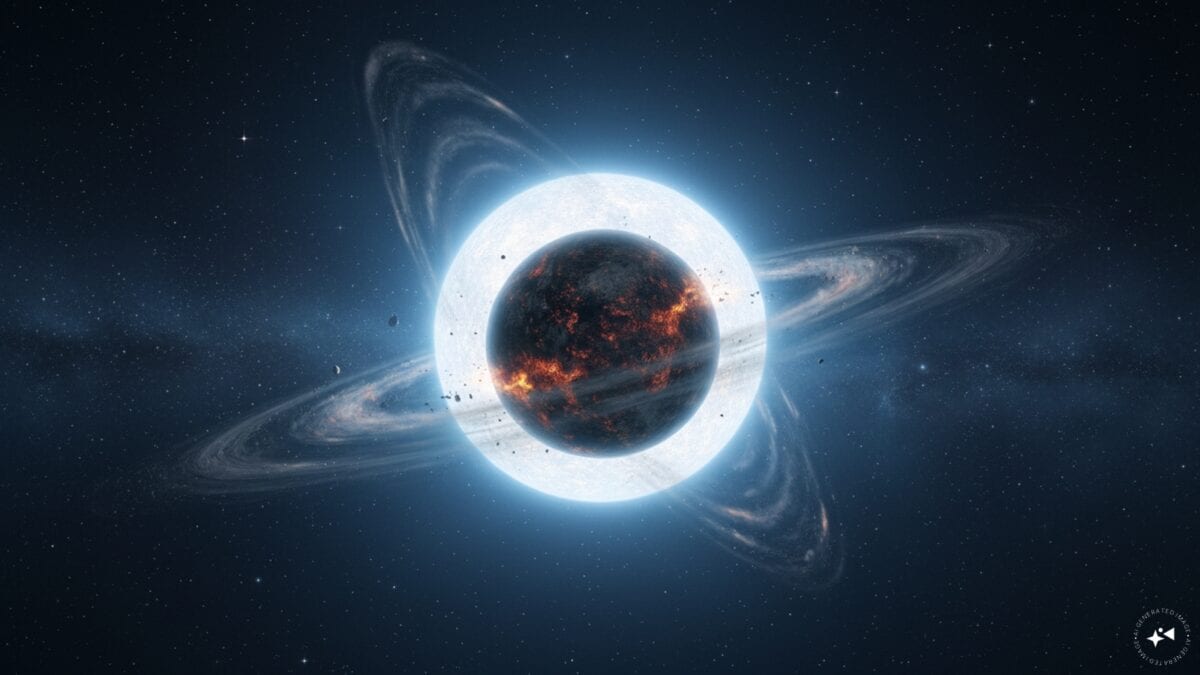
A white dwarf is the leftover core of a star that has used up its fuel.
Astronomers found signs that a Jupiter-sized planet circles one called HS 0209+0832.
The planet goes around its star once every 4.4 days.
Hubble observations found unusual amounts of certain heavy elements around the white dwarf.
Researchers think these elements may have come from material the star threw off as it died.
They suggest an unseen companion star may have helped gather that material into a disc.
A new planet may then have formed from the disc, which is why researchers call it a second-generation planet.
The white dwarf’s radiation is now heating and removing gas from the planet’s outer atmosphere.
The planet is a candidate, and the proposed formation process is the researchers’ explanation of the evidence.

Astronomers identified the first candidate for a second-generation planet orbiting a white dwarf, HS 0209+0832.
The white dwarf is about 270 light-years from Earth, and its Jupiter-sized companion completes an orbit every 4.4 days.
Hubble observations found heavy elements including zinc, copper and unusually abundant niobium in the white dwarf’s atmosphere.
Researchers say the chemical signature suggests the planet formed from material expelled by the star as it died.
The team proposes that an unseen companion star drew the expelled material into a disc; the planet’s atmosphere is now being stripped by radiation.
- Who
- Astronomers led by the University of Warwick research team; the candidate planet orbits the white dwarf HS 0209+0832.
- What
- Researchers reported the first candidate for a second-generation planet orbiting a white dwarf.
- Where
- Around HS 0209+0832, about 270 light-years from Earth.
- When
- The report was published on October 7, 2026; the study appeared in Nature Astronomy.
- Why
- Unusual heavy-element signatures detected by Hubble led researchers to propose that the planet formed from material expelled by the dying star.
Evidence and Interpretation
Caveat
Planet’s origin
Evidence and Interpretation
Researchers interpret the heavy-element signature as evidence that the planet formed from material expelled by the dying star, possibly gathered into a disc by an unseen companion.
Caveat
The report describes the object as a candidate and presents the formation pathway as the research team’s belief, not as a directly observed process.
Key facts
- White dwarf
- HS 0209+0832
- Distance from Earth
- About 270 light-years
- Candidate planet
- Jupiter-sized gas giant
- Orbital period
- 4.4 Earth days
- Notable element
- Niobium was reported at levels 1,000 times greater than in the Sun.
- Observation source
- NASA’s Hubble Space Telescope
- Study journal
- Nature Astronomy
Sources
Related news
Scientists Say Young Sun May Have Swallowed Super-Earth
Astronomers Confirm Youngest Known Planet, Still Inside Birth Disk

Earth and Mars Formed Differently Despite Sharing Solar System Origins
First Radio Signals Directly Localized to Exoplanet Beta Pictoris b

Five-Hour Moon Formation Theory Sparks Biblical Creation Debate

NASA Curiosity Captures Martian Dawn Near Mount Sharp

El Niño, Stubble Burning Raise Concerns Over Delhi's Winter Air

Tuvalu Reclamation Effort Highlights Pacific Climate Vulnerability
NASA Backs Mission to Probe Mysterious Lunar Pit