1 day ago
AI Helps Astronomers Create Video of Black Hole Jet
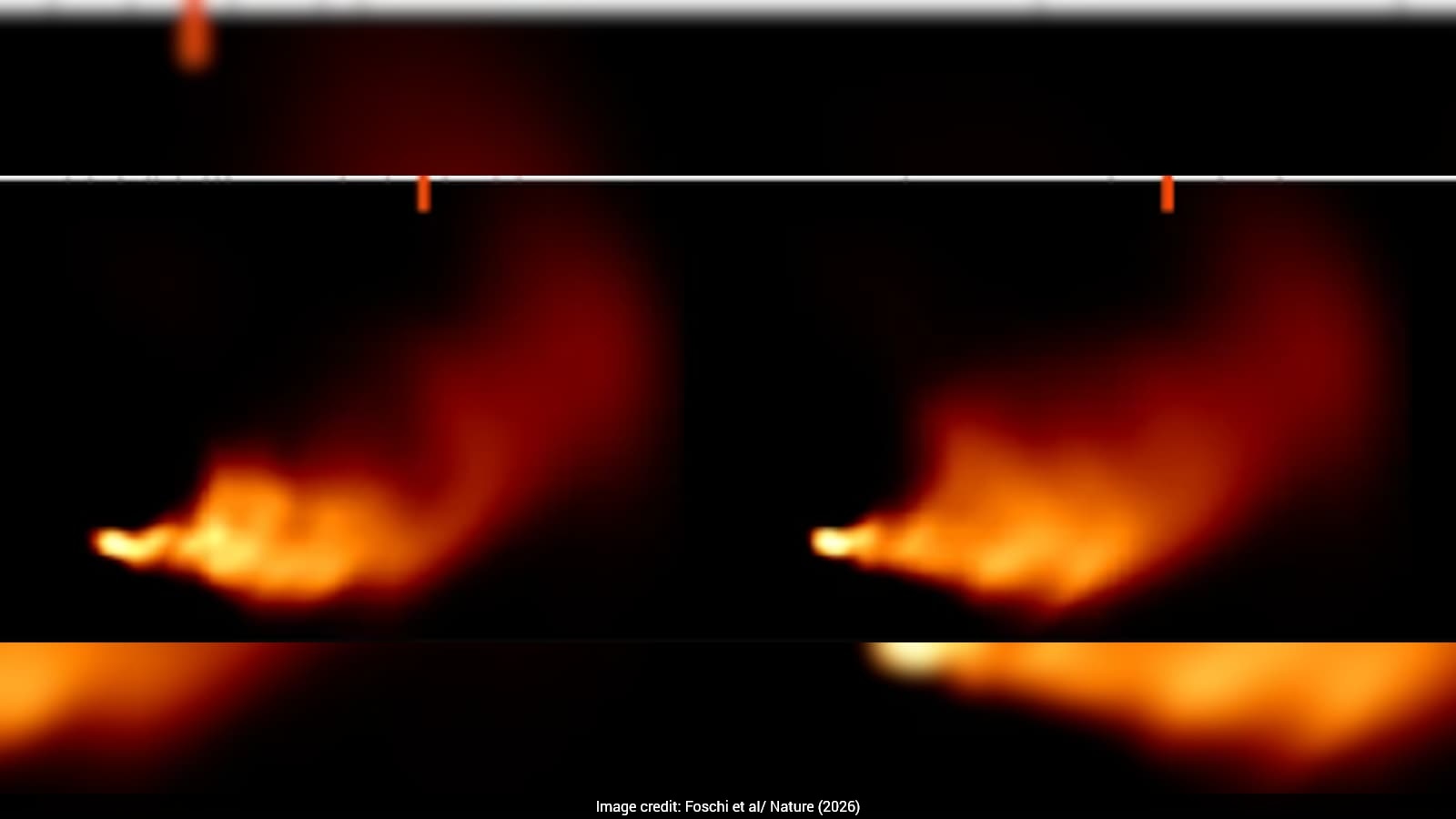
Astronomers studied a distant object called a blazar.
A blazar is a supermassive black hole shooting a powerful stream of hot material into space.
The stream from 3C 345 points roughly toward Earth.
The object is about 5.5 billion light-years away.
Scientists collected 116 radio images over 27 years.
They used an AI program called Kine to connect the images and fill in missing parts.
This made the changing jet look more like a continuous video.
The clearer video may help scientists study how the plasma moves.

Caltech astronomers created a video of the blazar 3C 345, located about 5.5 billion light-years away.
The blazar’s supermassive black hole sends a high-energy plasma jet toward Earth.
Researchers analyzed 116 radio-telescope images collected between 1995 and 2022.
Lead researcher Marianna Foschi’s team used a neural-network algorithm called Kine to fill visual gaps.
The algorithm improved image clarity by about four times, allowing continuous tracking of the plasma’s movement.
- Who
- Astronomers at Caltech, led by Dr Marianna Foschi.
- What
- They used AI to create a detailed video showing plasma moving from the blazar 3C 345.
- Where
- 3C 345 is about 5.5 billion light-years away in the constellation Hercules.
- When
- The analyzed observations were collected from 1995 to 2022, over 27 years.
- Why
- To track the blazar’s plasma movement continuously and improve the clarity of observations.
Key facts
- Object
- Blazar 3C 345
- Distance
- About 5.5 billion light-years
- Location
- Constellation Hercules
- Data analyzed
- 116 radio-telescope images
- Observation period
- 1995–2022
- AI algorithm
- Kine, a neural-network algorithm
- Reported improvement
- About four times greater clarity
Quotes
Dr Marianna Foschi
Lead researcher on the Caltech study
“In simple terms, we mapped the image with peaks where parts of the blazar appear brightest, and valleys in the parts that appear darkest.”
 NDTV
NDTV
“We are all very excited by the amount of resolution and contrast that we can get thanks to our new algorithm.”
NDTV
Sources
Related news
London Surgeons Use AI in World-First Brain Tumour Operation
uGMRT Detects Extreme Radio Flashes From Rare Neutron Star

Simple Ways to Check Whether Viral Videos Are AI-Generated

Anima Anandkumar Named Among TIME’s Most Influential AI Leaders
Astronaut Shares Four Dazzling Night Cycles From Space

How Smartphone AI Spots Crop Disease From Leaf Photos

PM to Inaugurate Northeast's First Highway Emergency Landing Strip