

1 hr ago
Scientists Suggest Venus May Have Destroyed Its Own Moon
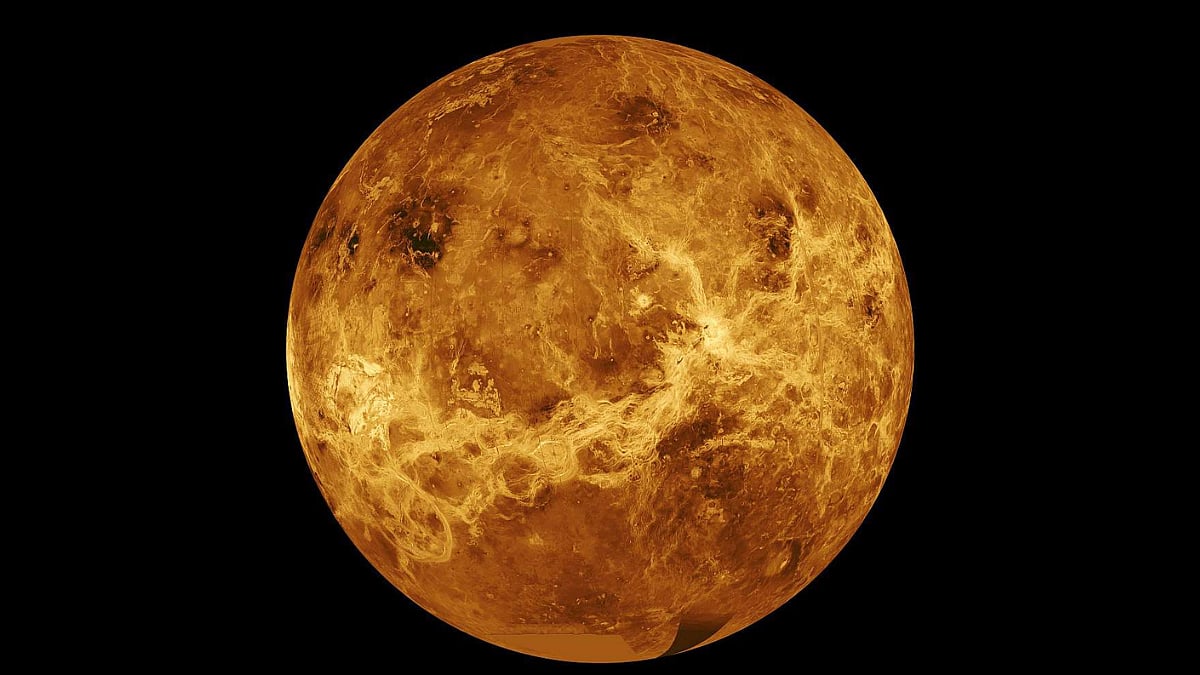
Scientists are trying to explain why Venus does not have a moon.
They suggest Venus may once have had one.
Venus spins very slowly, taking 243 Earth days to rotate once.
This slow spin could have pulled the moon closer to Venus.
Eventually, the moon may have crashed into the planet.
Computer simulations produced this result for moons of different sizes.
Older ideas said Venus might never have had a moon or that a large impact destroyed it.
Learning how Venus became so different from Earth may help scientists understand planetary climates.

A University of California, Riverside study suggests Venus may once have had a moon that spiralled into the planet.
Researchers say Venus’s exceptionally slow rotation would have pulled a hypothetical moon inward rather than pushing it away.
Computer simulations indicated that moons of various sizes could have collided with Venus within the Solar System’s first billion years.
The theory differs from earlier explanations that Venus either never had a moon or lost one in a massive impact.
Researchers say studying Venus’s divergence from Earth could provide clues about long-term climate change on Earth.
- Who
- Researchers at the University of California, Riverside, led by astrophysicist Stephen Krane.
- What
- They proposed that Venus may have swallowed a former moon after the moon spiralled inward and collided with the planet.
- Where
- The proposed collision occurred at Venus; the research was conducted by University of California, Riverside researchers.
- When
- The study was published in The Astrophysical Journal and presented this week; the proposed collision would have occurred within the Solar System’s first billion years.
- Why
- Venus’s unusually slow rotation may have caused gravitational effects that pulled a moon inward instead of allowing it to move away.
New Moon-Destruction Theory
Earlier Explanations
Why Venus lacks a moon
New Moon-Destruction Theory
The researchers argue that Venus likely had a moon, but its slow rotation caused the moon to spiral inward and collide with the planet.
Earlier Explanations
Earlier explanations proposed that Venus never captured a moon or that a moon was destroyed in a massive impact.
Role of planetary rotation
New Moon-Destruction Theory
The study says Venus’s 243-day rotation would pull a moon inward, unlike Earth’s faster rotation, which gradually pushes its moon outward.
Earlier Explanations
The earlier explanations did not identify Venus’s slow rotation as the primary reason for the planet’s moonless state.
Key facts
- Study source
- The Astrophysical Journal
- Research institution
- University of California, Riverside
- Lead author
- Stephen Krane
- Venus’s rotation
- 243 Earth days per rotation
- Proposed timing
- Within the Solar System’s first billion years
- Earth’s lunar drift
- About 4 centimetres per year outward
- Venus surface temperature
- Up to 880°F (471°C), according to the article
Sources
Related news
New Simulations Suggest Moon Formed Within Five Hours
Scientists Say Young Sun May Have Swallowed Super-Earth
Skywatchers in Uttar Pradesh See Moon and Venus Together
Five-Hour Moon Formation Theory Sparks Biblical Creation Debate
NASA Orbiter Reveals 60-Foot Crater From SpaceX Rocket Impact

NASA Finds Earth Microbes Could Survive Near Moon’s South Pole

Apollo: Britain’s Long-Running Magazine Covering Art and Collecting

Nvidia gives away free AI models to drive chip sales

Nvidia Partners With Wall Street Giants to Raise $500 Billion
NASA Invites ISRO to Join Moon Base Programme
