2 weeks ago
NITI Aayog's $81 billion chemical export target faces challenges
NITI Aayog is a group of experts in India that helps the government plan for the future.
They wrote a report about chemicals — the ingredients used to make medicines, plastics, paints, and many other things.
The report says India should try to sell $81 billion worth of chemicals to other countries by 2030.
Right now, India buys a lot of chemicals from other countries, and that costs more than it earns from selling them.
The experts say India can make more chemicals at home instead.
To do that, India needs better factories, more money for new ideas, and more trained workers.
The report also says the government can help by supporting companies that make special chemicals.
If India reaches its goals, it could become a bigger player in the world and help its economy grow.
But there are challenges, so reaching the target will not be easy.

NITI Aayog has outlined an $81 billion export target for India's chemical sector by 2030, including $45 billion in specialty chemical exports, $26 billion in petrochemical exports, and $5–10 billion in inorganic chemical exports.
India's chemical market consumption is projected to reach $290–310 billion by fiscal 2030, accounting for roughly 5–6% of global chemical consumption.
India holds an 8% share of the global specialty chemical export market (as of 2024), behind China, the US, Germany, and France.
The industry ran a $31 billion trade deficit in 2023, driven by import dependence on feedstock, minerals, active pharmaceutical ingredients, and high-purity chemicals.
NITI Aayog recommends viability gap funding and incentives for complex derivatives such as ethylbenzene, cumene, cyclohexane, and nitrobenzene to boost domestic manufacturing.
- Who
- NITI Aayog, India's government policy think tank, authored the report; the Indian chemical industry is the subject.
- What
- An $81 billion chemical export target by 2030, along with market consumption projections and policy recommendations to reduce import dependence.
- Where
- India.
- When
- By 2030 (fiscal 2030); the report also cites a $31 billion trade deficit recorded in 2023 and an 8% export market share as of 2024.
- Why
- To address India's trade deficit and import dependence, strengthen domestic manufacturing, and position India as a key global chemicals player.
Key facts
- Export target (2030)
- $81 billion
- Specialty chemical exports
- $45 billion
- Petrochemical exports
- $26 billion
- Inorganic chemical exports
- $5–10 billion
- Projected market consumption (FY30)
- $290–310 billion
- Global specialty export share (2024)
- 8%
- Trade deficit (2023)
- $31 billion
- Required CAGR
- 14% production; 10–11% consumption
Quotes
NITI Aayog report
Government think tank report
“A robust manufacturing base is essential for promoting self‑reliance, reducing import dependence, and increasing value addition, particularly in critical sectors such as electronics, defense, and renewable energy.”
 financialexpress.com
“India’s high import requirements highlight a significant shortfall in domestic production, underscoring the need to enhance domestic manufacturing capabilities.”
financialexpress.com
Sources
Related news

India chemicals industry eyes $81 billion exports by 2030

NITI Aayog identifies four key sectors for India's manufacturing hub

India Eyes USD 1 Trillion Chemicals Sector by 2040
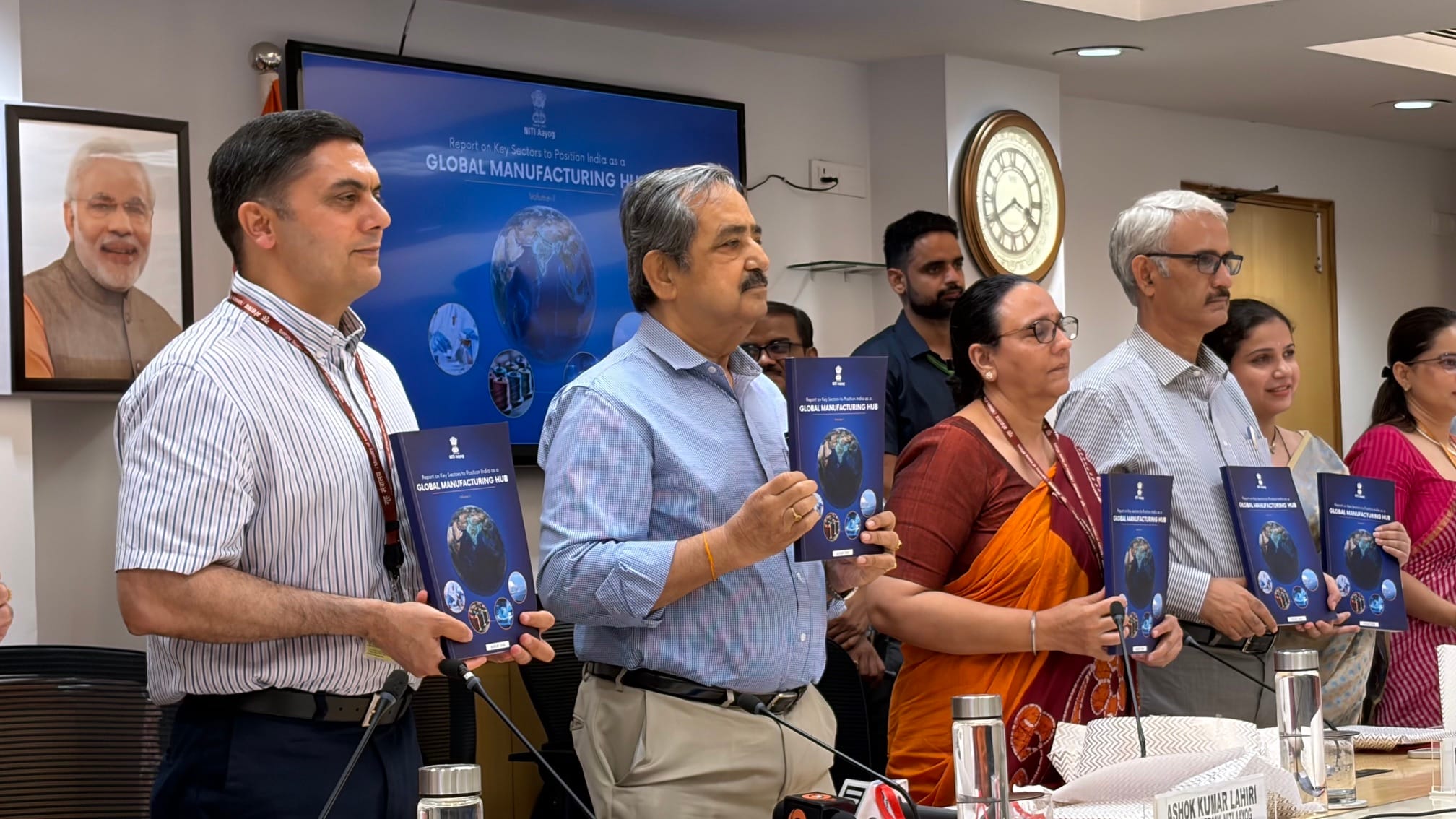
NITI Aayog identifies 12 sectors for India's global manufacturing push

NITI Aayog Proposes Industrial Clusters to Boost India's Global Manufacturing

India Needs Structural Transformation To Reach $2 Trillion Exports

Pentagon Turmoil Deepens as Hegseth Tightens Grip on Military

Damaged Lohit River Bridge Cuts Off Arunachal Border Villages

Nepal Flood Exposes Delayed Alerts and Cross-Border Warning Gaps

Chinese Workers Fight Office Ageing With Parasols And Sunscreen
UPSC Key Covers SCO, Electoral Rolls, Economy, Defence and Climate