2 weeks ago
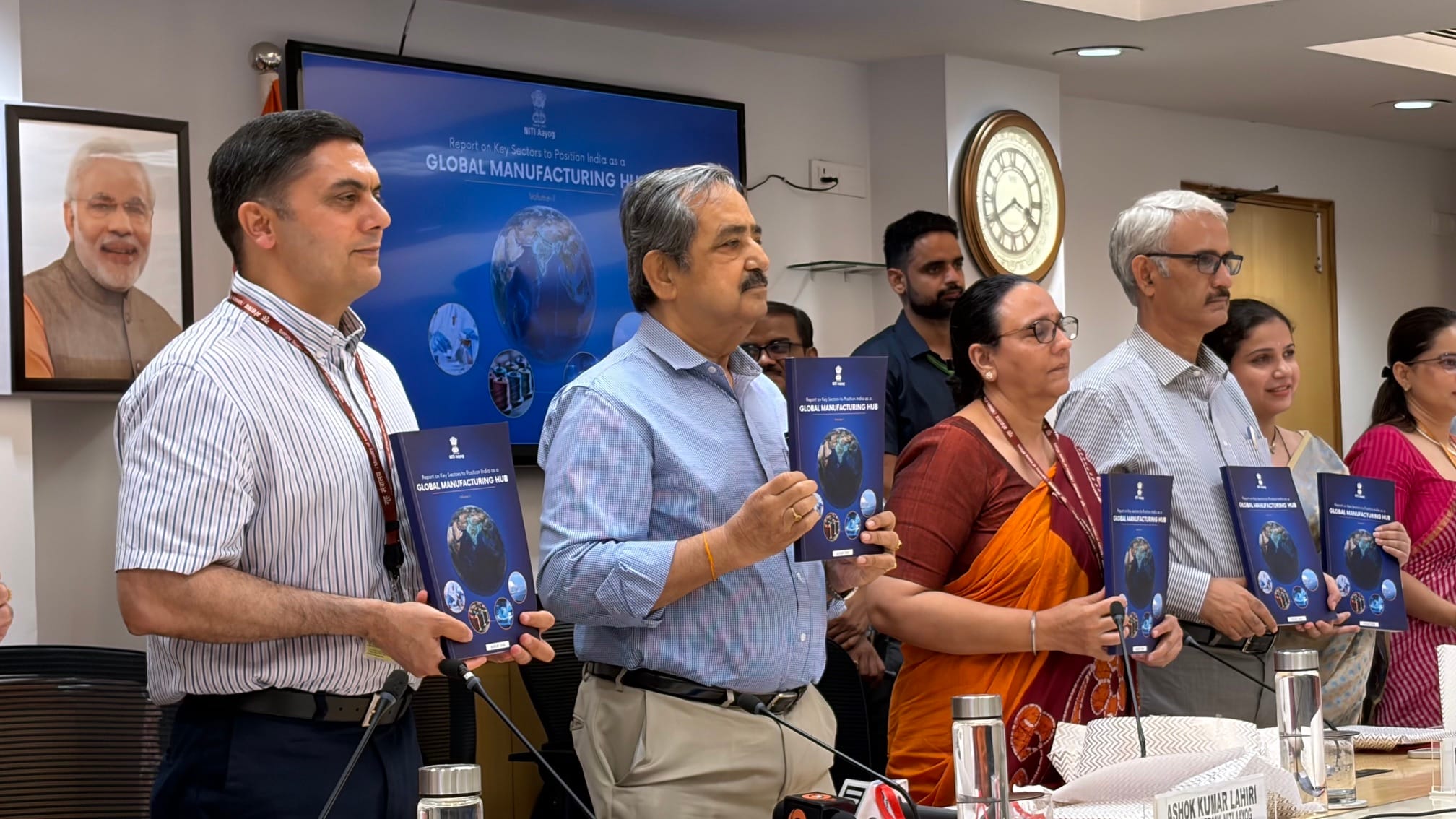
NITI Aayog identifies four key sectors for India's manufacturing hub

The government of India has a special office called NITI Aayog that helps plan how the country can grow.
This week, the office shared a report about making India a place where lots of things are made.
The report says India should focus on four big areas: chemicals, textiles, phones and network equipment, and solar panels.
Chemicals are things used to make materials like plastics and synthetic fibres.
Textiles are fabric and clothing, and India already earns a lot of money from making them.
Making more phones, network equipment and solar panels at home means India won't need to rely so much on other countries.
India already has one of the biggest phone and internet markets in the world, with over 1.2 billion users.
If India makes more of these things itself, it can create jobs and sell more products to other countries.
NITI Aayog will also publish reports on eight more sectors in the future.

NITI Aayog highlighted four high-potential manufacturing sectors: chemicals, textiles, telecom and network equipment, and solar photovoltaic manufacturing.
The sectors are detailed in a report titled 'Key Sectors to Position India as a Global Manufacturing Hub.'
India's textile and apparel industry contributes approximately 2 per cent to national GDP, 11 per cent to manufacturing GVA, and 9 per cent of merchandise exports.
India is the world's second-largest telecommunications market with more than 1.2 billion subscribers, about 85 per cent telecom penetration, and nearly 75 per cent internet usage.
This edition covers four sectors, with reports on eight more high-potential sectors to follow.
- Who
- NITI Aayog, India's government policy think tank
- What
- Highlighted chemicals, textiles, telecom and network equipment, and solar photovoltaic manufacturing as key sectors to position India as a global manufacturing hub
- Where
- New Delhi, India
- When
- Thursday
- Why
- To fuel India's ambition to become a global manufacturing powerhouse by strengthening domestic capabilities, competitiveness, value addition, and export-oriented manufacturing growth
Key facts
- Report Title
- Key Sectors to Position India as a Global Manufacturing Hub
- Focus Sectors
- Chemicals, textiles, telecom and network equipment, solar photovoltaic manufacturing
- Textile Contribution to National GDP
- Approximately 2 per cent
- Textile Share of Manufacturing GVA
- 11 per cent
- Textile Share of Merchandise Exports
- 9 per cent
- Telecom Market Ranking
- World's second-largest
- Telecom Subscribers
- More than 1.2 billion
- Telecom Penetration
- Approximately 85 per cent (near 75 per cent internet usage)
Quotes
NITI Aayog official
Government advisory body on economic planning
“The project seeks to identify sectors where India has significant growth potential and where targeted interventions can strengthen domestic capabilities, enhance competitiveness and value addition, and accelerate export-oriented manufacturing growth.”
 thehansindia.com
“India’s textile industry has significant potential to strengthen its global competitiveness by improving raw material availability, scaling up manufacturing through infrastructure support, and expanding market access through deeper trade integration.”
thehansindia.com
Sources
Related news
NITI Aayog identifies 12 sectors for India's global manufacturing push

NITI Aayog Proposes Industrial Clusters to Boost India's Global Manufacturing

NITI Aayog's $81 billion chemical export target faces challenges

India chemicals industry eyes $81 billion exports by 2030

Sitharaman Urges Global Investors to Build for World from India

India Eyes USD 1 Trillion Chemicals Sector by 2040

Hooda Accuses Haryana Government of Evading Assembly Questions

India's R&D Ecosystem Faces Hurdles On Path To Knowledge Economy

India’s AI Ambition Faces Questions About School Foundations

Hyderabad Reports Police Aid, Prison Death And Scheme Dispute

Why JSW MG Motor May Bring EREV Technology to India