1 month ago
Scientists Find First Evidence of Twin Stars Exploding as Supernovas
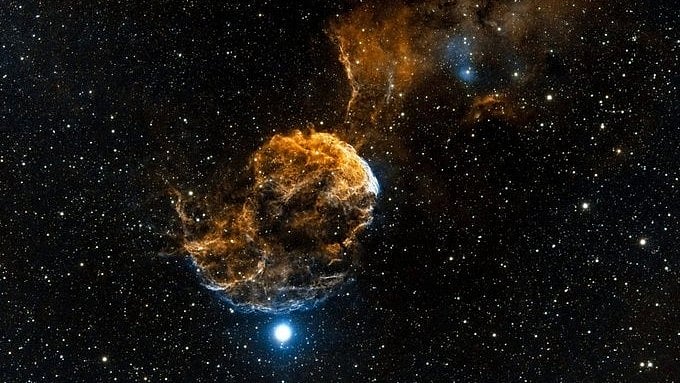
Scientists have found the first evidence of two big stars that were born together and both exploded as supernovas.
These stars were in a binary system, meaning they were gravitationally bound to each other.
The explosions left behind glowing clouds of gas called nebulae.
One of these nebulae is known as the Jellyfish Nebula.
The scientists used data from a space telescope to find a second nebula nearby, linking them as the remains of the two stars.
The stars were very bright and massive, much bigger than our Sun.
The explosions happened thousands of years apart, and the first explosion might have disrupted the system, sending the surviving star through space before it also exploded.
This discovery helps scientists understand how big stars evolve and interact in binary systems.

Scientists discovered evidence of two companion stars in a binary system that both exploded as supernovas.
The explosions left behind two nebulae, one of which is the well-known Jellyfish Nebula.
The stars were at least 15 to 25 times and at least 20 times the mass of the Sun, respectively.
The explosions occurred between 20,000 and 110,000 years apart, with the first explosion disrupting the binary system.
The discovery provides direct observational evidence to improve understanding of how massive binary stars evolve.
- Who
- Scientists using data from NASA's Fermi Gamma-ray Space Telescope
- What
- Discovered evidence of two companion stars that exploded as supernovas
- Where
- The nebulae are located in the constellation Gemini, about 6,000 light-years from Earth
- When
- The study was published on Tuesday in the journal Nature Communications
- Why
- To improve understanding of how massive binary stars evolve
Theoretical Models
Observational Evidence
Understanding Stellar Evolution
Theoretical Models
Theoretical models and numerical simulations have been the primary tools for understanding the final evolutionary stages of massive binary stars.
Observational Evidence
The discovery of the binary system where both stars exploded provides direct observational constraints on how massive stars evolve in binary systems.
Key facts
- Distance from Earth
- 6,000 light-years
- Constellation
- Gemini
- Mass of First Star
- 15 to 25 times the Sun's mass
- Mass of Second Star
- At least 20 times the Sun's mass
- Time Between Explosions
- 20,000 to 110,000 years
- Current Separation
- 30 to 50 light-years
- Initial Orbital Distance
- A few times the distance between Earth and the Sun
Quotes
Miltiadis Michailidis
Postdoctoral fellow in Stanford University's physics department and lead author of the study
“"This system provides a rare opportunity to reconstruct the complete evolutionary history of a massive binary — from the birth and interaction of two massive stars, through both supernova explosions, to the remnants they left behind."”
 freepressjournal.in
Sources
Related news

Professor, Five Students Arrested in IGKV Paper Leak

Srirama Engineering College signs MoU with BLOQ Quantum Technology

Andhra Pradesh steps up lithium, gallium exploration in Kadapa basin

Pune Police Bust Interstate Burglary Gang, Recover ₹37 Lakh Jewellery