1 week ago
India’s Rs 7,280-Crore Magnet Scheme Draws Three Diverse Bidders
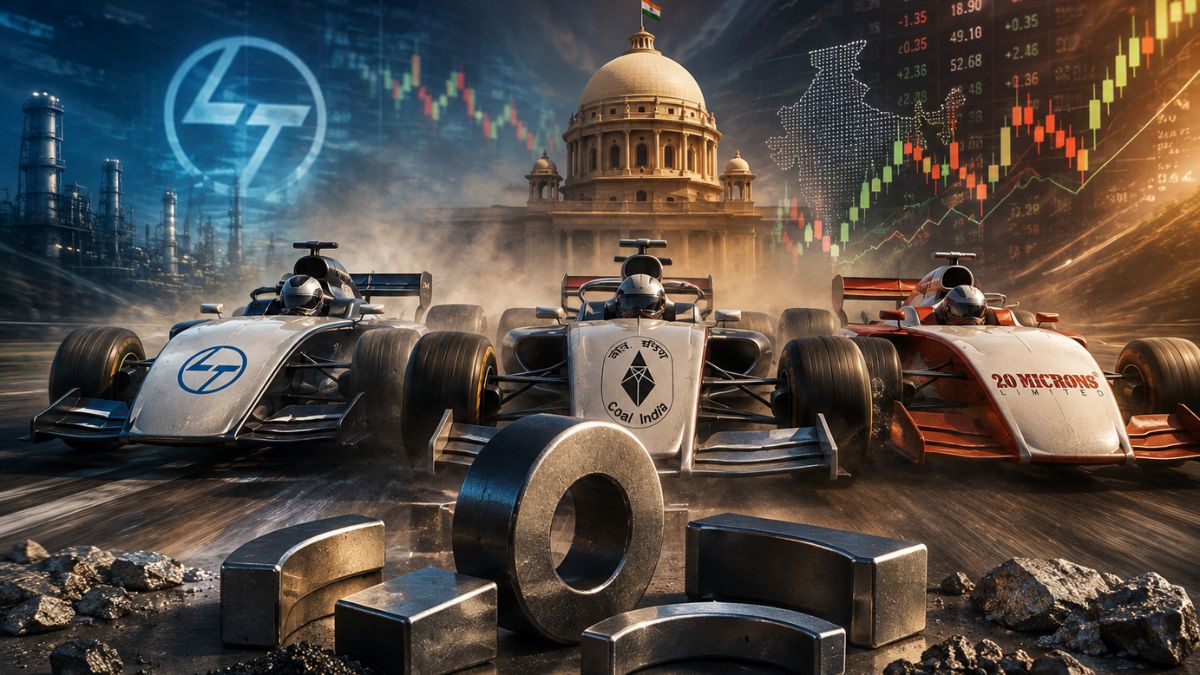
India wants to make more rare earth magnets inside the country.
These magnets are used in electric vehicles, wind turbines, robots, electronics and defence equipment.
The government has created a Rs 7,280-crore programme to support this goal.
It wants factories that can make 6,000 tonnes of magnets each year.
Five companies will be chosen from 20 bidders.
Larsen & Toubro already works in engineering, electronics and electric-vehicle technologies.
Coal India has money, mining experience and interest in critical minerals, but magnet-making would be a new field for it.
20 Microns processes industrial minerals, but it would need new metallurgy and manufacturing expertise.
The final winners will show which companies the government believes can build this supply chain.

The Ministry of Heavy Industries’ Rs 7,280-crore scheme targets 6,000 tonnes per year of integrated sintered NdFeB magnet capacity.
Five of 20 bidders will be selected, with each eligible for up to 1,200 tonnes per year.
Larsen & Toubro offers the strongest existing links to precision engineering, electronics, defence and electric-vehicle motor applications.
Coal India brings substantial financial resources, mining expertise and involvement in critical-mineral initiatives, but lacks established magnet-manufacturing capabilities.
20 Microns contributes mineral-processing and materials expertise, although NdFeB magnet production would require a major technological expansion.
- Who
- The Ministry of Heavy Industries and 20 bidders, including Larsen & Toubro, Coal India and 20 Microns.
- What
- A Rs 7,280-crore incentive scheme to establish 6,000 tonnes per year of integrated sintered NdFeB rare earth permanent magnet capacity.
- Where
- India, with 20 Microns also expanding mineral operations in Malaysia.
- When
- The companies’ cited operating and financial data are from Q1 FY27; share prices referenced in the article are dated August 24, 2026.
- Why
- To develop domestic rare earth permanent magnet manufacturing and reduce dependence on overseas supply for materials used in electric vehicles, renewable energy, electronics, aerospace and defence.
Existing Industrial Synergy
Financial or Materials-Based Entry
Likely strategic advantage
Existing Industrial Synergy
Larsen & Toubro has the most direct links to precision engineering, electronics, defence and electric-vehicle traction motors, which are important magnet applications.
Financial or Materials-Based Entry
Coal India’s potential advantage is financial strength, mining experience and participation in critical-mineral opportunities, while 20 Microns offers mineral-processing expertise.
Connection to the supply chain
Existing Industrial Synergy
Larsen & Toubro could extend an existing engineering and manufacturing platform into magnet production and related end-use industries.
Financial or Materials-Based Entry
Coal India could potentially contribute to the upstream materials side, while 20 Microns could build on mineral beneficiation and particle-processing capabilities.
Main challenge
Existing Industrial Synergy
Larsen & Toubro has not publicly disclosed its proposed capacity, investment or project structure, and it is not currently a rare earth magnet producer.
Financial or Materials-Based Entry
Coal India would need processing, metallurgy, alloying and magnet-making capabilities; 20 Microns would need a substantial technological expansion beyond industrial minerals.
Key facts
- Government scheme
- Rs 7,280 crore
- Planned national capacity
- 6,000 tonnes per year of integrated sintered NdFeB magnets
- Selection process
- Five beneficiaries from 20 bidders
- Maximum allocation
- Up to 1,200 tonnes per year for each successful bidder
- Larsen & Toubro Q1 FY27 revenue
- Rs 67,940 crore consolidated revenue
- Coal India Q1 FY27 profit
- Rs 8,850 crore profit after tax
- 20 Microns Q1 FY27 revenue
- Rs 244.72 crore revenue from operations
Sources
Related news
L&T Plans India Rare-Earth Magnet Manufacturing to Reduce China Dependence
India has the rare earths; China still makes the magnets
L&T Plans Rare-Earth Magnet Production as India Cuts China Reliance

India Seeks Strategic Foothold in Laos’s Rare Earth Sector

MIDHANI could ride India's Rs 1.25 lakh crore defence push
Coal India Evaluates Chile Lithium Asset Acquisition for EV Supply

Jefferies Sets Target Prices for Indian Industrial Stocks

Indian Rs 1 Trillion Market Cap Club Expands
Edelweiss Large & Mid Cap Fund Bets on Next Cycle
Adani Power Nears Record High on Raipur Expansion Progress
JM Financial Sees 30% Upside in Adani Power Shares