

3 weeks ago
India has the rare earths; China still makes the magnets
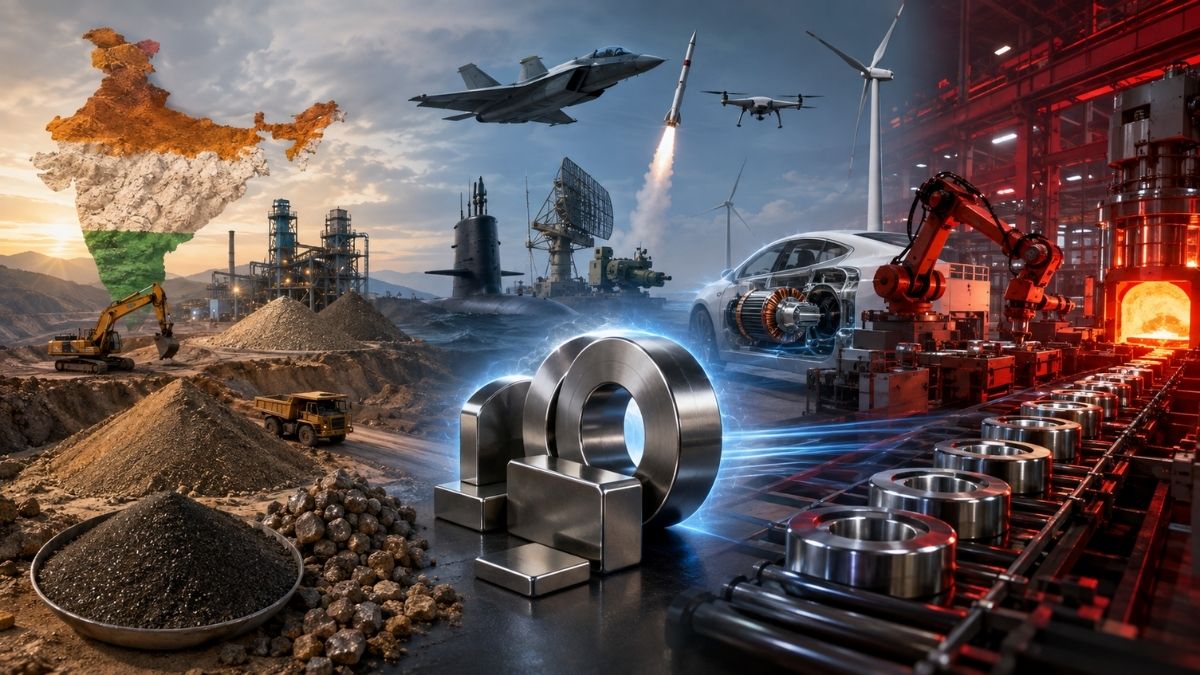
There are special magnets made from materials called rare earths.
These magnets help electric cars, wind turbines, planes, missiles and drones work.
India has a lot of rare earths in the ground.
But it cannot yet turn them into finished magnets.
Almost all of these magnets are made in China.
This is risky because China could stop selling them.
In 2025, China did limit exports, and some car factories had to pause work.
So India approved a big scheme costing ₹7,280 crore to make its own magnets.
The plan would make 6,000 tonnes of magnets every year.
But India may need about 8,220 tonnes a year by 2030, so it might still need help from other countries.

India imports all of its sintered neodymium-iron-boron (NdFeB) permanent magnets despite holding large rare-earth resources, leaving defence and high-tech industries exposed to China.
The IEA says China produced 60% of the world's mined magnet rare earths, 91% of refined output and 94% of sintered permanent magnets in 2024.
China's April 2025 licensing controls on seven heavy rare-earth elements cut exports sharply and forced some overseas carmakers to reduce production.
India approved a ₹7,280-crore scheme in November 2025 to build 6,000 tonnes a year of integrated sintered-magnet capacity across five beneficiaries.
Assessments by IREL, the Defence Metallurgical Research Laboratory and the Bhabha Atomic Research Centre project demand of 8,220 tonnes a year by 2030, which the scheme could cover at about 73%.
- Who
- India's government and defence-research agencies, including IREL (India) Limited, the Defence Metallurgical Research Laboratory and the Bhabha Atomic Research Centre, as well as China, the dominant global producer of rare-earth magnets.
- What
- India is trying to build a domestic rare-earth permanent magnet manufacturing chain, approving a ₹7,280-crore scheme to cut reliance on Chinese sintered magnets used in defence systems, electric vehicles and wind turbines.
- Where
- India, centred on government policy in New Delhi, with planned rare-earth corridors in Odisha, Kerala, Andhra Pradesh and Tamil Nadu; the supply chain also spans China.
- When
- China imposed export licensing controls in April 2025; India approved the magnet scheme in November 2025; demand is projected for 2030 and reporting continued into 2026.
- Why
- Because China controls 94% of global sintered rare-earth magnet production, India's defence and civilian industries remain vulnerable to supply disruption and export restrictions.
Domestic capacity build-up
Continued external dependence
Adequacy of the magnet scheme
Domestic capacity build-up
The ₹7,280-crore scheme is a major first step toward a domestic mine-to-magnet industry and could meet roughly 73% of projected 2030 demand.
Continued external dependence
At full capacity the scheme would still leave a shortfall of about 2,220 tonnes a year, and the estimate does not account for capacity utilisation, production losses or defence-specific grades.
Self-reliance vs overseas partnerships
Domestic capacity build-up
India should build a complete domestic ecosystem, including rare-earth corridors, so it controls the industrial stages between mining and finished magnets.
Continued external dependence
India will still need overseas partners for materials and technologies that cannot be secured economically at home, meaning localisation will remain incomplete without them.
Key facts
- Scheme approved
- ₹7,280-crore rare-earth permanent-magnet scheme, approved November 2025
- Target capacity
- 6,000 tonnes of integrated sintered-magnet capacity per year
- Beneficiaries
- Five, each eligible for up to 1,200 tonnes a year
- Projected demand (2030)
- 8,220 tonnes per year (electric vehicles: 3,250; wind turbines: 1,800)
- China's 2024 share (IEA)
- 60% of mining, 91% of refining, 94% of sintered-magnet production
- India's rare-earth resources
- 7.23 million tonnes of rare-earth-oxide equivalent in monazite; 1.29 million tonnes in hard-rock deposits
- Demand gap
- About 2,220 tonnes per year, or roughly 27% of projected demand
- China export controls
- Licensing controls on seven heavy rare-earth elements imposed April 2025
Quotes
Aritra Banerjee
Senior journalist at Financial Express
“India’s challenge is not simply what is underground, but what happens after mining; the country needs to separate rare earths, turn oxides into metals, make alloys, produce magnets and ensure they meet the standards required for use in critical systems.”
 financialexpress.com
Sources
Related news
L&T Plans India Rare-Earth Magnet Manufacturing to Reduce China Dependence
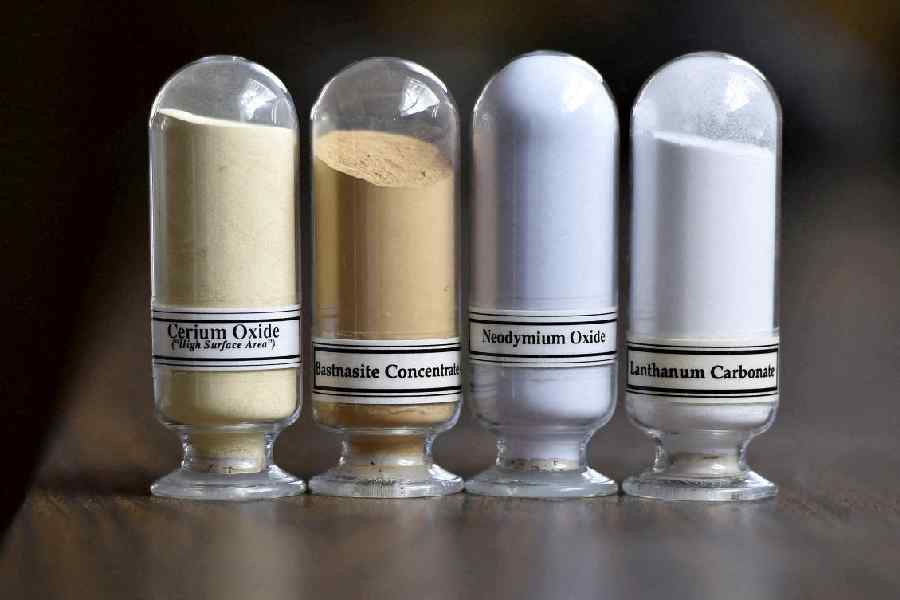
L&T Plans Rare-Earth Magnet Production as India Cuts China Reliance
India’s Rs 7,280-Crore Magnet Scheme Draws Three Diverse Bidders

India Seeks Strategic Foothold in Laos’s Rare Earth Sector
India Secures Uranium From Uzbekistan, Australia Amid Nuclear Expansion
Modi pushes self-reliance, energy security, chips in Independence Day speech

PM Modi: India signing pacts to secure critical minerals

Andhra Pradesh's lithium and gallium exploration expands critical mineral push
India Pushes Electric Mobility for Energy Security
