

3 weeks ago
UPSC Key: Tribunals bill, alcohol policy, Mecca Agreement and more
On Monday, India's Parliament passed a new law that will create a special group called the National Tribunals Commission.
This group will choose the leaders of tribunals, which are special courts that solve certain kinds of cases more quickly.
In Tamil Nadu, the chief minister made a rule that a special song honouring Mother Tamil must be sung first at official events.
Some people in the state were upset because, at a university ceremony, the national song was played before the Tamil song.
A research group called NCAER said Bihar's ban on alcohol should end because the ban costs the state a lot of money and has not stopped crimes against women.
Bihar has had the alcohol ban since April 2016.
A scientist named Deepak Dhar won a famous physics prize called the Dirac Medal for his work that helps explain things like earthquakes and traffic jams.
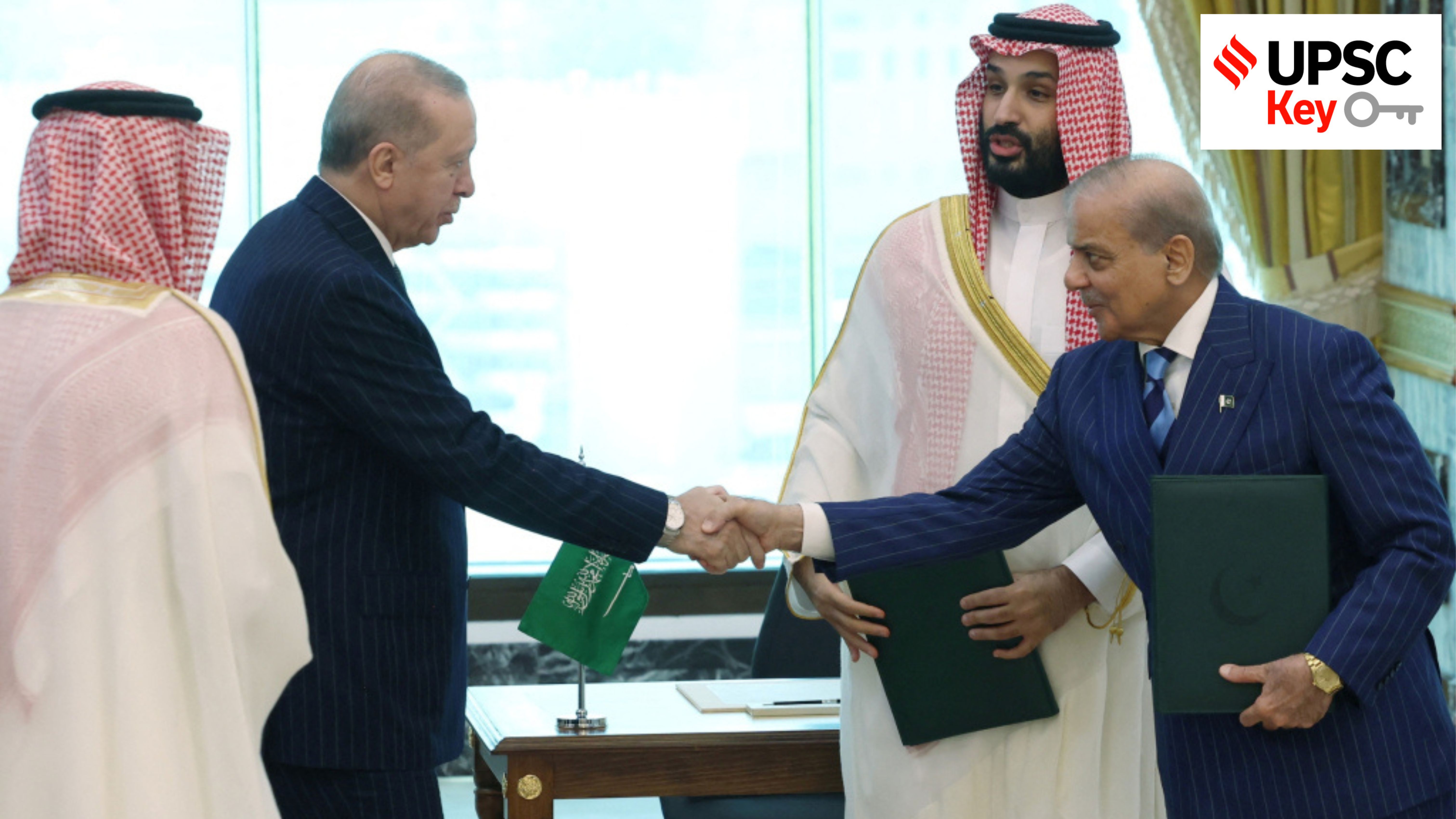
Three countries, Saudi Arabia, Pakistan and Turkey, signed an agreement saying that if one of them is attacked, it is treated as an attack on all of them.
India is watching this new agreement closely because it involves countries that matter to its region.

The Lok Sabha passed the Tribunals Reforms Bill, 2026, which creates a National Tribunals Commission to select chairpersons and members of 16 major tribunals.
Tamil Nadu Chief Minister C Joseph Vijay moved a resolution making 'Tamil Thaai Vazhthu' mandatory at the start of official functions, amid a dispute over the Vande Mataram playing order.
A National Council of Applied Economic Research (NCAER) study recommended lifting Bihar's decade-old liquor prohibition, estimating a 14-15% boost in state revenue and noting the ban failed to curb crimes against women.
Physicist Deepak Dhar, the first Indian to win the Boltzmann Medal, was named co-recipient of the 2026 Dirac Medal for work on complex systems like earthquakes and traffic jams.
Saudi Arabia, Pakistan and Turkey signed the Mecca Agreement on August 7, a collective defence pact in which an attack on any one of the three is regarded as an attack on all.
- Who
- The Lok Sabha, Tamil Nadu Chief Minister C Joseph Vijay, physicist Deepak Dhar, the NCAER research team, and the governments of Saudi Arabia, Pakistan and Turkey
- What
- Passage of the Tribunals Reforms Bill 2026, a Tamil Nadu resolution on Tamil Thaai Vazhthu, an NCAER recommendation to lift Bihar's liquor ban, Deepak Dhar's Dirac Medal, and the signing of the Mecca Agreement
- Where
- India (the Lok Sabha, Tamil Nadu, Bihar and Bengaluru); the Mecca Agreement was signed among Saudi Arabia, Pakistan and Turkey
- When
- August 11, 2026 for the parliamentary and state developments; the Mecca Agreement was signed on August 7, 2026
- Why
- To reform tribunal appointments, assert Tamil identity in official ceremonies, reassess a decade-old prohibition policy, recognise achievements in theoretical physics and strengthen regional collective defence
Social protection and regional identity
Fiscal efficiency and central policy direction
Bihar's alcohol prohibition
Social protection and regional identity
RJD spokesperson Subodh Kumar Mehta says all parties had unanimously backed the ban and his party still favours it; the NCAER study shows the 'utter failure' of the state government, including annual revenue loss and a parallel black liquor economy.
Fiscal efficiency and central policy direction
NCAER economists led by Ratna Sahay recommend transitioning to regulated sales with excise taxes, estimating a 14-15% boost in state revenue, and note the ban failed to curb crimes against women while pushing drinkers to illicit markets and alternative intoxicants.
Creamy layer for SC/STs
Social protection and regional identity
Petitioner Ashwini Kumar Upadhyay argues affluent SC/ST families are monopolising reservation benefits ('elite capture'), depriving the most marginalised members of access to education and public employment, and seeks income-based exclusion across all reserved categories.
Fiscal efficiency and central policy direction
The Centre argues historical disadvantage of SCs (from untouchability) and STs (from geographical isolation) cannot be equated with mere economic backwardness, and that altering reservation policy is Parliament's domain, not the courts'.
Order of songs at official events
Social protection and regional identity
Tamil Nadu's political spectrum criticised a university convocation where Tamil Thaai Vazhthu was placed third, after Vande Mataram and the National Anthem; the resolution insists the Tamil invocation comes first, without challenging the National Anthem.
Fiscal efficiency and central policy direction
The Union Home Ministry asked states and union territories to strictly comply with a January directive requiring Vande Mataram to be played before the national anthem at formal official events.
Key facts
- Tribunals Reforms Bill, 2026
- Passed by the Lok Sabha by voice vote on August 11, 2026; replaces the 2021 Tribunals Reforms Act, parts of which were struck down by the Supreme Court
- National Tribunals Commission
- Selects chairpersons and members for 16 major tribunals including CAT, Armed Forces Tribunal, NGT, ITAT and NCDRC; chairperson must be a former Supreme Court judge or High Court Chief Justice; five-year term or until age 70
- Tamil Thaai Vazhthu
- Invocation to Mother Tamil written by Manonmaniam Sundaranar in 1891; to be rendered first at official functions; public practice dates to a November 23, 1970 DMK government order
- Bihar liquor ban
- Total prohibition imposed in April 2016 by former Chief Minister Nitish Kumar; NCAER recommends returning to regulated sales with excise taxes
- Revenue estimate
- Lifting the ban could boost Bihar's revenue by 14-15%; Bihar's annual revenue is around Rs 65,000 crore
- Dirac Medal 2026
- Co-recipient: theoretical physicist Deepak Dhar, INSA distinguished professor at the International Centre for Theoretical Sciences, Bengaluru; previously at TIFR Mumbai; also co-winner of the 2022 Boltzmann Medal, a first for an Indian
- Mecca Agreement
- Signed August 7, 2026, by Saudi Arabia, Pakistan and Turkey; any armed attack on one is an attack on all, though no other details have been publicly released; Turkey is one of NATO's two Muslim-majority member states
- Creamy layer for SC/STs
- The Centre's Supreme Court affidavit opposes income-based exclusion for SCs/STs, arguing historical disadvantage cannot be equated with economic backwardness and that altering reservation lists is Parliament's domain
Quotes
Subodh Kumar Mehta
RJD national spokesperson
“The study shows the utter failure of the government. All political parties had unanimously implemented the liquor ban in the state. We are still in favour of the ban.”
 indianexpress.com
Sources
Related news
UPSC Mains 2026 Revision: Top 15 Polity Topics Aspirants Need
Kirpan attack on Sukhbir Badal in Maharashtra; assailant held
India Reviews Education, Survey, Labour, Security and Nuclear Policies
UPSC Key Covers Central Asia, Food Labels, Awards and Ecology
Money Bills, Polymer Banknotes and River Sedimentation: India's Current Affairs
UPSC Weekly Quiz Tests Ten Key Current Affairs Topics
India’s Gig Economy Growth Leaves Women Behind, Study Finds
Young Indians Demand Good Jobs as Aspirations Meet Reality
Azim Premji University Announces Lecture on India’s Middle Classes

Rs 18.66 lakh crore infrastructure projects approved under PM GatiShakti
