5 days ago
Debate Grows Over Bhumi Pujan At Indian State Events
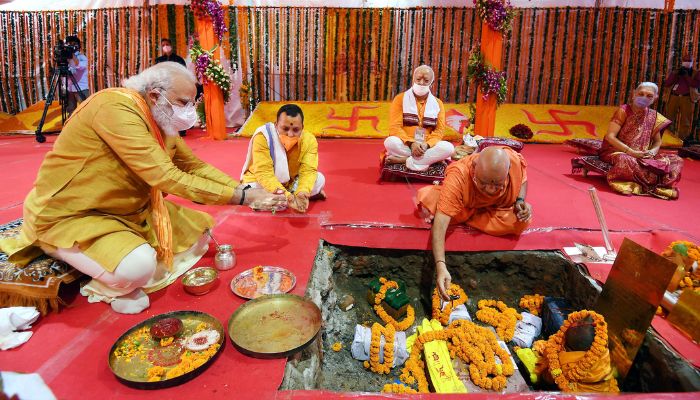
A legal debate is taking place about Hindu rituals at government ceremonies in India.
These rituals can include Bhumi Pujan, Havan, chanting and breaking a coconut.
One view says government officials should not appear to support one religion because India is secular.
It worries that people from other religions or people with no religion may feel excluded.
The opposing view says Indian secularism allows the government to respectfully engage with many religions and cultural traditions.
It also says watching a ritual is different from being forced to perform it.
Supporters point to other religious or cultural practices connected with public institutions, such as Iftar events and religious holidays.
The central question is whether these ceremonies cause real discrimination or are voluntary cultural expressions.

A Live Law opinion article questions whether officials joining Bhumi Pujan, Havan and related Hindu rituals at state events conflicts with secularism.
The article argues that public ceremonies invoking one religious tradition may identify the State with Hinduism and disadvantage citizens of other faiths or no faith.
Its rebuttal says India follows an accommodative model of secularism that permits cultural and religious engagement without establishing a theocracy.
The rebuttal distinguishes voluntary ceremonial participation from compelled observance, citing the Supreme Court’s decision protecting Jehovah’s Witness students who declined to sing the national anthem.
The debate also concerns Article 27, public spending, religious holidays, government involvement with religious institutions and officials’ participation in events such as Iftar gatherings.
- Who
- The Live Law opinion was written by Yash Mittal; the debate concerns constitutional officials, including the Prime Minister, judges, governors and other public officials.
- What
- Whether participation in Bhumi Pujan, Havan, Vedic chanting, coconut-breaking and similar rituals at state events violates secularism, equality or freedom of conscience.
- Where
- India, including public ceremonies for government buildings, hospitals, courts, highways and other infrastructure.
- When
- The Live Law article was published on 23 August 2026; the debate also refers to earlier court decisions, including S.R. Bommai and Bijoe Emmanuel.
- Why
- The issue arises because critics view official association with Hindu rituals as religious endorsement, while supporters view it as permissible cultural participation under India’s accommodative model of secularism.
Critics of Official Religious Rituals
Supporters of Cultural Accommodation
Meaning of secularism
Critics of Official Religious Rituals
State officials and institutions should avoid formally associating public functions with rituals rooted in one religious tradition, because this may undermine neutrality and equality.
Supporters of Cultural Accommodation
India’s secular model does not require a complete separation of religion from public life; respectful engagement with religious and cultural traditions can coexist with neutrality.
Effect on citizens
Critics of Official Religious Rituals
Non-Hindu citizens and people without religious beliefs may reasonably feel that a public ceremony has become a Hindu religious event rather than a state function.
Supporters of Cultural Accommodation
Attendance or passive witnessing does not amount to compelled religious observance, and the rebuttal says participants are not punished or denied services for declining to join rituals.
Constitutional precedent
Critics of Official Religious Rituals
The Live Law article invokes secularism, freedom of conscience, equality and the Bijoe Emmanuel judgment to question official religious ceremonies.
Supporters of Cultural Accommodation
The rebuttal says S.R. Bommai does not treat every individual ritual as theocracy, while Bijoe Emmanuel concerned compelled participation rather than voluntary ceremonial presence.
Key facts
- Opinion article
- Live Law published “Can ‘Culture’ Justify Religious Rituals At State Functions? Constitutional Examination Of Bhumi Pujan Ceremonies” on 23 August 2026.
- Critics’ concern
- Official participation in rituals invoking Hindu deities could make the State appear aligned with one religion, according to the article’s argument.
- Indian secularism
- The rebuttal describes Indian secularism as principled engagement with all faiths rather than a strict wall separating religion and public life.
- S.R. Bommai case
- The article discusses the 1994 Supreme Court case concerning the dismissal of state governments over alleged complicity in communal violence after the Babri Masjid demolition.
- Bijoe Emmanuel case
- The Supreme Court protected Jehovah’s Witness students who declined to sing the national anthem on religious grounds, emphasizing freedom of conscience under Article 25.
- Article 27
- The rebuttal says Article 27 restricts taxes specifically appropriated for propagating or maintaining a particular religion.
- Public symbols cited
- The debate references the national motto “Satyamev Jayate,” the Ashok Chakra and the Supreme Court motto “Yato Dharmastato Jayaḥ” as religious or civilizationally rooted symbols.
Quotes
Yash Mittal
Author of the Live Law opinion piece discussed in the article
“Does it not discriminate against citizens following other religious faiths or no faith (atheists or agnostics)? Does it not amount to the creation of a theocratic state?”
 opindia.com
“Is this a ceremony of the State, or a religious ceremony being conducted by the State?”
opindia.com
Sources
Related news
Indian Express Kanwar Yatra column sparks secularism debate
Constitution, Not Bhagwat, Determines Muslims’ Belonging in India

Owaisi Questions IIT Delhi Convocation Protocol Over Bowing, Vedic Mantras
Pawan Khera Manusmriti Joke Sparks Debate Over Congress Secularism
Supreme Court defers challenge to Bodh Gaya Temple Act management

Supreme Court Collegium Recommends New Rajasthan High Court Chief Justice
JudgeGPT Trial Shows AI’s Potential to Speed Judicial Justice
Letter Urges Zohran Mamdani to Reconsider Mohan Bhagwat
CJI Says Rajasthan Acting Chief Justice Allegations Under Review