2 hrs ago
Government Defends UPI Merchant Fee, Says Consumers Won’t Pay

Some larger payments made to shops using UPI will have a small fee starting October 15.
The fee is 0.4% and is supposed to be paid by the shop, not the customer.
Government sources say the money will go to banks and payment companies, not the government.
They say the fee helps pay for the system that keeps UPI working.
Payments between two people will still have no MDR.
RuPay debit-card payments will also remain free of this fee.
Most everyday shop payments will not be affected.
Some merchants and consumers worry that shops may stop accepting UPI or raise prices, but officials say fears of people returning to cash are misplaced.

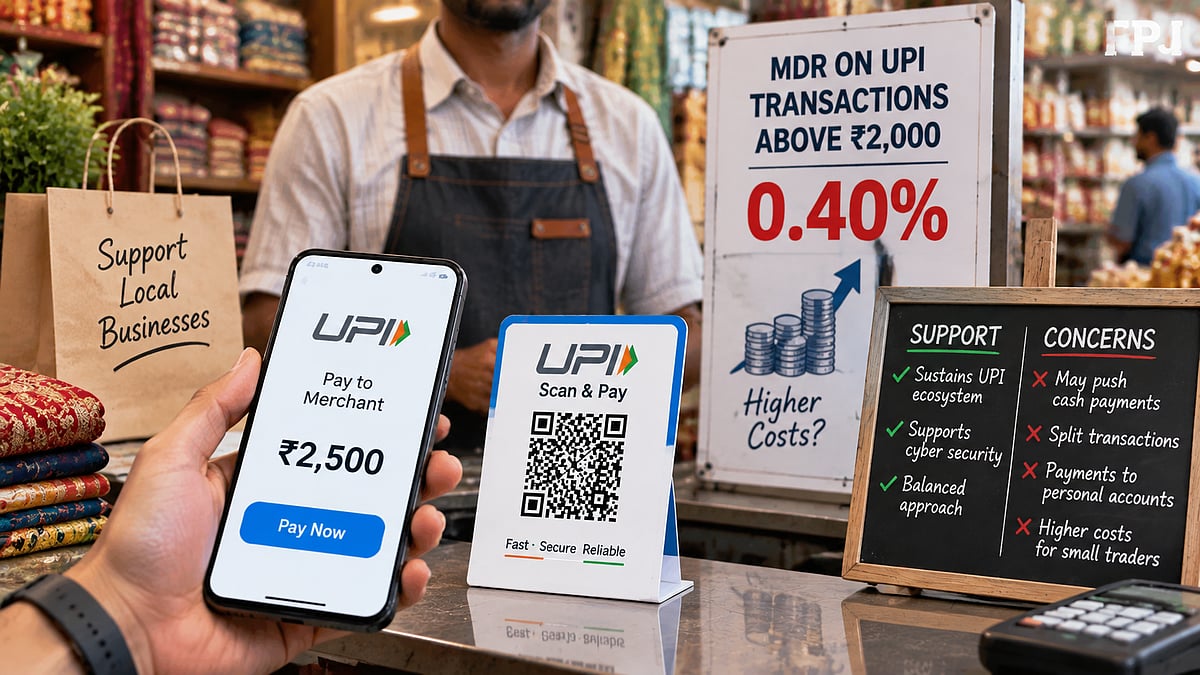
A 0.4% MDR will apply to person-to-merchant UPI payments above Rs 2,000 from October 15.
Government sources say merchants, not consumers, will pay the fee and that none of it will go to government coffers.
The MDR will be divided among customers’ banks, payment gateways, UPI apps and sponsoring banks.
Only about 4% of merchant UPI transactions exceed Rs 2,000, while person-to-person and RuPay debit-card payments remain exempt.
Officials say fears of a shift to cash are misplaced, while merchants and consumers remain concerned about fee pass-through and higher prices.
- Who
- The Indian government, the National Payments Corporation of India, banks, payment companies, merchants and consumers.
- What
- A 0.4% merchant discount rate will be charged on person-to-merchant UPI payments above Rs 2,000.
- Where
- Across India’s UPI digital-payments system.
- When
- The fee is scheduled to begin on October 15; the GST Council is scheduled to meet on October 7.
- Why
- The fee is intended to create a sustainable revenue framework and help cover the costs of operating UPI and processing transactions.
Government and Payment-System View
Merchant and Consumer Concerns
Who bears the fee
Government and Payment-System View
Government sources say the 0.4% MDR will be paid by merchants and will not be passed on to consumers; banks and the Indian Banks’ Association are expected to address misconceptions.
Merchant and Consumer Concerns
Merchants and consumers are concerned that shops could pass the cost to buyers through higher prices or stop accepting UPI.
Effect on cash and digital payments
Government and Payment-System View
Officials call fears of a shift back to cash misplaced, noting that credit- and debit-card MDRs are generally higher, at roughly 1–3%, yet those cards remain in use.
Merchant and Consumer Concerns
Critics worry that adding a fee to UPI, which has had no MDR since January 2020, could reduce acceptance or usage.
Purpose and destination of funds
Government and Payment-System View
Officials say MDR is neither a tax nor a cess, and that the money will go to banks, payment gateways, UPI apps and other industry participants to support the ecosystem.
Merchant and Consumer Concerns
Opposition criticism describes the measure as a tax on consumers, while concerns remain about the additional cost for merchants and the possible 18% GST on MDR.
Key facts
- MDR rate
- 0.4% on person-to-merchant UPI payments above Rs 2,000.
- Maximum charge
- The fee is capped at Rs 300 for transactions of Rs 75,000 or more.
- Fee distribution
- Collections are allocated 40% to customers’ banks, 30% to payment gateways, 20% to UPI apps and 10% to the sponsoring bank.
- Exemptions
- Person-to-person UPI payments, RuPay debit-card payments and payments by small merchants collecting up to Rs 1 lakh monthly through UPI QR codes remain exempt.
- Affected transactions
- Around 4% of person-to-merchant UPI transactions exceed Rs 2,000, but they account for about two-thirds of transaction value.
- UPI operating cost
- The annual cost of UPI infrastructure and transaction settlement is estimated at around Rs 20,000 crore.
- Small-merchant support
- The government has set aside Rs 2,000 crore for the 2026-27 incentive scheme, while 5% of MDR collections will support a small-merchant UPI fund.
Quotes
Government official
Anonymous government official discussing the need to charge for UPI services
“Merchants have always absorbed the MDR on credit cards. But people are still getting Visa, Mastercard, and Amex cards. Why is it that suddenly UPI, an indigenous product that has done so well, is something that merchants can’t pay for when they are paying for all other methods?”
 indianexpress.com
“MDR levy of 0.4 per cent on UPI transactions above Rs 2,000 will not be passed on to the consumers. Banks, as well as the Indian Banks’ Association, will address misconceptions related to MDR charges and their impact on users.”
 theprint.in
Sources
Related news

UPI Sets 0.4% MDR on High-Value Merchant Payments

India Plans Daily Monitoring of New UPI Merchant Fee
India Adds UPI Merchant Fees Above ₹2,000

UPI MDR Begins October 15, Merchants Face Charges, Customers Don’t

New UPI MDR Rules Keep Consumers Free, Charge Eligible Merchants
India’s New UPI MDR Fee Sparks Debate Over Customer Costs

Finance Ministry Seeks to Keep UPI MDR Off Consumers
CAIT Welcomes New E-Commerce Rules, Seeks Tougher Platform Action
Fuel Pumps Threaten UPI Restrictions Over Proposed MDR Fees

BJP Leaders Across India Mark PM Modi’s 76th Birthday