

1 hr ago
Government Sets UPI Merchant Fee Above ₹2,000

The government is changing how some UPI payments are funded.
People sending money to other people will still pay nothing.
Buying something from a merchant for ₹2,000 or less will also remain free.
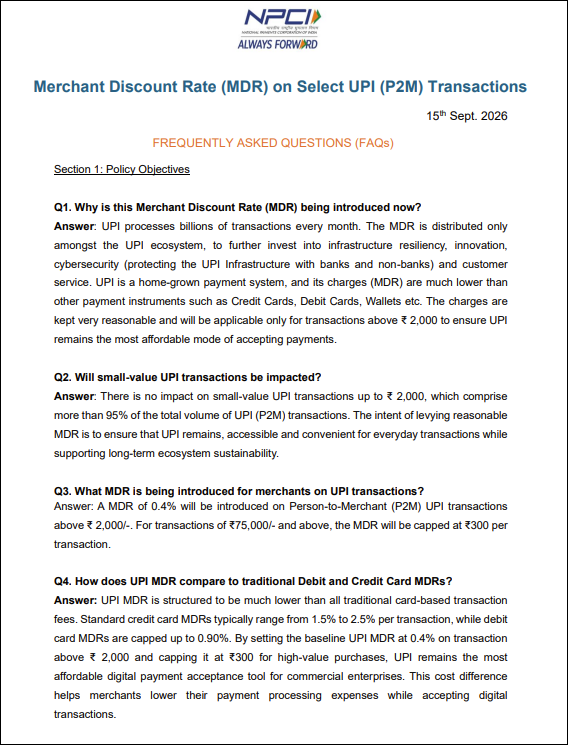
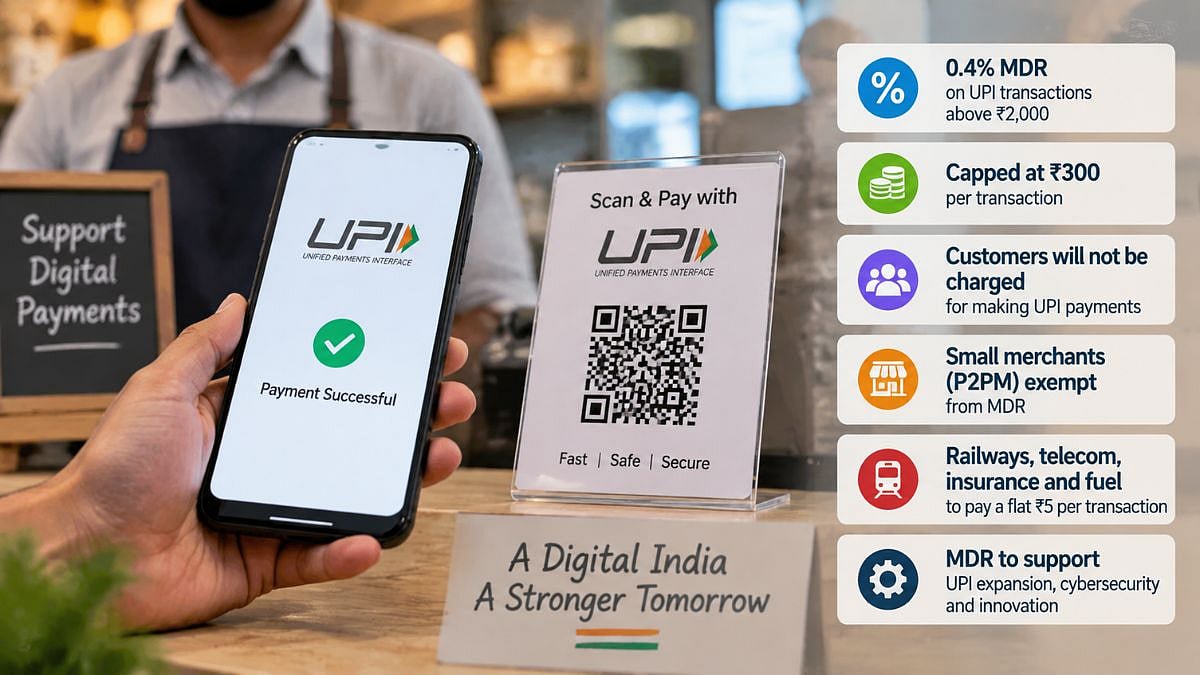
For certain merchant payments above ₹2,000, the merchant’s payment ecosystem will pay a 0.4% fee.
Customers are not supposed to be charged this fee directly.
Small shops and vendors receiving up to ₹1 lakh each month through UPI QR codes will remain exempt.
Some essential services will pay a flat ₹5 fee instead.
The money will be shared with banks and payment companies to help maintain and improve UPI.
Opposition leaders criticized the policy, while the government said claims of a consumer tax were false.

A 0.4% Merchant Discount Rate will apply from October 15, 2026, to specified UPI person-to-merchant payments above ₹2,000.
Person-to-person transfers and merchant payments up to ₹2,000 will remain free for consumers, with no monthly usage quotas.
Small merchants receiving up to ₹1 lakh monthly through UPI QR codes will continue to pay zero MDR on all transactions.
Essential sectors and specified utility and education payments above ₹2,000 will face a flat ₹5 MDR, while high-value transactions carry a ₹300 cap.
The government and NPCI say the fees will support UPI infrastructure, cybersecurity and innovation, but opposition parties criticized the move.
- Who
- The Government of India, the National Payments Corporation of India, banks, payment providers and merchants are affected; opposition criticism included Congress leader Rahul Gandhi.
- What
- A new Merchant Discount Rate will charge 0.4% on specified UPI person-to-merchant transactions above ₹2,000, while consumer UPI usage remains free.
- Where
- The policy applies to UPI transactions in India.
- When
- The announcement was made on September 15, 2026, and the revised MDR takes effect on October 15, 2026.
- Why
- The government and NPCI say the revenue will support UPI infrastructure, cybersecurity, innovation and customer service, reducing reliance on government subsidies.
Critics and Opposition
Government and Payment Ecosystem
Political interpretation
Critics and Opposition
Rahul Gandhi described the levy as another surrender by Prime Minister Narendra Modi to American pressure. The Congress also criticized the change.
Government and Payment Ecosystem
The BJP accused the Congress of spreading fake news and said the policy clearly does not impose MDR on consumers.
How UPI should be funded
Critics and Opposition
Critics objected to ending the fully free UPI model, which had protected users from transaction costs.
Government and Payment Ecosystem
The government and NPCI said permanent reliance on subsidies is uncertain and that a commercial, threshold-based MDR is needed to fund infrastructure, fraud prevention, cybersecurity and technological investment.
Who bears the cost
Critics and Opposition
The change has raised concern that merchant fees could eventually affect businesses or consumers, despite the stated protections.
Government and Payment Ecosystem
The Finance Ministry said MDR is an internal merchant-payment charge rather than a tax, while banks were advised to stop merchants from passing it to customers.
Key facts
- Standard MDR
- 0.4% on specified person-to-merchant UPI transactions above ₹2,000.
- High-value cap
- MDR is capped at ₹300 for payments of ₹75,000 and above.
- Essential sectors
- Railways, telecommunications, insurance, fuel and agricultural inputs above ₹2,000 attract a flat ₹5 MDR.
- Small merchants
- Merchants receiving up to ₹1 lakh per month through UPI QR codes remain at zero MDR.
- Consumer protection
- Individuals will not pay transaction, platform or hidden fees, and banks are advised to prevent merchants from passing MDR to customers.
- Expected coverage
- The government says approximately 96% of P2M transactions, or about 4% of merchant transactions, will be affected or unaffected depending on the cited measure.
- Implementation date
- October 15, 2026.
Quotes
RBI Governor Sanjay Malhotra
Reserve Bank of India governor commenting on the need to fund UPI transaction costs.
“Charges will apply only to person-to-merchant (P2M) transactions exceeding Rs 2,000. A nominal merchant discount rate of 0.4 per cent will be levied on P2M transactions above Rs 2,000. This commission will be shared amongst the payment ecosystem partners including banks and app providers.”
 rediff.com
“The new UPI framework introduced has no impact on any person-to-person transactions. UPI will continue to remain completely free for all person-to-person transactions, irrespective of the amount transferred.”
 opindia.com
Sources

Related news

Government Sets UPI Merchant Fees While Keeping P2P Payments Free
UPI MDR Rules Keep Customers Free, Target Merchant Payments
Government Prepares Possible MDR on High-Value UPI Payments

UPI Charges Debate Grows as MDR Framework Opens Higher Payments
UPI Merchant Payments Above ₹2,000 Face New MDR
Panel to Decide UPI MDR Charges Above ₹2,000 Soon
August Inflation Surge Puts India’s October Rate Decision In Focus

RBI Governor Meets Sitharaman Amid Rate Hike Debate
Crude Tops $100 as RBI Rate-Hike Pressure Intensifies

RBI Unveils Fintech Initiatives for India’s Digital Finance Next Phase
