1 hr ago
Traders Split Over UPI Charge on Large Payments
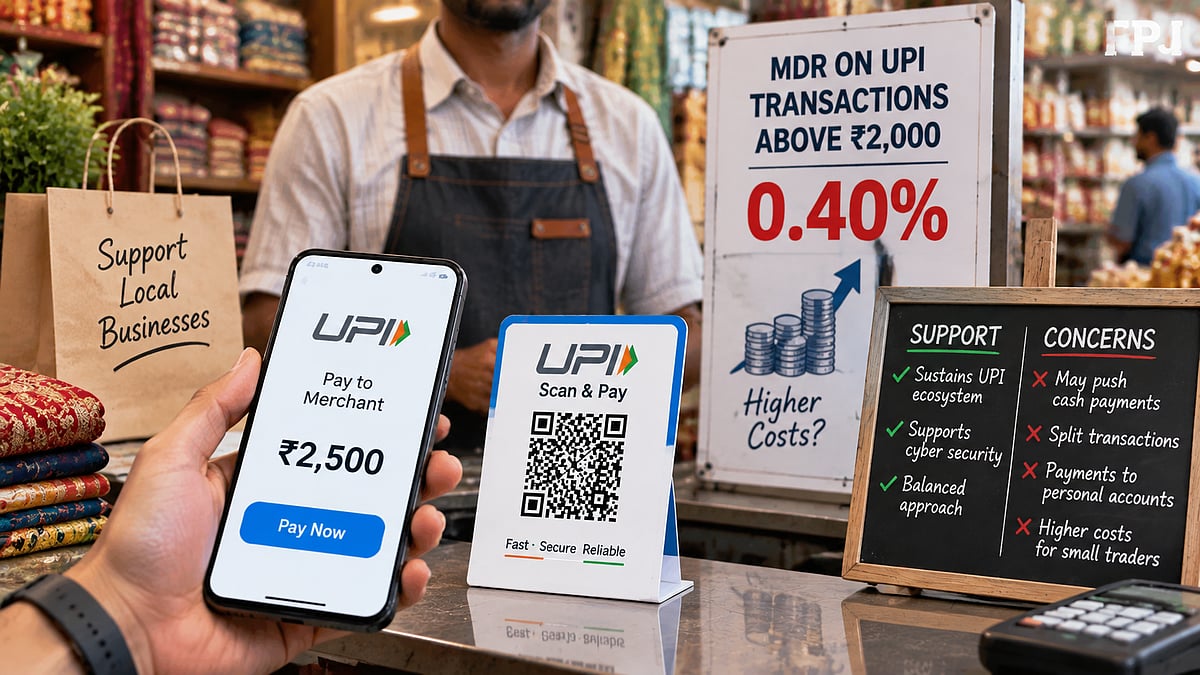
A new fee is being discussed for some large UPI payments made to businesses.
The fee would be 40 basis points, or 0.4 percent, on payments above Rs 2,000.
CAIT says the decision is balanced because running and protecting UPI costs money.
Other trader groups worry that the fee could make businesses and customers use cash instead.
They also fear people might split one large payment into smaller payments to avoid the charge.
Some merchants might send customers to personal UPI accounts instead of business accounts.
This could make business records and tax reporting less clear.
Small retailers and fuel sellers want the government to reconsider or remove the fee for their sectors.

NPCI plans a 40-basis-point MDR on UPI merchant transactions above Rs 2,000.
CAIT supports the charge, citing UPI management costs and reduced currency-printing expenses.
FRTWA warns fees could encourage payment splitting, personal-account transfers and tax under-reporting.
Small retailers and transporters say the charge could raise business costs and prices.
AIPDA has requested a complete MDR exemption for fuel retailers.
- Who
- NPCI, trader associations, small retailers, transporters and fuel dealers are involved in the debate.
- What
- A proposed 40-basis-point MDR would apply to UPI merchant transactions above Rs 2,000.
- Where
- The debate concerns UPI transactions in India, with views reported from Mumbai traders.
- When
- The article does not specify an implementation date.
- Why
- Supporters cite the cost of operating and securing UPI, while opponents fear higher business costs, cash shifts, payment splitting and tax-reporting risks.
Supporters of the MDR
Critics of the MDR
Cost of operating UPI
Supporters of the MDR
CAIT says the government has taken a balanced approach because substantial funds are spent on cybersecurity and managing UPI transactions.
Critics of the MDR
FRTWA says transaction charges could become an additional business cost and should be reconsidered.
Effect on retailers
Supporters of the MDR
CAIT argues the impact would be limited because about 80 percent of retail transactions are below Rs 2,000 and some proprietary-shop payments are person-to-person.
Critics of the MDR
Small retailers say festive purchases and other ordinary bills often exceed Rs 2,000, making the charge difficult to avoid or absorb.
Payment behavior and tax reporting
Supporters of the MDR
Supporters point to reduced currency-printing costs from increased digital transactions as a compensating benefit.
Critics of the MDR
Critics warn that customers and merchants may use cash, split payments or personal accounts, making accounting harder and creating opportunities for tax avoidance.
Key facts
- Proposed MDR
- 40 basis points on UPI merchant transactions above Rs 2,000
- Supporting group
- Confederation of All India Traders supports the move
- Opposing group
- Federation of Retail Traders Welfare Association has urged reconsideration
- Reported UPI spending
- The government is spending around Rs 20,000 crore on cybersecurity and managing UPI transactions, according to CAIT
- Transaction threshold
- CAIT says about 80 percent of retail transactions are below Rs 2,000
- Fuel retailers
- All India Petroleum Dealers Association seeks a complete MDR exemption
- Main concerns
- Payment splitting, transfers to personal accounts, cash use and under-reporting of receipts
Quotes
Sharad Satardekar
Cloth retailer representing the Matharpacady Vyapari Sangh
“When an average family shops for festive clothing, the bill will definitely exceed Rs 2,000. I cannot insist on cash because very few people use currency. Even children get their pocket money from parents online.”
 freepressjournal.in
“I am not justifying the decision, but I think the government has taken a balanced view. On one hand, the government is spending around Rs 20,000 crore on cyber security and to manage UPI transactions.”
freepressjournal.in
Sources
Related news

Small Retailers Resist UPI MDR as Cash Payments Loom
New UPI MDR Charges Raise Fears of Cash Return

Traders Oppose New UPI Fees on Merchant Payments

UPI Fee Plan Sparks Fears of Cash’s Return

UPI Sets 0.4% MDR on High-Value Merchant Payments

UPI MDR Begins October 15, Merchants Face Charges, Customers Don’t
Delhi BJP MP Praveen Khandelwal Holds Public Grievance Hearing

Cakes, Flowers and Pets Expand Raksha Bandhan’s Festive Basket

Raksha Bandhan Trade Expected To Cross Rs 30,000 Crore

Swadeshi Rakhis Boost India’s Festive Trade Ahead of Raksha Bandhan