4 days ago
Srikalahasti Kalamkari Artisans Face Pressure From Printed Products
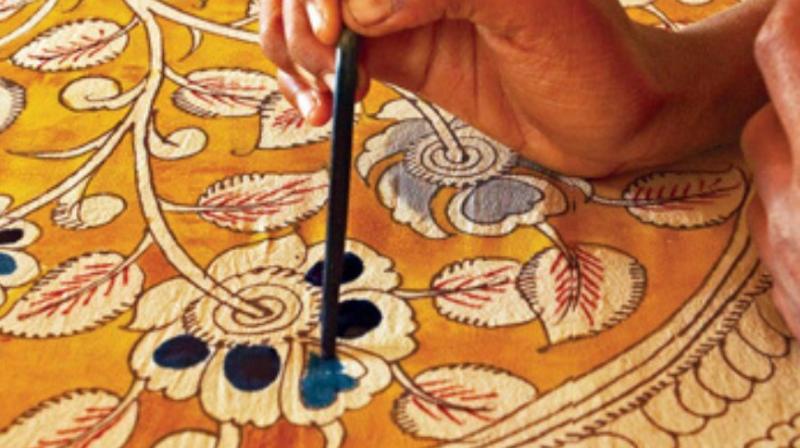
Traditional Kalamkari artists draw and colour designs on fabric by hand.
Making one piece can take many days.
Machines can print similar-looking designs much faster and on many pieces at once.
Printed products are often cheaper than handmade ones.
Artisans say shoppers may not always know which kind they are buying.
They also say some printed items are sold as traditional handmade work.
Although more shops have opened in Srikalahasti, artisans say their earnings have not grown.
Their association wants clearer labels and more support for handmade work.
Tirumala Tirupati Devasthanams already offers training in traditional Kalamkari, and artisans want similar support in Srikalahasti.

Hand-painted Kalamkari saris can take artisans 10 to 20 days to complete, while machines can reproduce designs in large quantities quickly.
Online listings show handmade cotton saris starting around ₹4,500 and elaborate silk pieces above ₹10,000; printed fabric is listed at about ₹300 a metre, with printed saris from ₹1,800.
Artisans say buyers may struggle to distinguish handmade work from machine-printed products, and allege some printed pieces are sold as traditional Kalamkari.
More than 100 shops have opened in Srikalahasti in the past five years, but traditional artisans say their earnings have not improved.
The Kalamkari Artisans Welfare Association seeks clear product labelling, marketing and direct-sales support, and training to preserve the hand-drawn technique.
- Who
- Traditional Kalamkari artisans in Srikalahasti and the Kalamkari Artisans Welfare Association.
- What
- Artisans say machine-printed products are competing with handmade Kalamkari and undermining its value and their earnings.
- Where
- Srikalahasti, Andhra Pradesh.
- When
- The article gives no publication date; it says more than 100 shops have opened in the past five years.
- Why
- Machine printing allows similar-looking designs to be produced faster and at lower prices, while artisans say buyers may not recognize the difference.
Key facts
- Handmade production time
- About 10 to 20 days for one piece, according to the article.
- Handmade cotton sari listings
- Starting at around ₹4,500.
- Elaborate handmade silk sari listings
- Above ₹10,000.
- Printed fabric listings
- Around ₹300 per metre.
- Printed sari listings
- Starting from ₹1,800.
- Shop growth
- More than 100 shops have opened in Srikalahasti during the past five years.
- Association proposals
- Clearly label handmade and printed products; provide marketing, direct-market, and training support.
Quotes
Kalamkari Artisans Welfare Association representative
Representative of an association advocating for Kalamkari artisans
“The Kalamkari trade in Srikalahasti has expanded rapidly. More than 100 shops have come up in the town during the past five years. But the increase in shops and products has not improved the earnings of traditional artisans. Despite the high retail prices of handmade Kalamkari saris, artisans, who spend days making them, continue to receive only modest returns.”
 deccanchronicle.com
“It takes nearly 20 days to complete one piece using traditional methods. We prepare the colours ourselves using natural sources. The drawing is done entirely by hand. It takes time and effort, but that is what gives it value. Today, many products imitate the Kalamkari look. That is affecting our art and remuneration.”
deccanchronicle.com
Sources
Related news

Jamakkalam Craft Finds New Life Through Young Weaver

iTokri Launches Craft-Based Festive Collection Ahead of Diwali 2026
Gadilanka’s Century-Old Clay Idol Craft Faces Steep Decline
Ganeshotsav 2026: Rising Costs Challenge Mumbai’s Eco-Friendly Idol Transition
Weavers Rally in Maheshwar to Protect 250-Year Saree Tradition
Rising Prices Drive Reusable Decoration Choices in Pune
Srikalahasti Temple Hundi Collections Top Rs 1.52 Crore
Police Trace Woman Missing for Eight Years in Andhra Pradesh
Suudalagunta Sugars Given November 30 Deadline to Clear Dues
Rs 214 Crore Urban Infrastructure Projects Sanctioned in Tirupati District