1 week ago
Ladakh’s Ancient Petroglyphs Reveal Millennia of Art and History
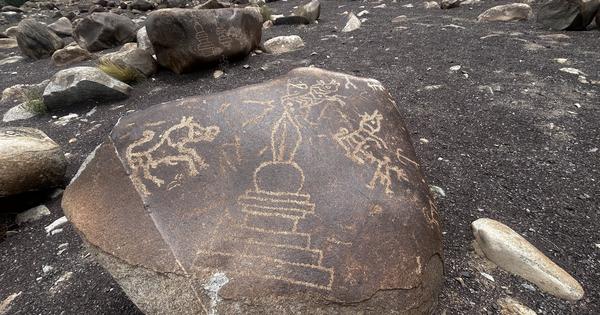
Ladakh has thousands of very old pictures carved into rocks.
One important group of carvings is near the village of Alchi, beside the Indus River.
The pictures show animals, people, buildings and mysterious signs.
Some may be more than 3,000 years old, while others were added much later.
The animals include ibexes, yaks, horses and possibly snow leopards.
Researchers think travelers, hunters, soldiers and religious communities may all have contributed to the carvings.
The pictures may show real animals and events, but they could also carry symbolic meanings.
The rocks are threatened by construction and environmental damage.
Officials and researchers are moving some vulnerable rocks to a new conservation park near Leh.

The Alchi petroglyph field contains about 250 boulders carved with animals, human figures, structures and inscriptions.
Researchers date Ladakh’s rock art from the Neolithic period through the Bronze and Iron ages, with later Tibetan and Buddhist additions.
Alchi’s carvings include ibexes, felines, hunting scenes, swastikas, stepped structures and inscriptions in multiple languages.
Researchers link some imagery to artistic traditions extending from Central Asia across Tibet, Mongolia and China, while debating whether motifs spread through migration or developed independently.
Ladakh’s government has announced a petroglyph conservation park at Sindhu Ghat, where vulnerable rocks are being relocated for preservation.
- Who
- Ancient artists and later Tibetan, Buddhist and other visitors created the carvings; researchers including Tashi Ldawa Tshangspa, Viraf Mehta and John Vincent Bellezza have documented and studied them.
- What
- Ladakh’s extensive heritage of rock carvings is being studied and partially protected, with particular attention to the Alchi petroglyph field.
- Where
- The main site described is at Alchi, about 65 km west of Leh, on a shelf overlooking the Indus; the planned conservation park is at Sindhu Ghat.
- When
- The carvings range from the Neolithic, Bronze and Iron ages to the medieval period; systematic documentation began in the late 19th and early 20th centuries, and a conservation park was announced in April.
- Why
- The petroglyphs preserve evidence of past artistic, social and religious activity, but many are vulnerable to infrastructure and environmental interference.
Symbolic and locally developed interpretations
Literal and cross-regional interpretations
What the animal images mean
Symbolic and locally developed interpretations
Viraf Mehta cautions that the carvings were made for symbolic reasons and should not automatically be treated as literal records of Ladakh’s wildlife or climate.
Literal and cross-regional interpretations
The depictions of animals and hunting scenes can provide supplementary clues about past diets, habitats and ecology when combined with other evidence.
How artistic motifs spread
Symbolic and locally developed interpretations
Some researchers raise the possibility that Ladakh’s “steppic” animal designs developed independently through the movement of images and ideas within the region.
Literal and cross-regional interpretations
Similarities with art from Central Asia, Tibet, Mongolia and China may indicate transmission through migration or long-distance cultural contact.
How to protect vulnerable carvings
Symbolic and locally developed interpretations
Relocating the most endangered rocks to the Sindhu Ghat conservation park could protect them from infrastructure and land division.
Literal and cross-regional interpretations
The article emphasizes that the carvings are tied to their landscapes, historic routes and river crossings, while reporting the relocation effort rather than presenting a direct objection to it.
Key facts
- Alchi site
- About 250 large boulders bear petroglyphs beside the Indus River.
- Recorded imagery
- An inventory cited in the article lists 24 anthropomorphic figures, 91 zoomorphic figures, 328 stepped structures and 131 inscriptions.
- Estimated age
- The oldest carvings are associated with the Neolithic, Bronze or Iron ages; one hunting scene is dated to 700–100 BCE.
- Regional documentation
- The Rock Art Resource Centre says it has documented 800 sites.
- Conservation plan
- Ladakh announced a petroglyph conservation park at Sindhu Ghat with the Department of Archives, Archaeology and Museums and the Archaeological Survey of India.
- Relocation effort
- Researchers identified 200 rocks within 100 km between Leh and Shara, and nearly 50 had been transported.
Quotes
Viraf Mehta
Researcher with the Rock Art Resource Centre in Leh
“About a thousand years ago...armies belonging to Tibetan forces, Ladakhi generals and clans were camped at Alchi on their expeditions to invade Baltistan”
 scroll.in
“They’re depicted for symbolic reasons…they are not necessarily supposed to be taken literally in all cases.”
scroll.in

Sonam Wangchuk
Researcher with the Rock Art Resource Centre in Leh
“the small ones are easy to move without a scratch, and for the big ones, we pack them up in thermocol”
scroll.in
Sources
Related news

Rayalaseema’s Ancient Heritage Faces Growing Neglect and Vandalism

World's Highest Art Biennale Transforms Ladakh's Leh–Kargil Corridor
10,000-Year-Old Rock Art and Caves Found at Indrapalanagaram

Saxena Flags Off Inaugural Ladakh Bike Week 2026

US Ambassador Sergio Gor Visits Ladakh’s Thiksey Monastery
GSI Investigates Adilabad Limestone Blocks Amid Cement Factory Hopes
Ancient Kevda Fossils Found in Assam
Himalayan Snow Droughts Threaten Water Security
37,000-Year-Old Thorny Bamboo Fossil Found in Manipur

Ancient Fossil Site in India Seeks UNESCO Heritage Tag