0 months ago
China Harvests First Space-Grown Rice Crop on Tiangong Station
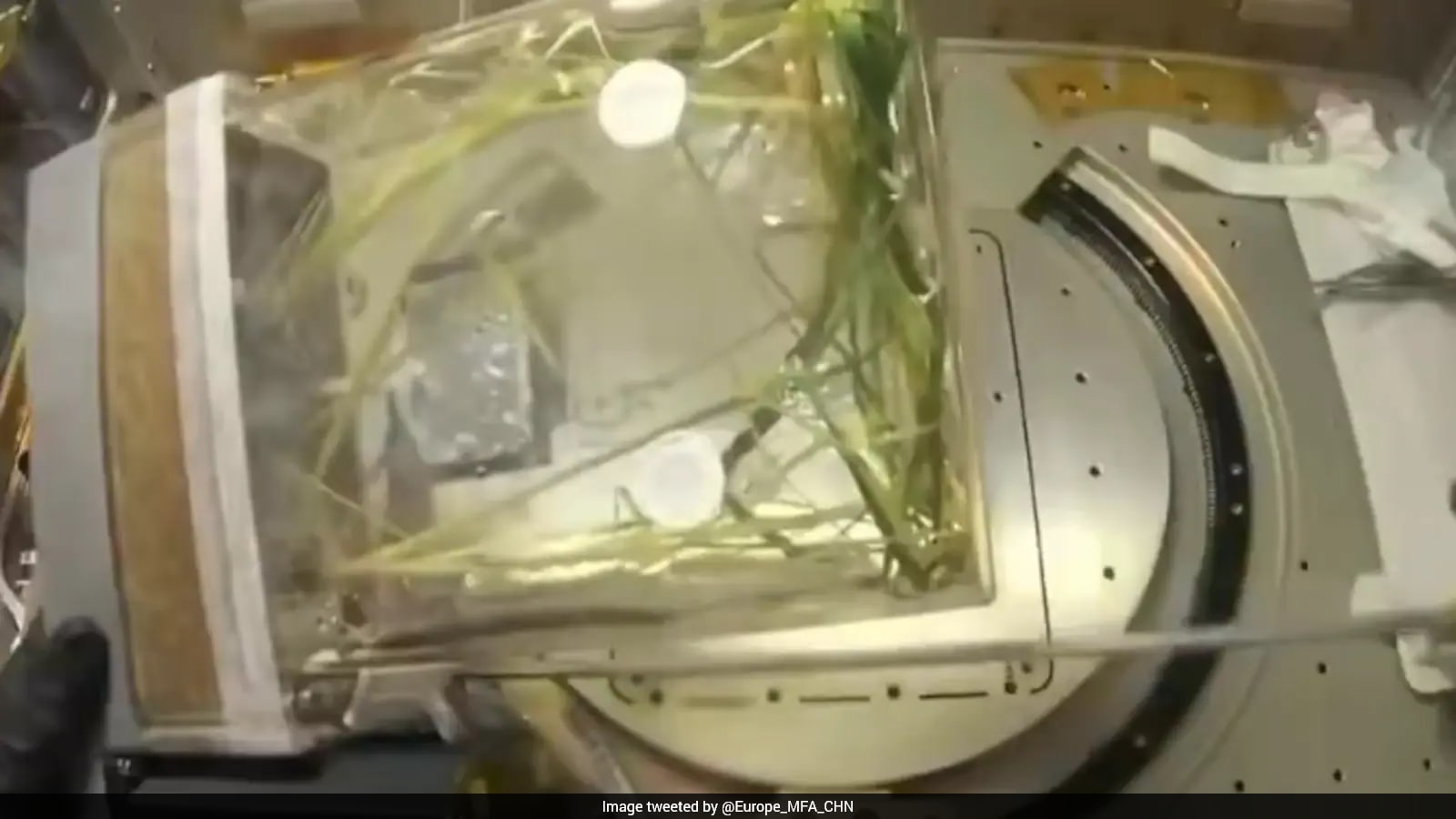
Astronauts on a space station grew rice in space and picked the first batch.
Growing food in space could help astronauts on long trips to the Moon or Mars.
If they can grow their own food, they will not need to carry so much from Earth.
The rice seeds traveled to the Tiangong space station on a spaceship called Shenzhou-23.
Three astronauts took care of the rice for more than two months before harvesting it.
This builds on an earlier experiment in 2022, when rice was grown in space for a full life cycle for the first time.
Now scientists want to see if rice that grew in space can produce more rice in space.
They are testing two ways of growing it, including letting new shoots grow from the roots of the first plants.
Some plant stems and leaves will be kept cold and brought back to Earth for scientists to study.
This research will help us learn how to farm beyond Earth one day.

Chinese astronauts aboard the Tiangong space station harvested the first batch of rice grown in orbit on the Shenzhou-23 mission.
Astronauts Zhu Yangzhu, Zhang Zhiyuan, and Lai Ka-ying collected the rice samples after more than two months of cultivation.
The harvest builds on China's 2022 world-first full life-cycle rice experiment, in which six seeds spent 120 days in orbit and produced 59 space-grown seeds.
Scientists are comparing two types of japonica rice and two growing methods — seed-to-seed reproduction and ratooning — aiming to grow two consecutive generations in orbit.
Stems and leaves preserved at low temperatures will be returned to Earth to improve space farming for future Moon and Mars missions.
- Who
- Three Chinese astronauts — Zhu Yangzhu, Zhang Zhiyuan, and Lai Ka-ying — aboard the Tiangong space station.
- What
- Harvested the first batch of rice grown in orbit and stored plant samples for further research.
- Where
- Aboard the Tiangong space station in orbit.
- When
- The Shenzhou-23 mission launched on May 24, with the harvest taking place after more than two months of cultivation.
- Why
- To learn whether food can be grown entirely in space so long-duration missions no longer depend on supplies from Earth.
Key facts
- Mission
- Shenzhou-23
- Space Station
- Tiangong
- Launch Date
- May 24
- Astronauts
- Zhu Yangzhu, Zhang Zhiyuan, Lai Ka-ying
- Rice Type
- Japonica rice (ordinary and space-descended seeds)
- Cultivation Units
- 4 units with 6 rice seeds each
- Growing Methods
- Seed-to-seed reproduction and ratooning
- 2022 Prior Experiment
- 6 seeds, 120 days in orbit, 59 space-grown seeds
Sources
Related news

NASA Finds Earth Microbes Could Survive Near Moon’s South Pole

Redcliffe Labs and Skyroot Partner to Test Space Diagnostics
Ooty Workshop Examines Space Simulation and Human Biology Research

China’s Chang’e-7 Moon Mission Hunts Water Ice South Pole

China Lands Rocket Booster, Narrowing Gap With SpaceX
China’s Chang’e-7 Targets Lunar Ice at South Pole
India’s Solar Module Glut Threatens Factories With Low Utilisation
Modi-Xi Signals May Help Reset India-China Ties

India’s Fourth BRICS Chair Faces a Much Larger Summit

Nepal Families Seek Missing Loved Ones After Deadly Flash Floods

Putin Faces Western Isolation While Russia Builds Non-Western Ties