

1 hr ago
India’s Global Power Ambitions Face Economic and Democratic Setbacks
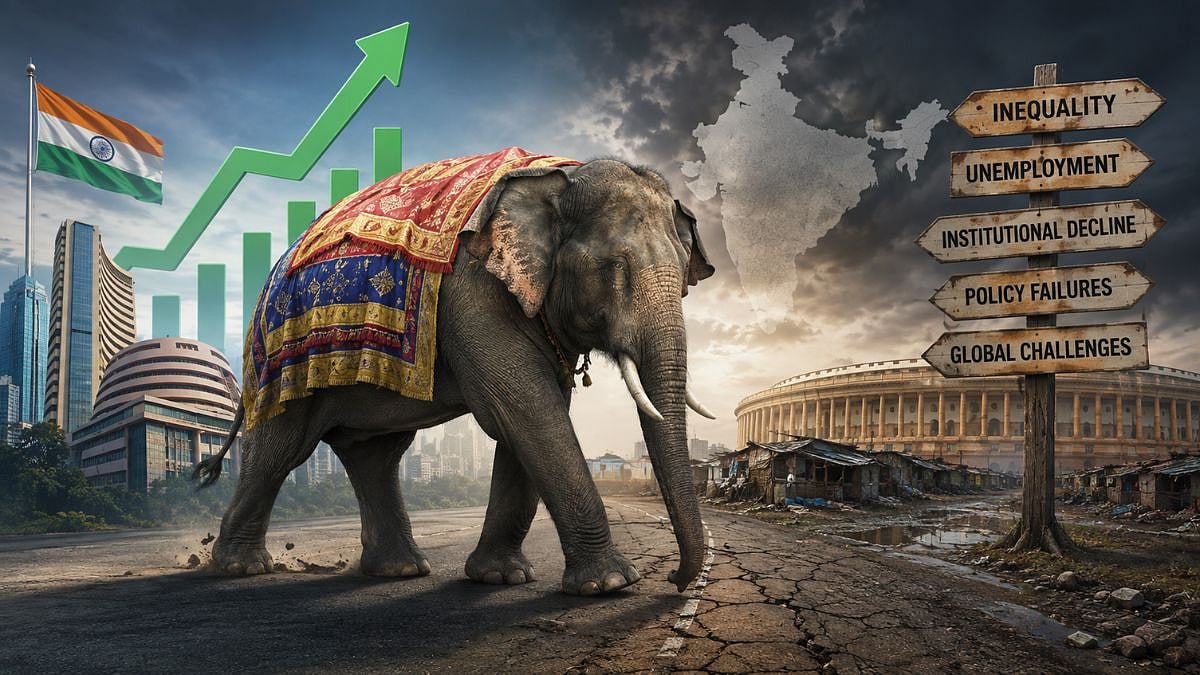
The article asks whether India is becoming as powerful as its leaders and supporters hope.
Prime Minister Narendra Modi presents India as a bright spot of growth and hope.
The author argues that India’s economy, democracy, and foreign policy have not progressed enough to make it a great power.
The article says political leaders have become more powerful while institutions and ordinary people have become weaker.
It criticizes the use of investigative agencies and pressure on opposition groups, media, and civil society.
It also says India has experienced many internet shutdowns despite calling itself a natural ally of open societies.
The author believes India’s foreign policy has not shown enough independence or strategic planning.
The article contrasts the nationalism of Gandhi and Tagore with what it describes as the more persecuted and culturally superior nationalism of Hindutva forces.
It ends by calling for a more imaginative approach to India’s future.

The article argues that India’s economic progress has not matched its ambitions of becoming a global power.
It criticizes the Modi government for weakening democratic institutions, federalism, media freedom, and civil society.
The author says nationalism has emphasized persecution and cultural superiority instead of constitutional values.
India’s foreign policy is described as lacking strategic vision and punching below the country’s potential.
The article concludes that India needs new political and institutional thinking to halt its perceived decline.
- Who
- The article discusses India, Prime Minister Narendra Modi, the Modi government, Hindutva forces, and Indian democratic and foreign-policy institutions.
- What
- It evaluates India’s economic performance, democracy, federalism, nationalism, and foreign policy against its ambition to become a global power.
- Where
- India, in relation to its domestic institutions and international role.
- When
- The discussion covers the Modi government’s past 12 years, with specific references to 2021 and earlier periods.
- Why
- The author argues that economic weaknesses, institutional decline, inequality, and an insufficiently strategic foreign policy are preventing India from becoming a great power.
Author’s Critique
Government’s Optimistic Case
India’s economic trajectory
Author’s Critique
The author argues that India’s economic performance has fallen short of the expectations created by its projected rise and that politics has expanded while the economy has weakened.
Government’s Optimistic Case
Prime Minister Narendra Modi’s stated position, as presented in the article, is that the world sees India as a bright spot of growth and hope.
Democracy and institutions
Author’s Critique
The author says India is moving toward a delegative form of democracy, marked by pressure on institutions, opposition groups, media, civil society, and states.
Government’s Optimistic Case
The government’s stated democratic framing includes Modi’s description of India as a natural ally of open society at the 2021 G7 Summit.
National power and foreign policy
Author’s Critique
The author argues that India lacks a clear strategic vision, punches below its potential, and has not demonstrated the influence expected of a rising power.
Government’s Optimistic Case
The article presents the broader pro-government view that India’s growth and potential justify its aspiration to join the world’s leading powers.
Key facts
- Leader discussed
- Prime Minister Narendra Modi
- Central ambition
- India becoming a global or great power
- Economic assessment
- The author says India’s growth potential has generated expectations that have not been fully realized.
- Democratic concerns
- The article alleges pressure on investigative agencies, opposition groups, media, civil society, and states.
- Internet restrictions
- The article describes India as witnessing the largest number of internet shutdowns.
- Foreign-policy concern
- The author argues that India lacks a sufficiently clear strategic vision and has remained largely silent on Israeli actions against Palestinians.
- Comparison with China
- The article says China is in a different league and that India cannot simply copy it.
Quotes
Foreign Policy Journal
Publication cited by the article in its criticism of India’s governance and foreign policy
“no grand plan, no strategic vision for its foreign policy in a post-cold war period”
 freepressjournal.in
“Modi fiddles while India burns”
freepressjournal.in
Sources
Related news

Karnataka BJP celebrates Independence Day; Narayanaswamy hails Modi leadership
From 'Fragile Five' to world's fastest-growing major economy: Modi

India's Journey From 'Fragile Five' to Major Economy: PM Modi
India’s Modi-ism Must Evolve Into Institution-Centered Nation-Building
Former Envoy Says India Still Suffers From Trump Policies

Fadnavis Says 'India Cannot Be Stopped' at Mumbai Tiranga Rally
BJP MLA Anil Sharma Dies After Prolonged Illness, Yogi Mourns
Sonia Gandhi Memoir Sparks Debate Over Politics, Publishing And Speech

Rajasthan BJP Promises Early Disturbed Area Law Enforcement

Punjab Police, ED Clash Over Alleged Transfer-Posting Network
