1 week ago
Vijayawada Railway Division Expands Solar Power and Green Initiatives

The Vijayawada Railway Division is using more solar power to make railway operations greener.
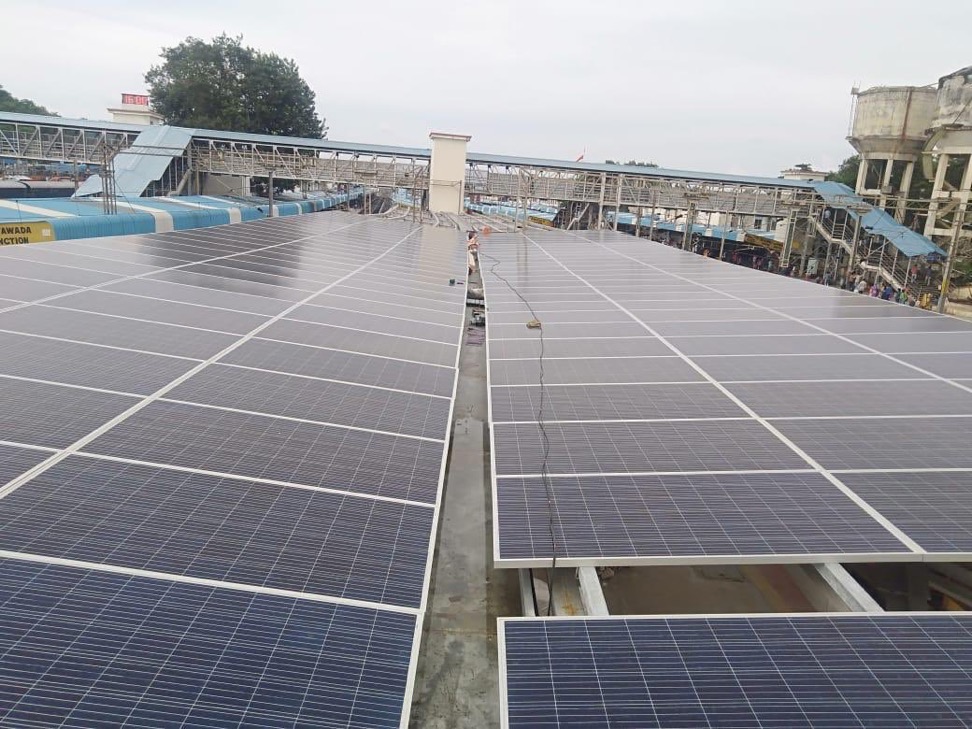
It has solar panels at stations, offices, staff housing and level-crossing gates.
These panels use sunlight to produce electricity.
In 2025-26, they generated more than 4.4 million units of clean energy.
This saved money and reduced carbon dioxide pollution.
Ten stations produced enough solar power to become energy-neutral and generate extra electricity.
Vijayawada Railway Station received a Platinum certification for sustainable design.
The division is also using LED lights, solar water heaters, bio-toilets and rainwater-harvesting systems.
These efforts support Indian Railways’ goal of reaching net-zero carbon emissions by 2030.

The division has installed 4,864 kWp of solar capacity across 265 rooftop and standalone installations.
Solar systems generated 4,406,903 units in 2025-26, saving ₹461.40 lakh and avoiding 3,525.52 tonnes of CO₂ emissions.
Vijayawada Railway Station has IGBC Platinum certification and 610-kWp building-integrated photovoltaic rooftop panels.
Ten stations achieved Net-Zero “Shunya Plus” status, generating surplus solar power and producing 172,777 units in 2025-26.
LED lighting, solar water heaters, biogas plants, bio-toilets, rainwater harvesting and Head-On Generation trains support wider environmental goals.
- Who
- The Vijayawada Division of South Coast Railway, led by Divisional Railway Manager Mohit Sonakiya.
- What
- The division expanded solar generation and introduced energy-efficiency and environmental measures.
- Where
- Across the Vijayawada Railway Division, including stations, offices, staff quarters, hospitals, running rooms and 70 level-crossing gates.
- When
- The initiatives were highlighted on Indian Akshay Urja Diwas; reported figures cover 2025-26 and April-July 2026.
- Why
- To generate renewable energy, reduce costs and emissions, and support Indian Railways’ goal of becoming a Net Zero Carbon Emitter by 2030.
Key facts
- Installed solar capacity
- 4,864 kWp across 265 rooftop and standalone installations
- Solar capacity distribution
- 2,978 kWp at stations, 1,476 kWp at service buildings and offices, 120 kWp at staff quarters, and 290 kWp at 70 level-crossing gates
- Clean energy generated in 2025-26
- 4,406,903 units
- 2025-26 savings and emissions reduction
- ₹461.40 lakh saved and 3,525.52 tonnes of CO₂ emissions avoided
- April-July 2026 output
- 1,990,741 units generated, with ₹185.54 lakh in savings and 1,592.59 tonnes of CO₂ emissions avoided; one report instead states the savings as “Rs 1.85.54 crore”
- Solar water-heating capacity
- 56,700 litres per day
- Other reported measures
- 81 solar-powered street lights and signal installations, 3,688 bio-toilets across 960 coaches, and 252 rainwater-harvesting pits
Quotes
Mohit Sonakiya
Divisional Railway Manager
“"Every unit of clean energy generated and every measure reducing the carbon footprint contributed to Indian Railways’ Net Zero vision. He said the Division remained committed to renewable-energy adoption and energy efficiency to build a greener and future-ready railway."”
 deccanchronicle.com
Sources
Related news

Northeast Frontier Railway Reaches 42.1 MWp Solar Capacity

NFR Reaches 42.1 MWp Solar Capacity, Leading Indian Railways
Rajasthan Railway Stations Receive Rs 56,000 Crore Upgrade Push
Kishan Reddy, Vishweshwar Reddy Inspect Vikarabad Station Modernisation Works

Indian Railways Invests Rs 56,000 Crore in Rajasthan

Pawan Kalyan Birthday Celebrations Feature Bike Rallies Across Andhra Pradesh
Collector Rajakumari Receives Red Cross Gold Medal for Services
IB Detains Shivtek Safety Officer Amid 2016 Blast Concerns

Krishna Collector Balaji Receives Red Cross Seva Swarna Award Again
AP Governor Presents Red Cross Awards to Seven District Collectors