1 day ago
CAFE-III Gazette Reveals EV Metric and Credit-Window Errors

India’s new CAFE-III fuel-efficiency rules contain two wording problems.
The English version measures electric energy over 100 kilometres, but the Hindi version says 1,000 kilometres.
The rules also call October 1 through October 31 a 30-day period, even though those dates cover 31 calendar days.
Officials may need to clarify both issues before the rules begin.
CAFE-III sets a fleet-efficiency benchmark for carmakers, not a promise that every car will travel 30 kilometres on one litre.
The rules give extra compliance credit to several types of cleaner technology.
Plug-in hybrids receive a 2.5-times multiplier, while range-extended electric vehicles receive 3 times.
Some experts support moving directly to fully electric vehicles instead of relying on hybrid technology.

The English and Hindi versions use different distance references for EV energy consumption: 100 km versus 1,000 km.
The Gazette calls October 1–31 a “30-day” credit-trading period, creating uncertainty over the deadline.
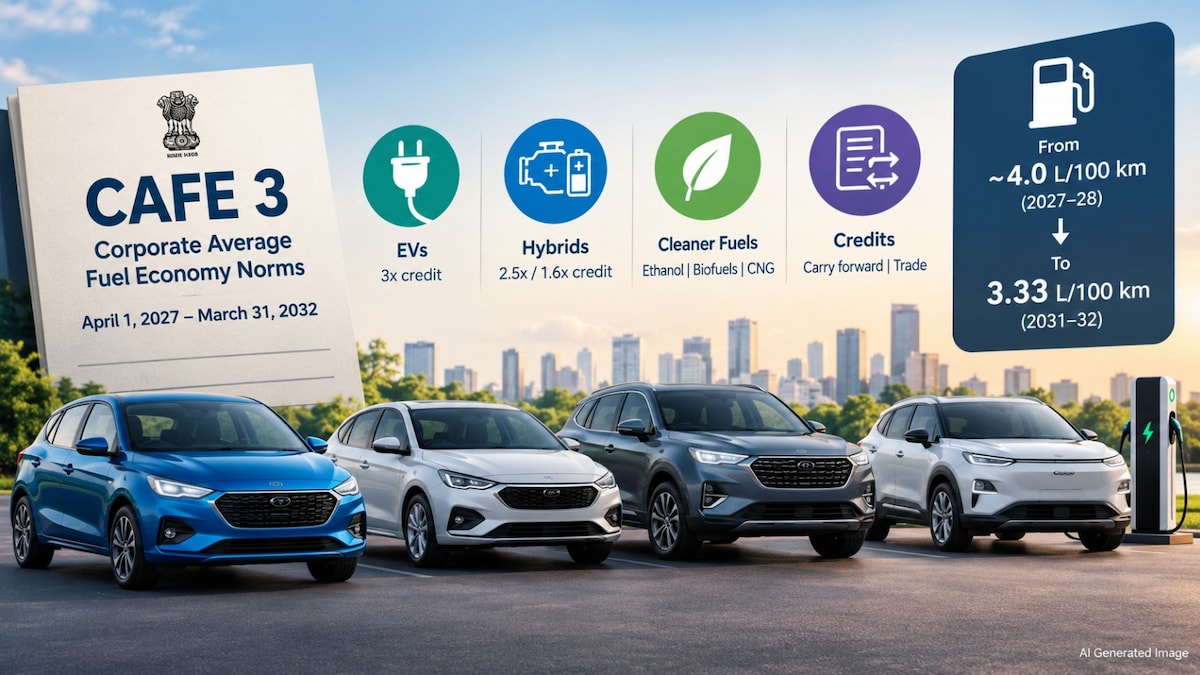
CAFE-III’s FY32 benchmark is 3.327 litres per 100 km, but this is a compliance benchmark, not an individual-car mileage guarantee.
The framework offers compliance incentives including powertrain multipliers, technology allowances, carbon-neutrality factors and credits.
PHEVs receive a 2.5-times multiplier and REEVs 3-times, while analysts say the rules do not require charging or electric-distance data.
- Who
- Indian carmakers, regulators and experts including Randheer Singh and Amitabh Kant are affected or cited.
- What
- India’s final CAFE-III Gazette contains a 10-fold EV energy-unit discrepancy and a conflicting credit-trading duration.
- Where
- India.
- When
- The Gazette was published on October 1, 2026; the CAFE-III regime is scheduled to begin on April 1, 2027.
- Why
- Clarification may be needed so manufacturers know the applicable measurement and credit-trading deadline while preparing for CAFE-III.
Direct Electric Transition
Transitional Technologies
Role of hybrids
Direct Electric Transition
Amitabh Kant argues that hybrids are only a bridge and that India should move directly to electric vehicles.
Transitional Technologies
CAFE-III gives compliance advantages to PHEVs and REEVs, allowing these technologies to contribute toward fleet-efficiency requirements.
How technology rewards are assigned
Direct Electric Transition
Critics may view multiplier-based rewards without charging or electric-distance data as insufficiently tied to actual electric use.
Transitional Technologies
The framework rewards PHEVs and REEVs through defined multipliers, with PHEVs receiving 2.5 times and REEVs 3 times.
Key facts
- EV measurement discrepancy
- The English text says kilowatt-hours per 100 kilometres; the Hindi text says kWh per 1,000 kilometres.
- Credit-trading window
- The Gazette states “Thirty days, from October 1 to October 31,” although those dates span 31 calendar days.
- CAFE-III start date
- The fuel-efficiency regime is scheduled to begin on April 1, 2027.
- FY32 benchmark
- The framework specifies 3.327 litres per 100 km, mathematically about 30 km per litre.
- PHEV multiplier
- Plug-in hybrid electric vehicles receive a 2.5-times multiplier.
- REEV multiplier
- Range-extended electric vehicles receive a 3-times multiplier.
- Compliance mechanisms
- The framework includes powertrain multipliers, technology allowances, carbon-neutrality factors and compliance credits.
Quotes
Randheer Singh
Former Director of Electric Mobility at NITI Aayog and founder of ForeSee Consulting
“They are a bridge, not the destination... India needs to go straight to electric”
 thehindubusinessline.com
“The multiplier is earned by label, not by capability.”
thehindubusinessline.com
Sources
Related news
India's CAFE 3 Rules Reshape Carmakers' Efficiency Strategies and Costs
CAFE-III Wins Industry Backing Amid Debate Over EV Ambition
CAFE 3 Rules Could Bring More EVs and Hybrids
India Notifies CAFE-III Rules With New Vehicle Efficiency Targets

New CAFE-III Norms Give EVs Threefold Compliance Benefit
India Notifies New CAFE-3 Rules, Retaining EV Incentives

India's CSR Spending Grows, but Poorer States Remain Underserved

CREDAI Seeks Area-Based Affordable Housing Without ₹45 Lakh Cap

New Affordable Housing Policy Expected Within Six Months, Credai Says
NITI Aayog Workshop Advances Sustainable Development Goals Budgeting