

7 hrs ago
India Notifies New CAFE-3 Rules, Retaining EV Incentives
India has created new rules to reduce pollution from cars.
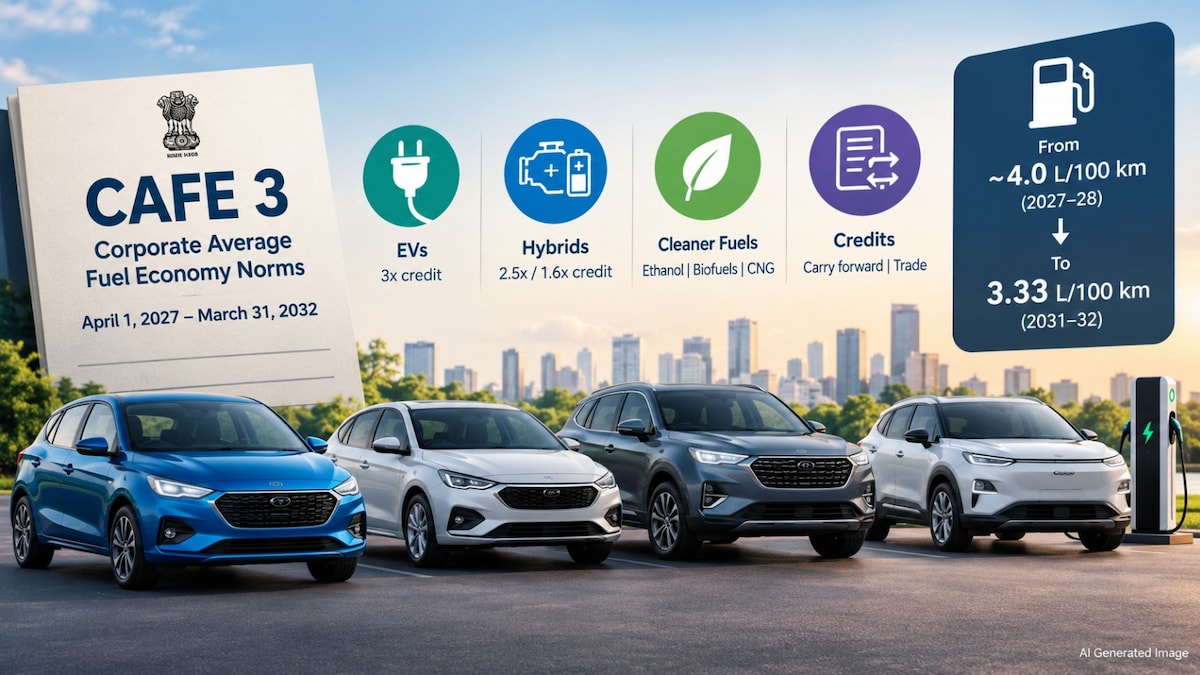
These rules are called CAFE-3.
They will start in April 2027 and continue until March 2032.
The government decided not to give small petrol cars a separate discount.
Maruti Suzuki India had requested such help, while Tata Motors, JSW MG Motor and electric-vehicle makers opposed it.
Instead, the government changed the formula used to set emission targets.
Smaller and lighter cars will have relatively easier targets than under the earlier draft, while very heavy vehicles will have stricter limits.
Electric vehicles will still receive extra compliance credit.
Companies can earn credits for doing better than their targets or accumulate debits for missing them.

The Ministry of Power has notified CAFE-3 regulations to reduce vehicle carbon dioxide emissions.
The rules will apply from April 2027 through March 2032 and provide no separate relief for small cars.
The final formula raises the reference vehicle weight to 1,229 kg from 1,170 kg in the draft.
Lighter vehicles receive relatively easier targets, while heavier vehicles face stricter limits under the revised formula.
Battery electric and range-extended electric vehicles retain a three-times compliance factor through the super-credit system.
- Who
- The Ministry of Power, automobile manufacturers, and electric-vehicle makers are involved; Maruti Suzuki India, Tata Motors, and JSW MG Motor are specifically mentioned.
- What
- The government notified CAFE-3 vehicle-emission regulations without a separate concession for small cars while retaining incentives for cleaner technologies.
- Where
- India.
- When
- The rules will apply from April 2027 through March 2032.
- Why
- The regulations aim to reduce carbon dioxide emissions from vehicles.
Supporters of Small-Car Relief
Opponents and Final Framework
Separate small-car concession
Supporters of Small-Car Relief
Maruti Suzuki India sought relief for lightweight vehicles, and the September 2025 draft proposed a 3 grams-per-kilometre concession for petrol cars weighing up to 909 kg.
Opponents and Final Framework
Electric-vehicle manufacturers and other automakers, including Tata Motors and JSW MG Motor, opposed the proposal, saying it would favour a segment largely controlled by one manufacturer. The final rules omit the separate concession.
How targets should be adjusted
Supporters of Small-Car Relief
The proposed concession would have reduced the emissions burden for qualifying lightweight petrol cars when calculating a manufacturer's overall CAFE compliance.
Opponents and Final Framework
The government instead changed the overall formula, raising the reference weight and flattening the weight adjustment so lighter vehicles receive relatively easier targets and heavier vehicles face stricter limits.
Key facts
- Implementing authority
- Ministry of Power
- Implementation period
- April 2027 to March 2032
- Small-car concession
- No separate relief was included in the final rules.
- Reference weight
- Raised from 1,170 kg in the draft to 1,229 kg in the final formula.
- Electric-vehicle factor
- Battery electric vehicles and range-extended electric vehicles receive a 3x compliance factor.
- Compliance mechanism
- A manufacturer-level passbook will track credits and debits.
- Emission examples
- A 909-kg vehicle has an FY28 target of about 82.8 g/km, while a 2,500-kg vehicle faces about 142.4 g/km.
Sources
Related news

New CAFE-III Norms Give EVs Threefold Compliance Benefit
India's CAFE 3 Rules Reshape Carmakers' Efficiency Strategies and Costs
CAFE 3 Rules Could Bring More EVs and Hybrids
CAFE-III Wins Industry Backing Amid Debate Over EV Ambition

India’s Low-Speed EV Weight Limit Faces a Safety Test
Indian Oil’s Gujarat Refinery Plans Polypropylene Production by Fiscal Year-End
S&P Says Tata Sons Listing May Reshape Long-Term Strategy
Tata Expands BaaS Option Across Its Full EV Range
