5 days ago
India’s Women Face Conditional Freedom Despite Empowerment Claims

The article says women in India are legally free in many ways, but society often puts extra rules on them.
Men may be praised for speaking harshly, while women can be criticized for using similar words.
Women are also judged for their clothes, relationships, careers, and personal choices.
At home, women often do more childcare, family planning, and emotional work.
At work, they may receive fewer opportunities or be expected to sacrifice their careers.
The article says violence and harassment are sometimes blamed on women instead of the people who hurt them.
It also questions whether political and corporate promises about empowerment lead to real change.
The author wants men to share responsibilities and accept women who disagree or act independently.
The main message is that freedom should not depend on behaving in a narrowly approved way.

The article argues that behavior accepted from men often becomes a cultural controversy when women display it.
Women’s choices about speech, clothing, relationships, sexuality, and careers remain subject to social judgment and restrictions.
The author links gender inequality to harassment, violence, unequal care work, workplace penalties, and digital abuse.
Political claims about women’s empowerment are questioned amid abusive public discourse and limited female representation in corporate leadership.
The article calls for shared care responsibilities, safer spaces, changed workplace expectations, and greater acceptance of women’s disagreement.
- Who
- Indian women, political leaders, families, workplaces, and companies are central to the article.
- What
- The article examines the social and professional barriers women face while exercising personal freedom.
- Where
- The article focuses on India, including political discussion around Jantar Mantar, remarks made in Pune, homes, workplaces, and digital spaces.
- When
- The discussion follows Narendra Modi’s comments about young women protesters and Rahul Gandhi’s remarks in Pune; no specific date is given.
- Why
- The author argues that social expectations, gender double standards, unequal care responsibilities, and weak institutional change continue to restrict women’s freedom.
Gender Equality Critique
Cultural Conduct Argument
Women’s public language
Gender Equality Critique
The article argues that women are unfairly judged for aggressive or abusive language that may be accepted as political toughness when used by men.
Cultural Conduct Argument
Narendra Modi’s comments, as described in the article, characterized young women protesters’ abusive language as a “cultural shock.”
Meaning of empowerment
Gender Equality Critique
The author says empowerment must include freedom to disagree, choose independently, share care work, and access equal opportunities beyond political slogans.
Cultural Conduct Argument
The article says politicians across the spectrum speak about women’s safety, dignity, representation, and empowerment, but it questions whether those claims produce social transformation.
Corporate representation
Gender Equality Critique
The author argues that one mandated woman independent director may become a compliance exercise and proposes 50 percent women on boards.
Cultural Conduct Argument
The current regulatory approach described in the article requires at least one woman independent director rather than equal board representation.
Key facts
- Central argument
- Women’s freedom in India is often treated as conditional on social approval.
- Political context
- The discussion was prompted by Narendra Modi’s comments about the “cultural shock” of young women protesters using abusive language at Jantar Mantar.
- Counterpoint in politics
- Rahul Gandhi’s remarks in Pune are presented as highlighting the different reactions to men’s and women’s aggressive language.
- Workplace issue
- Listed companies are required to have at least one woman independent director, according to the article.
- Corporate proposal
- The author suggests mandating 50 percent women on company boards.
- Unequal care work
- Women are described as carrying much of the responsibility for childcare, ageing parents, household coordination, and family emotional labor.
- Forms of harm
- The article cites rape, domestic violence, sexual harassment, trafficking, stalking, dowry-related violence, doxxing, and public shaming.
Quotes
Corporate employers
An unnamed corporate rationale cited in the article to explain limited female representation in senior leadership.
“We cannot find enough women”
 freepressjournal.in
Sources
Related news

Women's Profanity Protests Expose India's Double Standard in Politics

Rahul Gandhi Urges Women to Break Social, Economic Cages

Rahul Gandhi Urges Pune Students to Smash Patriarchy

India's young women need to be taken seriously, not forgiven
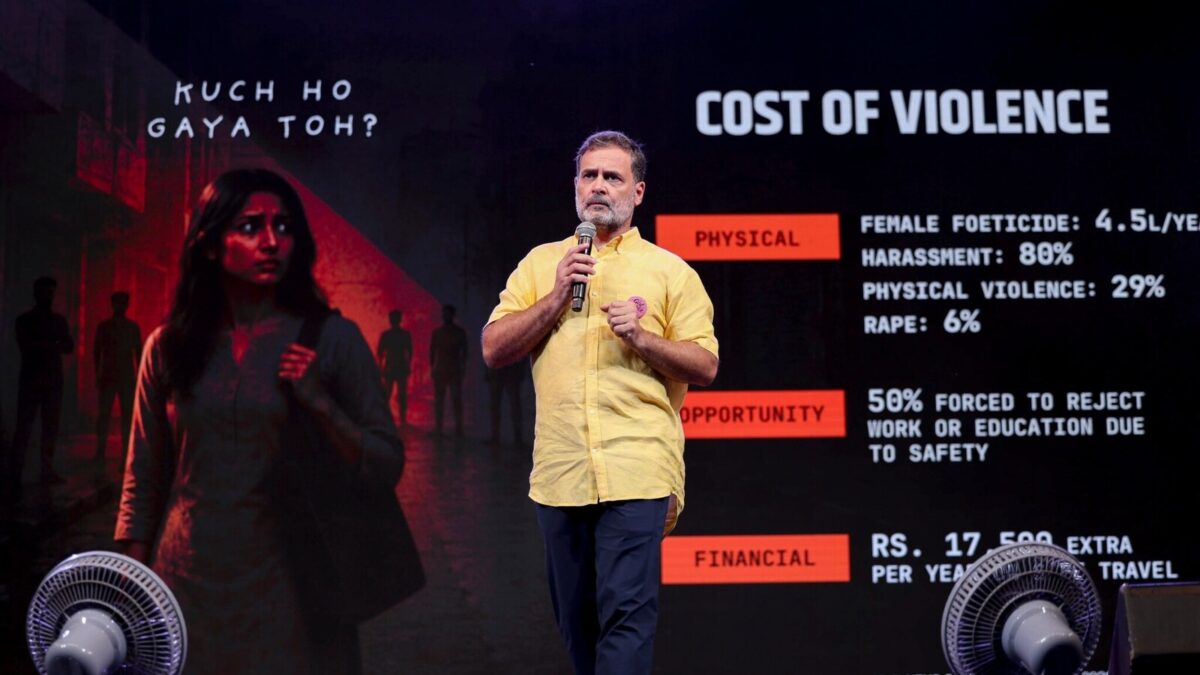
Rahul Gandhi Urges Women to Break Social Cages

80 Years of Independence, Yet Women Remain Chained and Smirked
Goyal Defends India’s 7.8% GDP Growth Amid Data Debate

Manipur Census Deferment Welcomed as Step Toward Public Aspirations
UPSC Key Covers SCO, Electoral Rolls, Economy, Defence and Climate

West Bengal CM Crushes Nearly 2 Lakh Seized Syrup Bottles

Modi Highlights India’s Growing Avocado Market and Farmer Gains