1 week ago
NASA’s 1984 Space Bees Built Honeycomb in Weightlessness
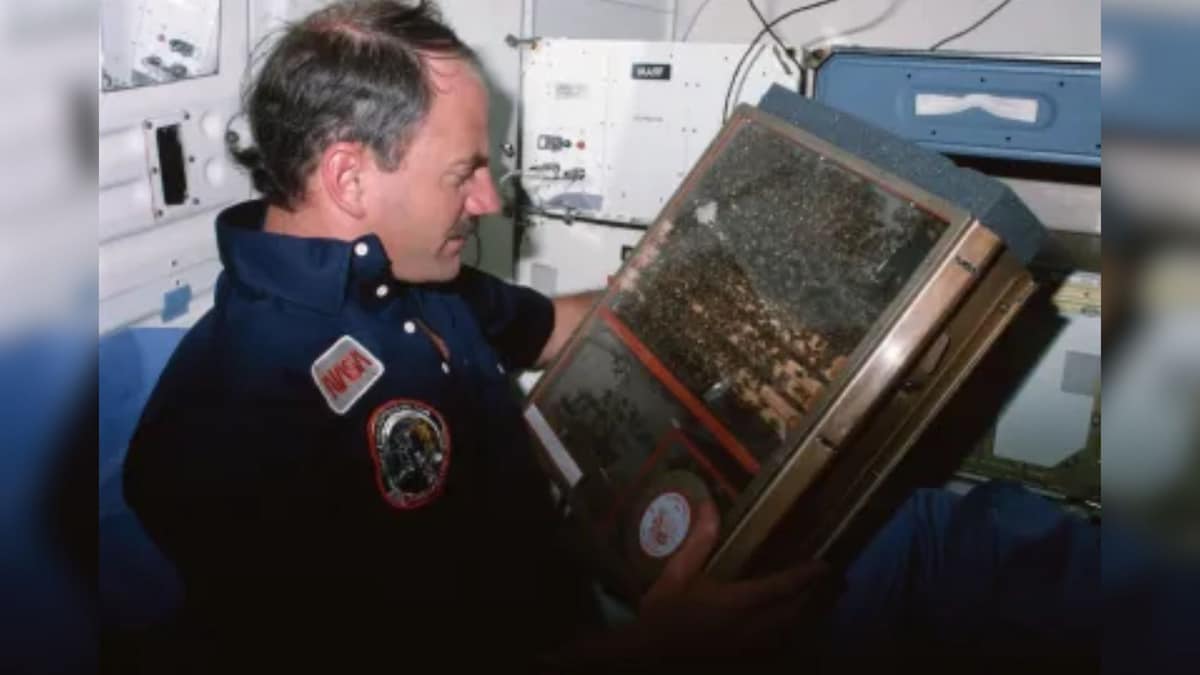
NASA sent about 3,300 honeybees into space in 1984.
They flew aboard Space Shuttle Challenger for about a week.
Scientists wanted to see whether bees could build honeycomb without normal Earth gravity.
The bees built about 200 square centimetres of honeycomb.
That is about 31 square inches.
Their honeycomb had normal-depth cells, but the cells were smaller and had thicker walls than the comparison samples.
At first, some bees had trouble flying and bumped into the enclosure.
By the end, they had adapted to moving in weightlessness.
The queen also laid about 35 eggs, but those eggs did not hatch after the experiment.

About 3,300 honeybees flew aboard Space Shuttle Challenger during NASA’s STS-41C mission in April 1984.
The week-long experiment tested whether bees could build honeycomb in microgravity.
The bees produced about 200 square centimetres, or 31 square inches, of honeycomb.
Space-grown cells had smaller diameters and thicker walls, while average cell density was broadly similar to ground samples.
The bees initially collided with the enclosure walls but eventually adapted to walking, floating and flying in microgravity.
- Who
- About 3,300 honeybees, NASA researchers and the Challenger crew.
- What
- A student experiment studied how honeybees moved and built honeycomb in microgravity.
- Where
- Inside a specially designed enclosure aboard Space Shuttle Challenger during the STS-41C mission.
- When
- The mission launched on April 6, 1984, and the experiment lasted about one week.
- Why
- Researchers wanted to compare space-built honeycomb and bee behavior with samples produced under normal gravity.
Key facts
- Mission
- STS-41C aboard Space Shuttle Challenger
- Launch date
- April 6, 1984
- Honeybees
- About 3,300
- Honeycomb produced
- About 200 square centimetres, or 31 square inches
- Cell findings
- Normal-depth cells, with smaller average diameters and thicker walls than comparison samples
- Behavioral adjustment
- The bees initially collided with enclosure walls but later completely adapted to microgravity
- Queen’s eggs
- About 35 eggs were laid; they did not hatch after transfer to a standard hive
Sources
Related news
Ooty Workshop Examines Space Simulation and Human Biology Research

NASA Finds Earth Microbes Could Survive Near Moon’s South Pole
Bhubaneswar start-up tests drug manufacturing in space

Redcliffe Labs and Skyroot Partner to Test Space Diagnostics
Animal Dances Reveal Surprising Behaviors, From Bees’ Waggle Dance

Astronaut Shares Ancient Manicouagan Crater View From Space

Science Quiz Covers Vehicle Communication, Space, Medicine, Missiles and Time

NASA Launches Roman Telescope to Probe Universe’s Mysteries

India's R&D Ecosystem Faces Hurdles On Path To Knowledge Economy

NISAR's Nepal Flood Silence Raises Questions About Disaster Readiness

Next Lunar Eclipse Set for February 2027 Across India, World