3 weeks ago
Indian parliamentary panel seeks 24x7 satellite forest fire tracking
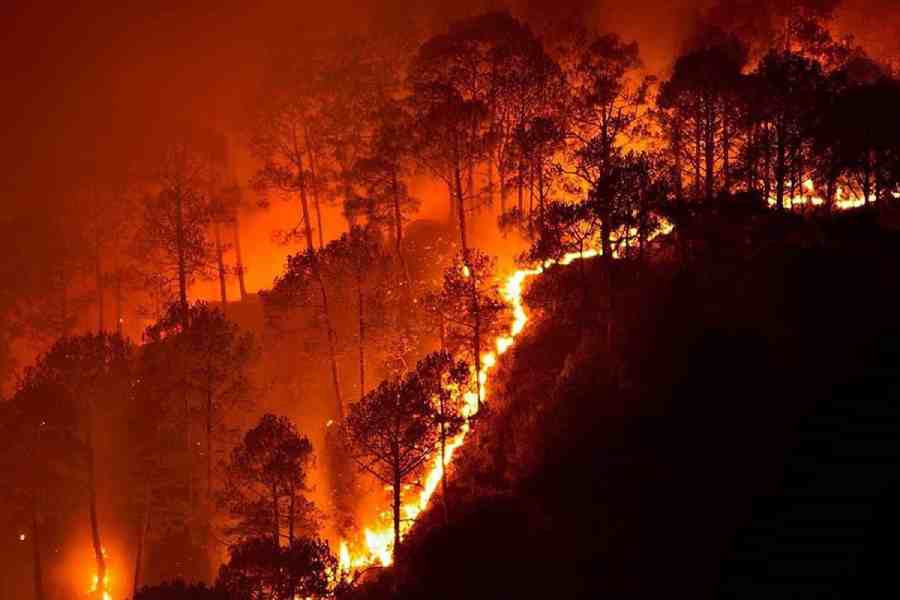
India uses satellites in space to watch its forests and spot fires.
The satellites India uses right now belong to other countries.
These satellites fly past India only about eight times a day.
That means there are many hours when no satellite can see a forest fire.
A group of important leaders called a parliamentary panel noticed this problem.
They wrote a report to the Rajya Sabha, one of India's houses of parliament.
The panel asked India to launch its own special satellite that stays fixed above India.
This kind of satellite can watch the same place all day and all night.
Then forest fires could be spotted quickly, even in the mountains of the Himalayas.
The panel also said India's weather experts could help predict when fires are likely to start.

A parliamentary standing committee headed by Medha Vishram Kulkarni flagged gaps in India's satellite-based forest fire monitoring.
The panel recommended launching a geostationary satellite capable of 24x7, round-the-clock fire tracking.
India currently relies on foreign polar-orbiting satellites (MODIS and SNPP-VIIRS) that observe the country only about eight times a day.
There is no near-real-time fire detection between 01:30-10:30 and 13:30-22:30 local time, a gap the environment ministry called critical.
The department of space outlined short-term plans to add higher-resolution data and medium-term plans for dedicated Indian fire-monitoring satellites.
- Who
- The parliamentary standing committee on science and technology, environment, forests and climate change, chaired by Medha Vishram Kulkarni, along with the Forest Survey of India, the environment ministry and the department of space.
- What
- Recommended launching a geostationary satellite for round-the-clock forest fire monitoring, citing critical gaps in the current satellite system.
- Where
- India, with particular focus on the Himalayan region and the Western and Eastern Himalayas.
- When
- The article does not specify a date; the committee's report was submitted to the Rajya Sabha.
- Why
- Foreign polar-orbiting satellites (MODIS and SNPP-VIIRS) observe India only about eight times a day, leaving long windows in which fires can start, spread and even extinguish undetected.
Key facts
- Committee
- Parliamentary Standing Committee on Science and Technology, Environment, Forests and Climate Change
- Committee head
- Medha Vishram Kulkarni
- Report submitted to
- Rajya Sabha
- Current satellite sensors
- MODIS and SNPP-VIIRS (foreign, polar-orbiting)
- Daily observation frequency
- About 8 times a day; revisit cycle roughly 12 hours
- Monitoring gaps
- No satellite pass between 01:30-10:30 and 13:30-22:30 local time
- Recommendation
- Launch a geostationary satellite for 24x7 forest fire tracking
- Existing geostationary asset
- INSAT, which misses many fires detected by VIIRS or MODIS
Quotes

Parliamentary Standing Committee on Science and Technology, Environment, Forests and Climate Change
Parliamentary committee that reviewed forest fire monitoring
“Both MODIS and SNPP-VIIRS operate on a revisit cycle of roughly 12 hours, with overpasses of the Indian region at approximately 01.30 and 13.30 local time.”
 telegraphindia.com
“India’s active-fire monitoring remains dependent on foreign, polar-orbiting satellites, which observe the country only about eight times a day.”
telegraphindia.com
Sources
Related news
India panel urges geostationary satellite for Himalayan forest fire monitoring

UPSC Weekly Quiz: 10 Current Affairs Questions for Prelims 2027
ISRO Sets September Launch for EOS-05 Earth-Imaging Satellite

India's Space Sector Finds Biggest Impact Back on Earth

Letters Debate Forest-Fire Prevention, Hotel Safety and Loneliness

ISRO Plans EOS 5 Comeback Launch After PSLV Setbacks

Arunachal Congress Protests FIR Against Rahul Gandhi

Parliament Panel To Examine Fertiliser, Wood Panels And Medicines

Inside India's Parliament, Disruptions Raise Questions About Democratic Accountability

MP Ashok Mittal Calls for National Commission for Men

Amrita Pritam’s Two Delhis: A City Lived, Written, Erased