

Science & Tech · Science & Environment · 1 hr ago
Egyptian fossils identified as a new 45-million-year-old crocodile species
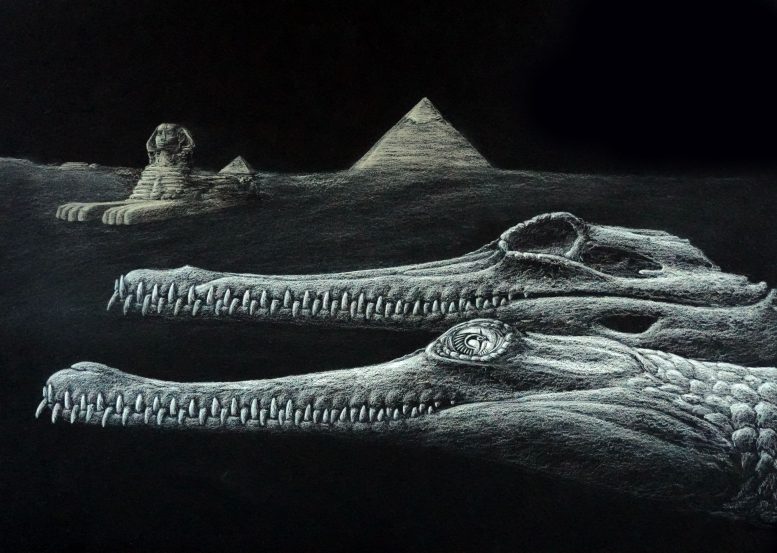
Researchers identified a new extinct crocodile species from fossils found in Egypt in the 1920s.
The species, named Herugavialis cairensis, lived about 45 million years ago in what is now Egypt.
CT scans of a nearly complete skull helped researchers distinguish it from the living false gharial, which the fossils had previously been grouped with.
The fossils came from the same rock formation used to build the Great Sphinx, and the skull is missing the tip of its snout.
Herugavialis lived in shallow seas alongside other long-snouted crocodiles, showing that gavials once lived widely beyond Asia.
Crocodiles later disappeared from the Mediterranean region as it dried about 6 million years ago, after changing temperatures and sea levels had affected their diversity.

Researchers identified Egyptian fossils as a new extinct crocodile species, Herugavialis cairensis.
The fossils date to about 45 million years ago and come from Egypt’s Mokattam Formation.
CT scans of a nearly complete skull helped researchers distinguish the species from the living false gharial.
The skull is missing the tip of its snout and comes from rocks also used to build the Great Sphinx.
The study says crocodiles disappeared from the Mediterranean region about 6 million years ago as the sea dried.
- Who
- An international team led by Dr. Paul Burke identified the species.
- What
- Egyptian fossils were identified as a distinct extinct crocodile species, Herugavialis cairensis.
- When
- The fossils date to about 45 million years ago. The study was published on 1 October 2026.
- Where
- The fossils came from Egypt’s Mokattam Formation.
- Why
- CT scans and other analyses showed differences from the false gharial, correcting the fossils’ earlier classification.
This story does not have two clearly opposing sides.
Crocodile fossils were recovered in Egypt and initially grouped with the false gharial.
Herugavialis lived in shallow seas covering much of the region.
The study on the species’ cranial anatomy was published in Royal Society Open Science.
SciTechDaily published its report on the discovery.
- Species
- Herugavialis cairensis
- Age
- About 45 million years
- Fossil formation
- Mokattam Formation, Egypt
- Initial classification
- False gharial, genus Tomistoma
- Study publication
- 1 October 2026 |
What people are saying
Given this coincidence with the famously missing nose of the Great Sphinx, we decided to name the new crocodile after the Egyptian god Heru, who was possibly the inspiration for this iconic monument.
Throughout much of the last 50 million years, the Mediterranean region hosted a high diversity of crocodiles, including gavials,
Sources
Related news

High-speed video shows how detached honeybee stingers keep pumping venom

Wolves Reduced Yellowstone Elk, but Tree Recovery Stayed Limited

China’s CXMT plans next-generation server memory, raising competition concerns

Trump revives effort to halt Ørsted offshore wind farm construction

Scientists urge governments to tighten rules on the exotic pet trade

Quantum simulator reveals predicted energy patterns at two tipping points

Pacific buoy recorded a 17.6-metre rogue wave nearly three times its neighbours

A 1960 population model set a ‘doomsday’ date that later growth disproved

Red dwarf slowly draws matter from a brown dwarf

Vellore starts clearing invasive plants from irrigation tanks before monsoon

Satellite Data Reveal Opposing Changes Beneath Nicaragua’s Masaya Volcano
