Science & Tech · Space · 2 hrs ago
Red dwarf appears to slowly draw matter from a brown dwarf
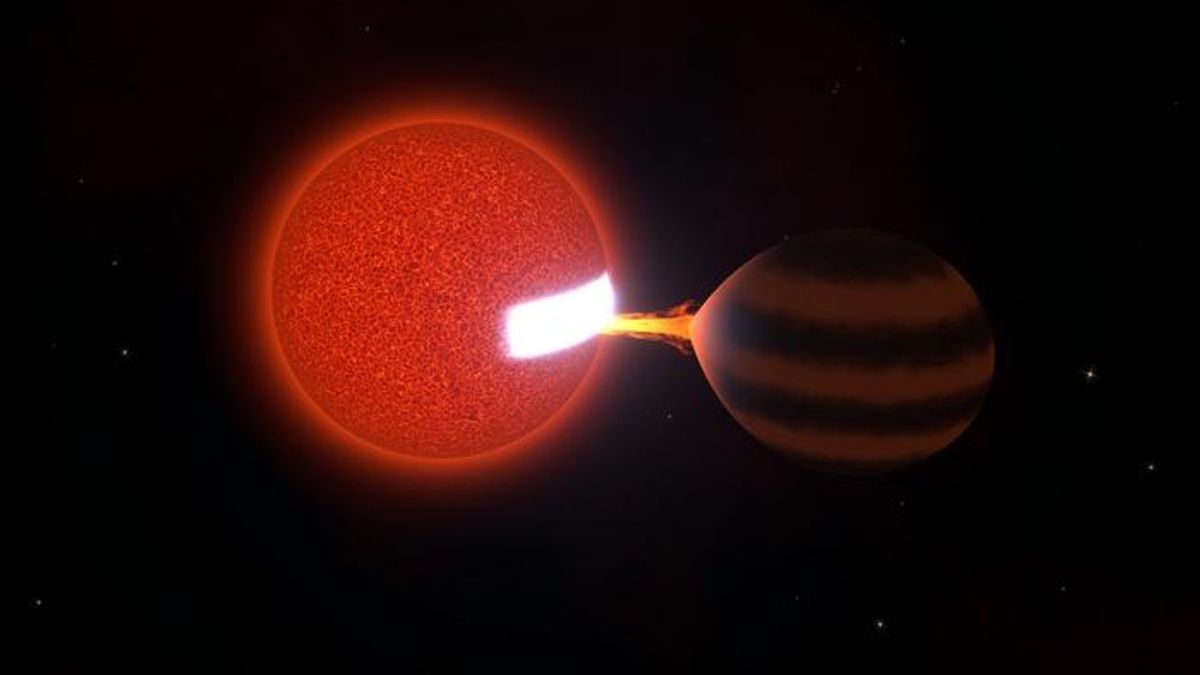
A red dwarf star about 300 light-years from Earth appears to be drawing matter from a nearby brown dwarf.
The pair, known as ZTF J0440+2325, is in the Milky Way.
A brown dwarf is larger than a planet but too small to shine like a star.
The objects orbit extremely close together, and their movements helped researchers identify the system.
Simulations suggest the red dwarf is slowly pulling material from its smaller companion, a process called accretion.
Researchers say this is the first observed case of one low-mass object gradually consuming another; at the estimated rate, the process could take billions of years.

Astronomers say a red dwarf is gradually drawing matter from a brown dwarf orbiting it.
The system, known as ZTF J0440+2325, is about 300 light-years from Earth in the Milky Way.
The brown dwarf has about 25 times Jupiter’s mass, while the red dwarf has about 85 times Jupiter’s mass.
The brown dwarf’s orbit is smaller than the diameter of the Sun.
Researchers estimate the red dwarf takes in matter equivalent to about 40 million dump trucks every second, and say it could take billions of years to consume the brown dwarf.
- Who
- Kevin Burdge and colleagues, including MIT graduate student Aaron Householder, studied the system.
- What
- A red dwarf appears to be gradually drawing matter from an orbiting brown dwarf.
- When
- The signal was first noticed several years ago; the research paper was published in Nature Astronomy.
- Where
- ZTF J0440+2325, about 300 light-years from Earth in the Milky Way.
- Why
- The researchers say the two objects are extremely close, and their simulations suggest the red dwarf is extracting matter from the brown dwarf.
This story does not have two clearly opposing sides.
Kevin Burdge noticed a repeating triangular signal while reviewing data from the Zwicky Transient Facility.
Burdge and Householder examined additional data and identified a small but significant wobble in the signal.
The researchers simulated how particles on the brown dwarf would behave over time and concluded the red dwarf may be extracting matter.
Discover reported that Burdge and colleagues had published their explanation in Nature Astronomy.
- System
- ZTF J0440+2325
- Distance
- About 300 light-years from Earth
- Brown dwarf mass
- About 25 Jupiters
- Red dwarf mass
- 85 Jupiters
- Estimated matter intake
- About 40 million dump trucks’ worth per second
- Possible time to consume companion
- Billions of years
What people are saying
Stars don’t make triangular waveforms like this
Instead of swallowing the thing up, the star can gradually eat it, for billions of years.
The wobble was too small in amplitude to be anything else.
Sources
Related news

SpaceX plans to launch 27 Starlink satellites from California

SpaceX plans ISS cargo launch carrying solar arrays and research equipment
Black hole in NGC 1275 launches radio jets after an X-ray flare

French astronaut Sophie Adenot says space brought a full range of emotions

NASA releases nearly 800 GB of Artemis II lunar data

Astronomers trace record-distant radio burst to a young galaxy

Hubble data point to a possible second-generation planet around a white dwarf

NASA releases more than 800GB of Artemis II mission data

NASA seeks ways to prevent electrical sparks during moonwalks
Camera captures aurora over parts of the Netherlands

New Images Reveal Gas Knots and a Possible Survivor in Supernova Remnant