

Science & Tech · Space · 2 days ago
Türksat and China Satcom agree to develop satellite technologies
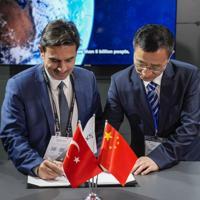
Türksat and China Satcom have agreed to work together on new satellite technologies.
These include ways to connect drones and devices used in energy, farming and shipping.
Satellite links could help monitor equipment in remote places without mobile phone networks.
The companies will share the work from early designs through testing and sales.

Türksat and China Satcom signed an agreement to jointly develop and commercialize satellite technologies.
The agreement was signed at the International Astronautical Congress in Antalya.
Planned projects include drone communications, satellite-based internet of things technologies and smart border security systems.
The companies will work together on development, testing and commercialization, with a joint committee overseeing progress.
The agreement expands a capacity-sharing partnership that began in 2025.
- Who
- Türksat and China Satcom.
- What
- They agreed to jointly develop and commercialize satellite technologies.
- When
- The agreement was signed at the 77th International Astronautical Congress; the article was published on October 10, 2026.
- Where
- At the congress in Antalya, Turkey.
- Why
- To expand cooperation into satellite hardware and software development and commercialize new technologies.
This story does not have two clearly opposing sides.
No direct quotes in the coverage so far.
Türksat and China Satcom began a capacity-sharing partnership.
Decisions reached there expanded cooperation into hardware and software development.
The companies signed an agreement in Antalya to jointly develop and commercialize satellite technologies.
- Signatories
- Selman Demirel, Türksat deputy general manager for satellite services, and Ma Haiquan, China Satcom CEO
- Planned technologies
- Drone communications, satellite-based internet of things and smart border security systems
- Oversight
- A joint steering committee with equal representation from both companies
- Review schedule
- Progress will be reviewed every three months
- Previous cooperation
- Capacity-sharing partnership began in 2025
Sources
Related news

French astronaut Sophie Adenot says space brought a full range of emotions

Margaret Hamilton, whose software helped Apollo astronauts reach the Moon, dies at 90
SpaceX plans to expand Starlink into a major US mobile carrier

NASA releases nearly 800 GB of Artemis II lunar data

Astronomers trace record-distant radio burst to a young galaxy

Camera captures aurora over parts of the Netherlands

Victoria Jaggard Takes on Space Editor Role at The New York Times

New Images Reveal Gas Knots and a Possible Survivor in Supernova Remnant
China’s Guowang network connects Arctic and Antarctic in video call

Webb links the most distant known fast radio burst to a small galaxy
NASA’s Crew-12 Returns to Earth After 237 Days on the Space Station
