Science & Tech · Space · 1 day ago
New Images Reveal Gas Knots and a Possible Survivor in Supernova Remnant

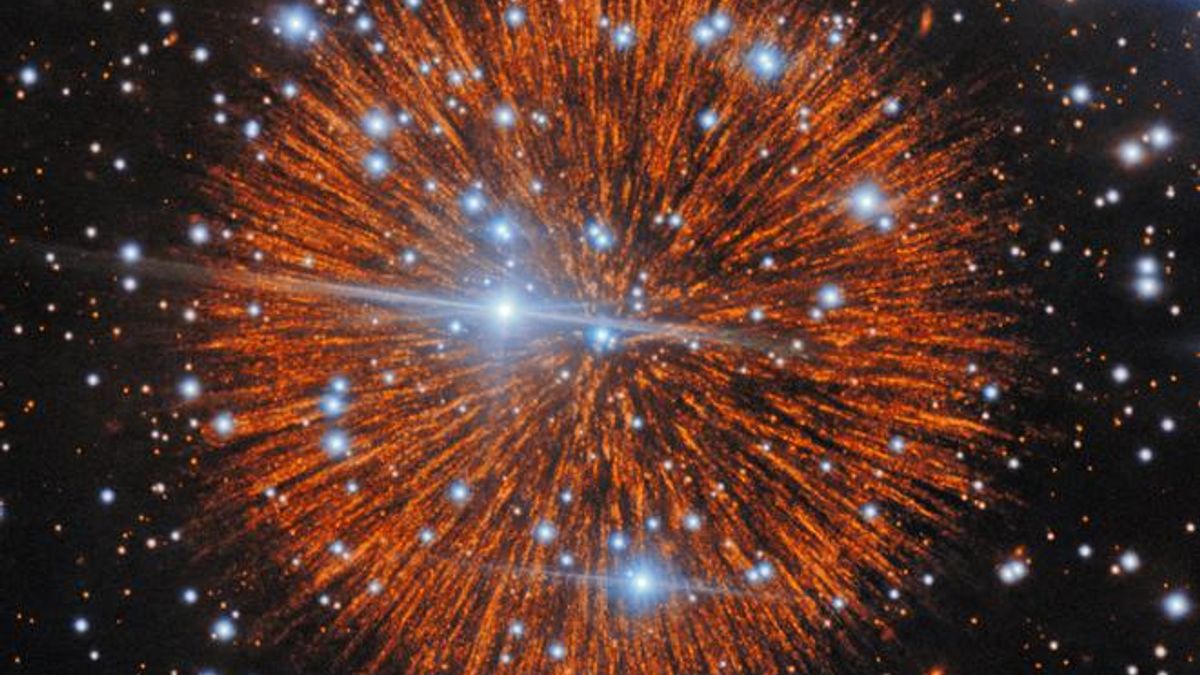
Astronomers have captured the clearest image yet of Pa 30, a nebula about 7,500 light-years from Earth.
They believe it is the remnant of a supernova that people saw in 1181 and recorded in historical accounts.
Observations with the Gemini North telescope in Hawaii revealed about 10 times more detail than earlier images.
The nebula’s streaks are made of gas knots that look like beads on strings, though scientists do not yet know exactly how they formed.
Pa 30 may have resulted from an unusual, relatively low-energy explosion involving two white dwarfs, the dense cores left after stars shed their outer layers.
A white dwarf appears to have survived at the center, earning the name “zombie star.”
Studying the knots and surviving star may help astronomers understand how these rare explosions happen.

Astronomers using the Gemini North telescope have produced the most detailed image yet of Pa 30, a remnant linked to a supernova seen in 1181.
The image reveals gas knots along the remnant’s filaments, with about ten times more structures visible than in earlier images.
Researchers say the explosion may have been a rare Type Iax supernova, which can leave a star behind.
A possible surviving star lies at the center of Pa 30, about 7,500 light-years from Earth.
The findings could help astronomers understand how these explosions occur and how surviving stars form.
- Who
- Astronomers studying Pa 30, including study coauthor Ilaria Caiazzo.
- What
- New observations reveal knots of gas in the remnant and suggest a star may have survived the supernova.
- When
- The supernova was seen in 1181; the new research was published on October 10, 2026.
- Where
- Pa 30 is about 7,500 light-years from Earth. The observations used the Gemini North telescope in Hawaii.
- Why
- Researchers are studying the remnant to understand its unusual gas structures and how a star might survive a supernova.
This story does not have two clearly opposing sides.
The planetary region of our solar system could fit in each knot about 10 times with room to spare.
This proximity makes Pa 30 uniquely valuable for study.
A supernova appeared in the sky and remained visible for months.
Pa 30 was discovered during a citizen science campaign to find planetary nebulae.
Articles reported new Gemini North observations that revealed detailed gas knots in Pa 30.
- Distance from Earth
- About 7,500 light-years
- Supernova year
- 1181
- Telescope
- Gemini North, Hawaii
- Newly resolved structures
- About 10 times more than in previous images
- Diameter of each knot
- About four light-days
Sources
Related news

Victoria Jaggard Takes on Space Editor Role at The New York Times

Margaret Hamilton, whose software helped Apollo astronauts reach the Moon, dies at 90
SpaceX plans to expand Starlink into a major US mobile carrier

NASA releases nearly 800 GB of Artemis II lunar data

Astronomers trace record-distant radio burst to a young galaxy

India-France TRISHNA satellite expected to launch within 12 to 16 months
Camera captures aurora over parts of the Netherlands

NASA posts more than 800GB of Artemis II science data online
Black hole jets may switch on at the same feeding threshold

Apollo 7 launches as the first crewed Apollo mission

French astronaut Sophie Adenot says space brought a full range of emotions