Science & Tech · Space · 5 hrs ago
Study Finds Possible Signs of Antimatter Escaping the Milky Way
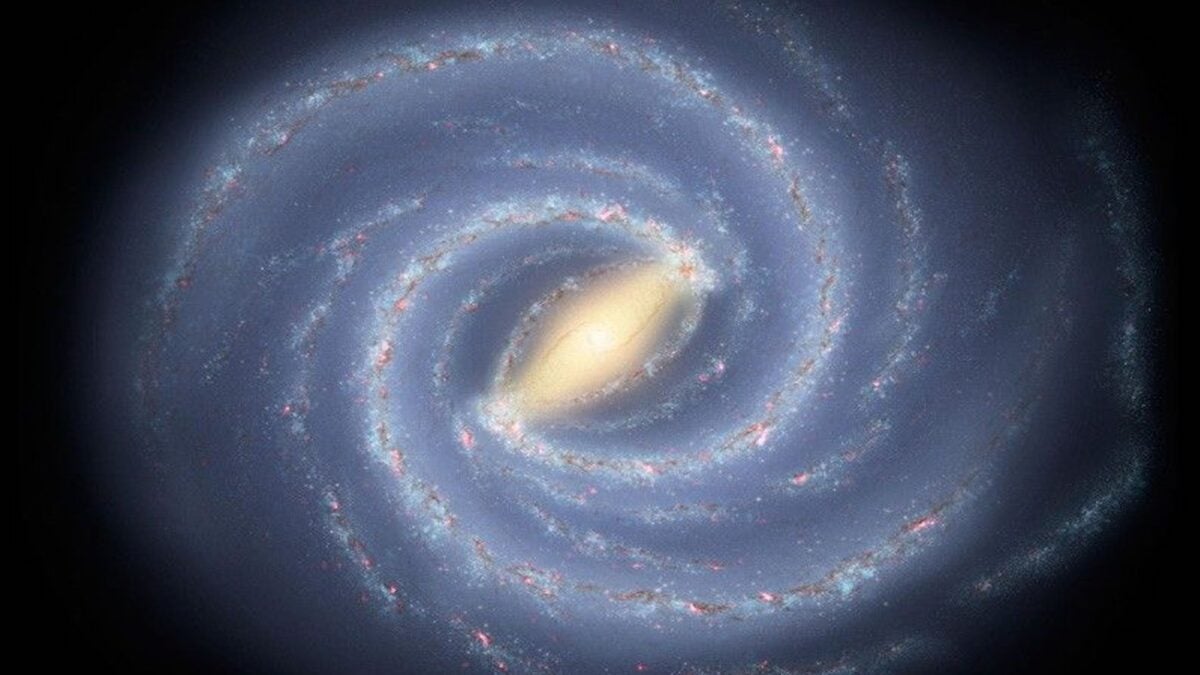
Astronomers have found a possible gamma-ray signal from positrons annihilating with electrons outside the Milky Way.
Positrons are antimatter particles, and when they meet ordinary matter, they can turn into energy.
Researchers used data from the European Space Agency’s INTEGRAL telescope to map a type of gamma ray linked to these collisions.
Most of the mapped signal came from the galaxy’s central regions, but known sources such as black holes and neutron stars do not explain the apparent number of positrons.
The study suggests that positrons may be made inside the Milky Way and then escape before annihilating in intergalactic space.
If so, astronomers may have been undercounting how much antimatter the galaxy produces.
A NASA gamma-ray telescope scheduled for launch in 2027 could help confirm the faint signal and improve estimates.

A study suggests that positrons produced in the Milky Way may escape into intergalactic space and annihilate there.
The researchers say this could explain why known sources do not account for the number of positrons observed in the galaxy.
The team used data from the European Space Agency’s INTEGRAL telescope to map the Milky Way’s 511-kiloelectronvolt gamma-ray emission.
The findings were published in Astronomy & Astrophysics.
Future observations may help test the proposed explanation and refine estimates of the galaxy’s antimatter production.
- Who
- A team of astronomers studied the gamma-ray signals.
- What
- The study suggests positrons may escape the Milky Way and annihilate outside it.
- When
- The findings were published in Astronomy & Astrophysics; the publication date is not stated.
- Where
- The Milky Way and intergalactic space.
- Why
- The proposed escape could explain why known sources do not account for the observed number of positrons.
This story does not have two clearly opposing sides.
Researchers used INTEGRAL telescope data to map the Milky Way’s 511 keV emission.
The findings were published in Astronomy & Astrophysics.
NASA’s Compton Spectrometer and Imager is scheduled for launch and could help confirm the signals.
- Data source
- European Space Agency’s INTEGRAL telescope
- Emission energy
- 511 kiloelectronvolts
- Publication
- Astronomy & Astrophysics
- Planned telescope launch
- 2027
- Proposed process
- Positrons may escape the Milky Way and annihilate in intergalactic space
Sources
Related news

Perseverance sets Mars driving record at 28.10 miles

SpaceX set to send solar arrays and supplies to the space station

Lockheed Martin unveils next-generation Patriot interceptor for advanced threats

China’s 16th Airshow to run in Zhuhai from December 7 to 13
China air show to feature more than 3,000 exhibits

All nine Nuriho rideshare satellites establish contact

Valkyrie combat drone completes first flight test in Europe

French astronaut Sophie Adenot says space brought a full range of emotions

NASA releases nearly 800 GB of Artemis II lunar data
Anduril develops modular interceptor missile family for US air defenses

SpaceX plans to launch 27 Starlink satellites from California