Science & Tech · Space · 3 days ago
New model explains how a long cloud forms over Mars’ Arsia Mons
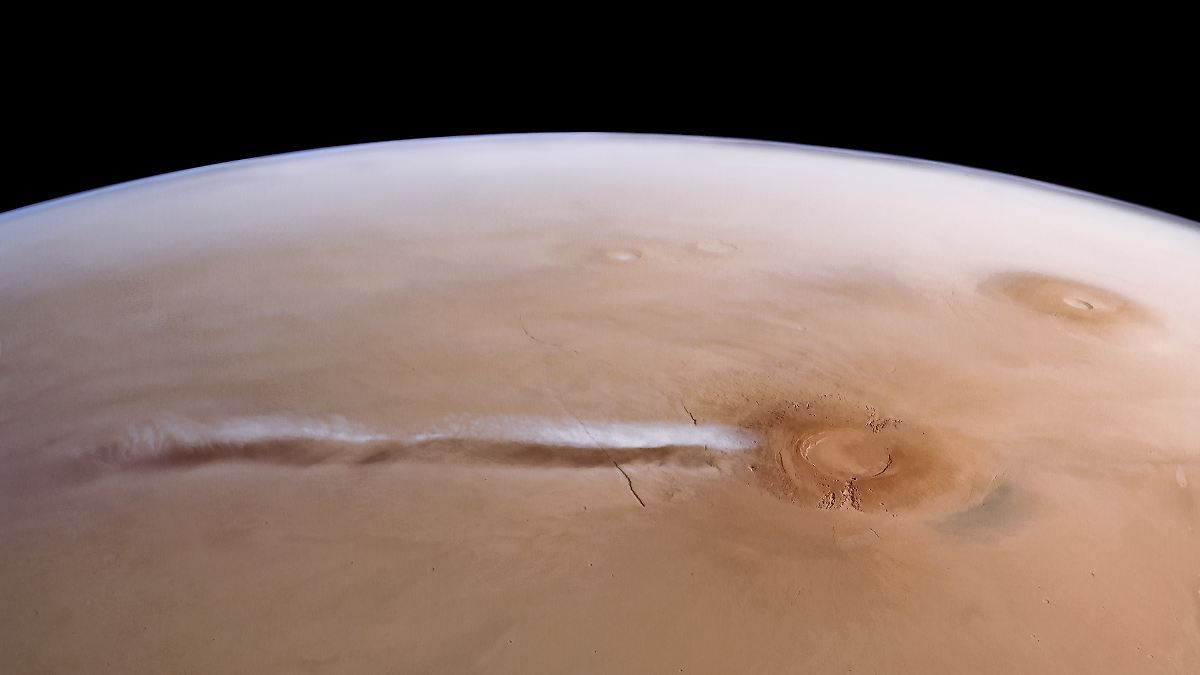
A long, tube-shaped water-ice cloud forms near Arsia Mons, a giant volcano on Mars, during southern spring and summer.
It appears in the morning, can stretch about 1,800 kilometers, and fades by midday.
Mars Express observations showed that the cloud returns regularly, but earlier weather models could not explain it.
On Earth, water vapor usually needs tiny particles such as dust or salt to form cloud droplets or ice crystals.
The researchers found that their model produced the Martian cloud when it allowed water vapor to form ice without those particles, a process called homogeneous nucleation.
They say the volcano’s shape, Mars’ thin atmosphere and the movement of moist air may create the extreme conditions needed.
The findings offer an explanation for the cloud, though the available accounts do not describe any further steps planned by the researchers.

A new model explains how the Arsia Mons Elongated Cloud forms over a giant Martian volcano.
The model suggests water vapor can form ice crystals without dust or other particles to seed condensation.
Researchers say unusual conditions around Arsia Mons and Mars’ thin atmosphere may allow this process.
The cloud appears during spring and summer in Mars’ Southern Hemisphere and can stretch about 1,800 kilometers.
Earlier meteorological models failed to reproduce the elongated cloud.
- Who
- A research team led by Jorge Hernández-Bernal.
- What
- The team modeled how the Arsia Mons Elongated Cloud forms, proposing that water vapor can freeze into cloud particles without condensation nuclei.
- When
- It appears each morning during spring and summer in Mars’ Southern Hemisphere, then fades by midday.
- Where
- Over Arsia Mons, a volcano on Mars.
- Why
- Unusual conditions may drive humidity high enough for water vapor to form ice crystals without dust or other particles.
This story does not have two clearly opposing sides.
To create the AMEC in our [modeling], we found that we needed to include some exotic physics… physics that, while included in textbooks, is treated as theoretical and usually thought not to happen in nature. It certainly hasn’t been seen in action before,
Once we included this physics in our simulations, the AMEC emerged just as we hoped.
For the AMEC, it seems that cloud formation takes place without needing any of this ‘stuff,’
Water [vapor] turns directly into icy cloud particles without any middle step.
The cloud was first spotted in images from the first Mars probes, according to n-tv.
The European Space Agency’s Mars Express reached Mars.
Mars Express spotted a massive water-ice cloud near Arsia Mons, according to Discover.
Researchers published a model in Nature Geoscience that reproduced the cloud using condensation without nuclei.
- Cloud length
- About 1,800 kilometers
- Location
- Arsia Mons, Mars
- Volcano height
- About 20 kilometers, according to n-tv
- Cloud season
- Spring and summer in Mars’ Southern Hemisphere
- Model process
- Water vapor forms ice particles without condensation nuclei
- Study journal
- Nature Geoscience
Sources
Related news

Margaret Hamilton, whose software helped Apollo astronauts reach the Moon, dies at 90
SpaceX plans to expand Starlink into a major US mobile carrier
NASA releases nearly 800 GB of Artemis II lunar data

Astronomers trace record-distant radio burst to a young galaxy

Victoria Jaggard Takes on Space Editor Role at The New York Times
Camera captures aurora over parts of the Netherlands

New Images Reveal Gas Knots and a Possible Survivor in Supernova Remnant

French astronaut Sophie Adenot says space brought a full range of emotions

India-France TRISHNA satellite expected to launch within 12 to 16 months

China’s Guowang network connects Arctic and Antarctic in video call

SpaceX Buys Spectrum to Expand Starlink Into U.S. Mobile Service