

Science & Tech · Space · 18 hrs ago
Astronomers Find Possible Planet Formed Around a Dying Star
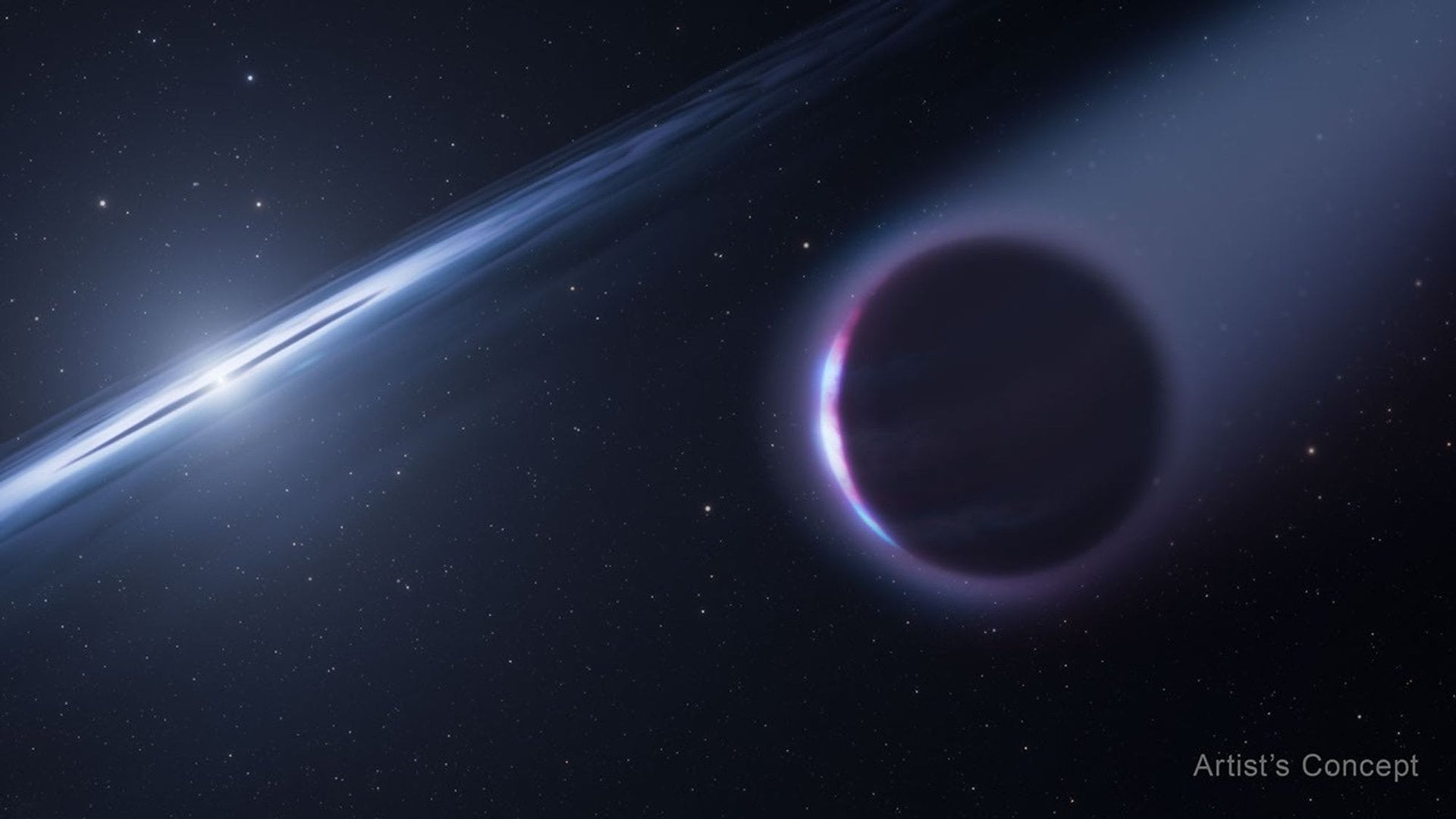
Astronomers have found evidence for a possible Jupiter-like planet around a white dwarf named HS 0209+0832.
The system is about 270 light-years from Earth, in the constellation Cetus.
A white dwarf is the remnant left after a star like the Sun has used up its fuel and shed material.
The team thinks the planet may have formed from that debris, rather than alongside the star when it was young.
Their main clue is an unusually high amount of niobium, a rare element, in the white dwarf’s atmosphere.
Data from space telescopes also indicate that the candidate planet orbits the white dwarf every 4.4 days.
If confirmed, it would be the first known example of a planet forming after its star’s main lifetime, showing that dying stars can create new worlds.
The researchers say more observations of hot white dwarfs with Hubble could reveal other candidates.

Astronomers report a possible Jupiter-like planet that may have formed from debris cast off by a dying white dwarf.
The white dwarf, HS 0209+0832, shows unusually high levels of niobium, which the research team says may indicate material from a second-generation planet.
The candidate planet is thought to orbit the white dwarf every 4.4 days.
The finding is based on archival observations from Hubble, FUSE and TESS.
The team says the result could show that planets can form after a star leaves its hydrogen-burning main sequence.
- Who
- A University of Warwick-led team, including lead author Jamie Williams.
- What
- Astronomers reported a possible second-generation Jupiter-like planet around a white dwarf.
- When
- The report was published on 2026-10-11. The observations used 25-year-old Hubble data.
- Where
- Around the white dwarf HS 0209+0832, about 270 light years away in the constellation Cetus.
- Why
- The team says unusually high niobium levels in the white dwarf’s atmosphere may indicate that it is accreting debris from a newly formed planet.
This story does not have two clearly opposing sides.
We now know that elements like niobium can be used as signatures of accretion from second generation planets
Niobium and other elements heavier than iron are not formed in the cores of stars by thermonuclear fusion
A new disc of material formed from debris cast off by the dying star, and the possible planet may have condensed from it.
Hubble collected data that the team later reanalyzed.
Universe Today reported the team’s possible detection of a second-generation planet around HS 0209+0832.
- White dwarf
- HS 0209+0832
- Candidate planet orbit
- 4.4 days
- Distance
- About 270 light years
- Location
- Constellation Cetus
- Niobium level
- More than 1,000 times the level in the Sun
- Observatories and mission
- Hubble, FUSE and TESS
Sources
Related news

Victoria Jaggard Takes on Space Editor Role at The New York Times

Margaret Hamilton, whose software helped Apollo astronauts reach the Moon, dies at 90

SpaceX plans to expand Starlink into a major US mobile carrier

NASA releases nearly 800 GB of Artemis II lunar data

Astronomers trace record-distant radio burst to a young galaxy

India-France TRISHNA satellite expected to launch within 12 to 16 months
Camera captures aurora over parts of the Netherlands

NASA posts more than 800GB of Artemis II science data online
Black hole jets may switch on at the same feeding threshold

New Images Reveal Gas Knots and a Possible Survivor in Supernova Remnant

Apollo 7 launches as the first crewed Apollo mission
