

2 days ago
Rising Crude and Metal Prices Threaten Corporate Margins Despite Resilience
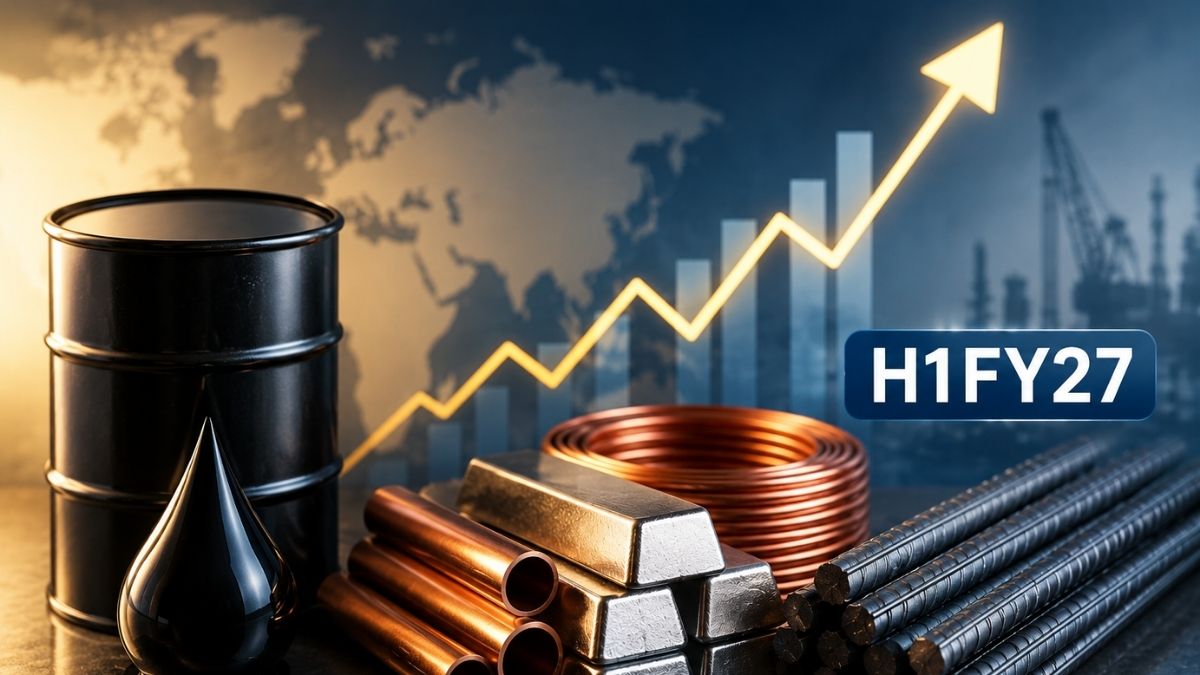
Oil and metal prices have become more expensive.
This can make it costlier for companies to produce goods.
Companies may have to accept lower profits or raise prices for customers.
Brent crude rose above $90 per barrel in August.
JM Financial said this could hurt corporate margins during the first half of FY27.
India’s economy still showed strength in areas such as vehicle sales, bank lending and digital payments.
The housing market was weaker, with fewer sales and new projects.
However, unsold homes declined and housing prices continued to rise.

Brent crude rose above $90 per barrel in August after averaging about $83 in July.
JM Financial warned that higher crude and metal prices could pressure corporate margins in H1FY27.
Aluminium, copper and petcoke prices increased sharply year-on-year, raising input costs.
India’s July economic indicators remained resilient, with strong vehicle sales, credit growth and digital payments.
Housing sales and launches declined, although lower unsold inventory and higher prices supported the real estate market.
- Who
- JM Financial and companies operating in India are central to the assessment.
- What
- Rising crude oil, metal and petcoke prices may pressure corporate margins, despite resilient domestic economic indicators.
- Where
- India, with Brent crude prices affected by renewed tensions between the United States and Iran.
- When
- The risks are expected to be important in the first half of FY27; crude crossed $90 per barrel in August, after averaging about $83 in July.
- Why
- Higher energy and raw-material costs could reduce profitability or force companies to raise prices, potentially weakening demand.
Cost Pressures and Margin Risks
Domestic Economic Resilience
Corporate profitability
Cost Pressures and Margin Risks
JM Financial said renewed crude pressure and elevated input costs could hurt margins, particularly for companies with limited pricing power.
Domestic Economic Resilience
Companies may be supported by resilient domestic demand indicators, including strong vehicle sales and financial activity.
Inflation and consumer demand
Cost Pressures and Margin Risks
Higher energy and raw-material costs could push inflation higher and force companies to raise prices, potentially weakening demand.
Domestic Economic Resilience
July economic activity remained strong, with higher bank credit, deposits, UPI transaction value and mutual-fund assets.
Real estate conditions
Cost Pressures and Margin Risks
Lower housing sales and new launches indicate that housing demand remains soft.
Domestic Economic Resilience
A 5.1% decline in unsold inventory and a 6.6% rise in residential prices suggest improving inventory absorption and continued price support.
Key facts
- Brent crude
- Averaged about $83 per barrel in July and crossed $90 per barrel in August.
- Consumer inflation
- Headline CPI inflation rose to 4.5% in July, while food inflation increased to 2.09% from 1.71%.
- Metal prices
- Aluminium prices rose 36.1% year-on-year and copper prices increased 40.1%.
- Petcoke prices
- Domestic prices rose 31.4% year-on-year and international prices increased 31.8%.
- Bank credit
- System credit growth accelerated to 19.3% year-on-year in July from 18.6% in June.
- Vehicle demand
- Passenger vehicle sales rose 30%, two-wheeler sales 29.1% and commercial vehicle sales 31.4% year-on-year.
- Housing market
- Pan-India housing sales declined 7% and new launches fell 17%, while unsold inventory declined 5.1%.
Quotes
JM Financial
Financial research firm cited in the article for its assessment of economic and corporate-margin risks
“Net-net, the domestic economy remains resilient, but renewed crude pressure and elevated input costs have re-emerged as key risks to inflation and corporate margins in H1FY27E.”
 financialexpress.com
Sources
Related news

India's corporate sales rise 24% in Q1 FY27

India Inc Growth Seen Slowing as Q2 FY27 Margins Tighten

Markets Open Flat as Crude Nears $90, Inflation in Focus

India’s Strong Growth Fails to Lift Stocks Amid Crude Surge

Indian Markets Open Higher Despite Elevated Crude Oil Prices

Nifty 50 profit growth hits 10-quarter high, lifting FY27 outlook

Iranian Officer Cites Milk Costs as Economy Worsens

UPSC Key Covers SCO, Electoral Rolls, Economy, Defence and Climate

Iran’s Proxy Network Weakens, But Its Wars Persist

Europe's Bond Selloff Deepens as Middle East Tensions Lift Oil

China's SCO Power Grab Shapes Global Alliances and Trade
