

1 week ago
How Artificial Intelligence Is Redefining Executive Education for Professionals

Artificial intelligence is changing how adults learn for their jobs.
Professionals now need to update their knowledge more often because workplaces are changing quickly.
Schools should not only teach about AI as a separate subject.
They can also use AI to personalise lessons, suggest useful materials and give feedback.
AI tools can help learners practise ideas and explore business situations.
However, AI cannot replace teachers, mentors or conversations with other professionals.
People still need to think carefully, make ethical choices and take responsibility for decisions.
The best executive education will combine smart technology with human experience and leadership skills.

AI is changing why professionals pursue executive education as workplace knowledge becomes outdated more quickly.
Institutions are being urged to integrate AI into learning, practice, feedback and personalised study journeys.
AI tools can identify knowledge gaps, recommend content, clarify concepts and simulate business situations.
Faculty expertise, peer discussion, mentorship, reflection and debate remain essential to meaningful executive learning.
Successful programmes will combine AI capabilities with human skills such as judgement, ethics, communication and leadership.
- Who
- Working professionals and the institutions providing executive education.
- What
- Executive education is being reshaped by AI, both as a subject of study and as a learning tool.
- Where
- Across executive education programmes and industries including finance, healthcare, marketing and technology.
- When
- The shift is occurring now and is expected to continue as workplaces become more AI-driven.
- Why
- Professionals need to keep their knowledge relevant while learning to work and make decisions alongside intelligent technologies.
Thoughtful AI Integration
Technology-Led Expansion
How AI should be used
Thoughtful AI Integration
AI should be applied selectively to improve relevance, engagement, accessibility and practical learning rather than used simply because it is new.
Technology-Led Expansion
AI can expand learning beyond lectures and static materials through personalised content, instant feedback, simulations and continuous knowledge support.
Role of educators
Thoughtful AI Integration
Faculty, mentors and peers remain essential because leadership requires interpretation, reflection, debate, human context and accountability.
Technology-Led Expansion
AI can provide information, suggest options and support practice at scale, potentially making learning more flexible and responsive for working professionals.
Key facts
- Main shift
- Executive education is moving from qualification-focused learning toward continuous knowledge and skills development.
- AI’s learning role
- AI can identify knowledge gaps, recommend content, provide feedback and adapt learning journeys.
- Generative AI uses
- Professionals can use generative AI to clarify concepts, test ideas and simulate business situations.
- Human contribution
- Faculty expertise, peer discussion, mentorship, debate and real-world experience remain central.
- Skills that remain essential
- Critical thinking, ethical judgement, communication, leadership, reflection and accountability.
- Institutional priority
- Institutions should use AI where it improves understanding, engagement, accessibility and workplace application.
Sources
Related news
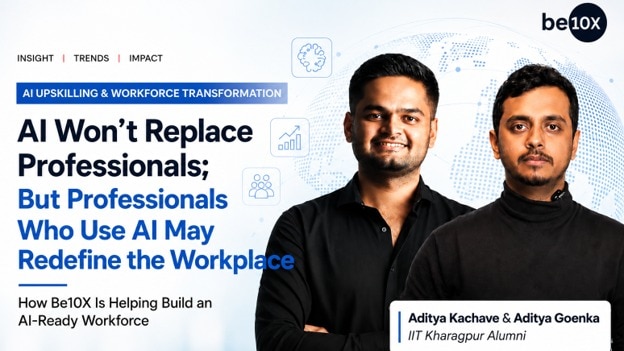
Be10X Builds AI-Ready Workforce as Professionals Learn to Use AI

AI Reshapes Management Education as Critical Judgment Remains Essential

How Workday Uses AI to Personalize Corporate Learning

AI Reshapes Entry-Level Work; Business Schools Struggle to Keep Up

Future Managers Need AI, Analytics and Human Skills, Says Expert
Chalkboards, AI Professors, and the Future of Human Teaching

India’s Insolvency Framework Faces New Questions From AI Transactions

AI, Networking Debate Intensifies Over Future of Tech Careers

Bessent Says AI Could Fuel U.S. Startup Boom

Readers Debate AI Content Rights and National Identity
