3 weeks ago
States' Fiscal Burden to Quadruple Under VB G RAM G

India has a programme that promises to give work to people who live in villages.
The old programme was called MGNREGA, and a new one called VB G RAM G is replacing it.
Under the new programme, state governments will have to pay about four times more money than before.
At the same time, the number of workdays given to villagers has fallen to its lowest level in twelve years.
The new programme promises 125 days of work, which is more than the 100 days promised earlier.
But even the old programme gave workers only about 43 days of work each year, and fewer than 4% of workers ever got all 100 days.
The wages on offer are also lower than what people can earn in other jobs.
This year the monsoon may bring less rain, which can make life harder for farmers.
Many experts worry that the new programme may not help village families enough when they need it most.

State governments' spending under the new VB G RAM G rural employment scheme is projected to rise nearly four-fold to Rs 35,300 crore in FY27, from Rs 8,690 crore under MGNREGA last year.
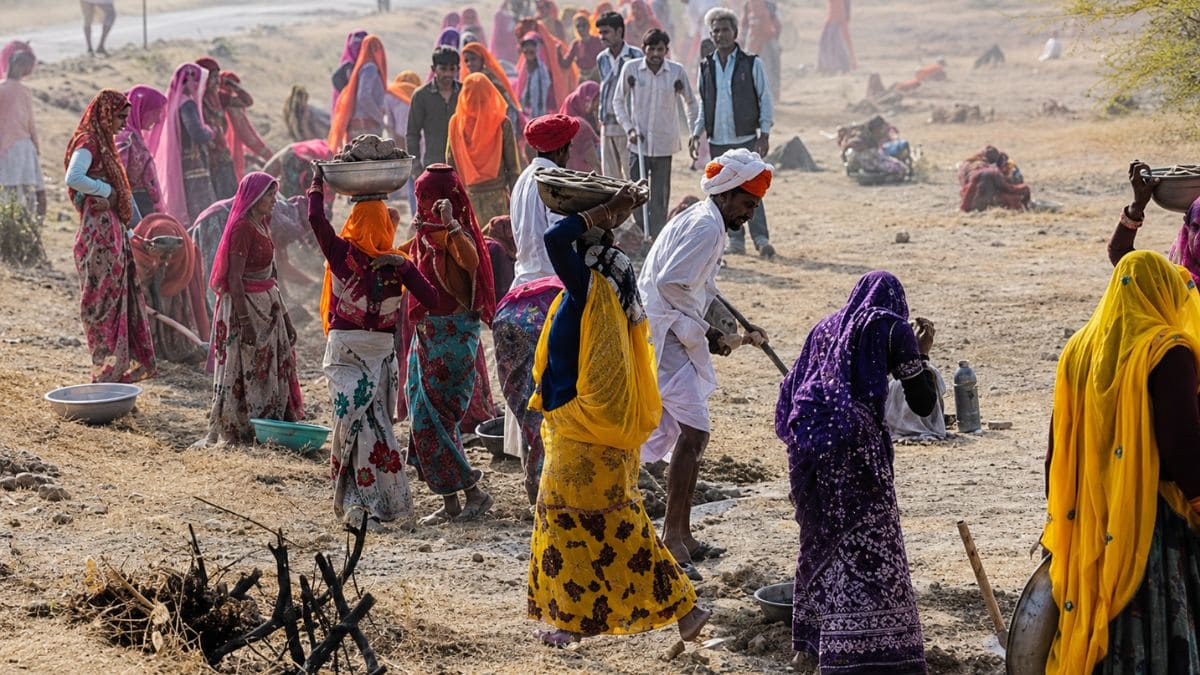
Rural employment is at its lowest level in 12 years, with 622.6 million person-days generated in Q1 of FY27, almost 40% lower than a year earlier and about 32% lower on a 12-month average basis.
The scheme raises guaranteed employment from 100 to 125 days, but MGNREGA workers received only 43 days on average a year and just about 4% completed 100 days.
MGNREGA wages are estimated to be 20-25% below prevailing rural wages, while the notified VB G RAM G wage of about Rs 327 a day is lower than the average rural wage of Rs 454 in June.
Dhananjay Sinha of Systematix Group attributes the decline to structural factors including fiscal consolidation, lower relative wages and stricter digital compliance requirements under the new scheme.
- Who
- Dhananjay Sinha, CEO and Co-Head of Institutional Equities at Systematix Group, whose analysis drives the findings; India's central and state governments; and rural workers who depend on the employment guarantee.
- What
- The transition from MGNREGA to the new VB G RAM G rural employment scheme, which is expected to nearly quadruple states' fiscal burden to Rs 35,300 crore in FY27 even as rural employment falls to a 12-year low.
- Where
- India, with the sharpest expected increases in state allocations in West Bengal, Uttar Pradesh, Punjab and Karnataka.
- When
- Fiscal year 2027 (FY27), with VB G RAM G rolled out in July and data covering the first quarter of FY27.
- Why
- Structural factors including fiscal consolidation, MGNREGA wages about 20-25% below market rates, and a more centralised, budget-driven scheme that shifts 40% of costs to states.
Government Position
Analysts' and State Governments' Concerns
MGNREGA arrears before the transition
Government Position
The central government claims that dues under MGNREGA have been cleared before the rollout of the new scheme.
Analysts' and State Governments' Concerns
Several state governments say arrears have not been settled and have expressed discomfort and dissatisfaction, with media reports backing their claims.
Will VB G RAM G generate more rural employment?
Government Position
The new scheme increases guaranteed employment from 100 to 125 days, suggesting a 25% rise in the work guarantee.
Analysts' and State Governments' Concerns
Analysts say VB G RAM G is budget-driven rather than demand-driven, and stricter digital compliance could make actual person-days similar to or lower than MGNREGA's 43-day average.
Uniform 40% state cost-sharing
Government Position
The new framework assigns states a uniform 40% share of costs, barring northeastern and hilly states, under a centralised, allocation-driven design.
Analysts' and State Governments' Concerns
Analysts argue the uniform share ignores states' differing fiscal capacities, overburdening weaker states and widening regional disparities in rural employment.
Key facts
- Projected state spend under VB G RAM G (FY27)
- Rs 35,300 crore, nearly four times the Rs 8,690 crore spent under MGNREGA last year
- State cost share
- 40% under VB G RAM G versus 10% earlier
- Person-days in Q1 FY27
- 622.6 million, nearly 40% lower year-on-year; lowest in 12 years
- Guaranteed work days
- 125 days under VB G RAM G versus 100 under MGNREGA
- Actual work under MGNREGA
- Average 43 days a year; only about 4% of workers completed 100 days
- Wages
- Notified VB G RAM G wage about Rs 327 a day, roughly 10% higher than MGNREGA but below the June average rural wage of Rs 454
- FY27 funds
- Overall allocation about Rs 95,000 crore, including about Rs 30,000 crore for MGNREGA; about Rs 18,300 crore spent
- Rollout
- VB G RAM G rolled out in July (FY27)
Quotes
Dhananjay Sinha
CEO and Co‑Head, Institutional Equities, Systematix Group
“The new scheme is more budget-driven and therefore constrained by the allocation made at the top.”
 deccanchronicle.com
Sources

Related news
VB-G RAM G sees nearly 50% drop in rural jobs
New rural jobs law sees nearly 50% employment dip

VB-GRAM G Changes India’s Rural Job Guarantee Scheme
Opposition States Riled by 60:40 Rural Jobs Funding Change

India’s Rural Employment Guarantee Scheme Shows Signs of Weakening
Karnataka Drought Villages to Get Jobs Under VBG-RAM-GI

EPFO Identifies PF Trusts Eligible for Amnesty Scheme 2026

Delhi Police Bust Interstate Arms Racket, Arrest Two

70-Year-Old Man Murdered in Etawah Cattle Shed
Banke Bihari Temple to Livestream Rare Janmashtami Mangala Aarti

Muslim Artisans Sustain Mathura’s Unique Janmashtami Craft Tradition