0 months ago
Ukrainian Astronomers Report More Than 20 UFOs Near the Moon
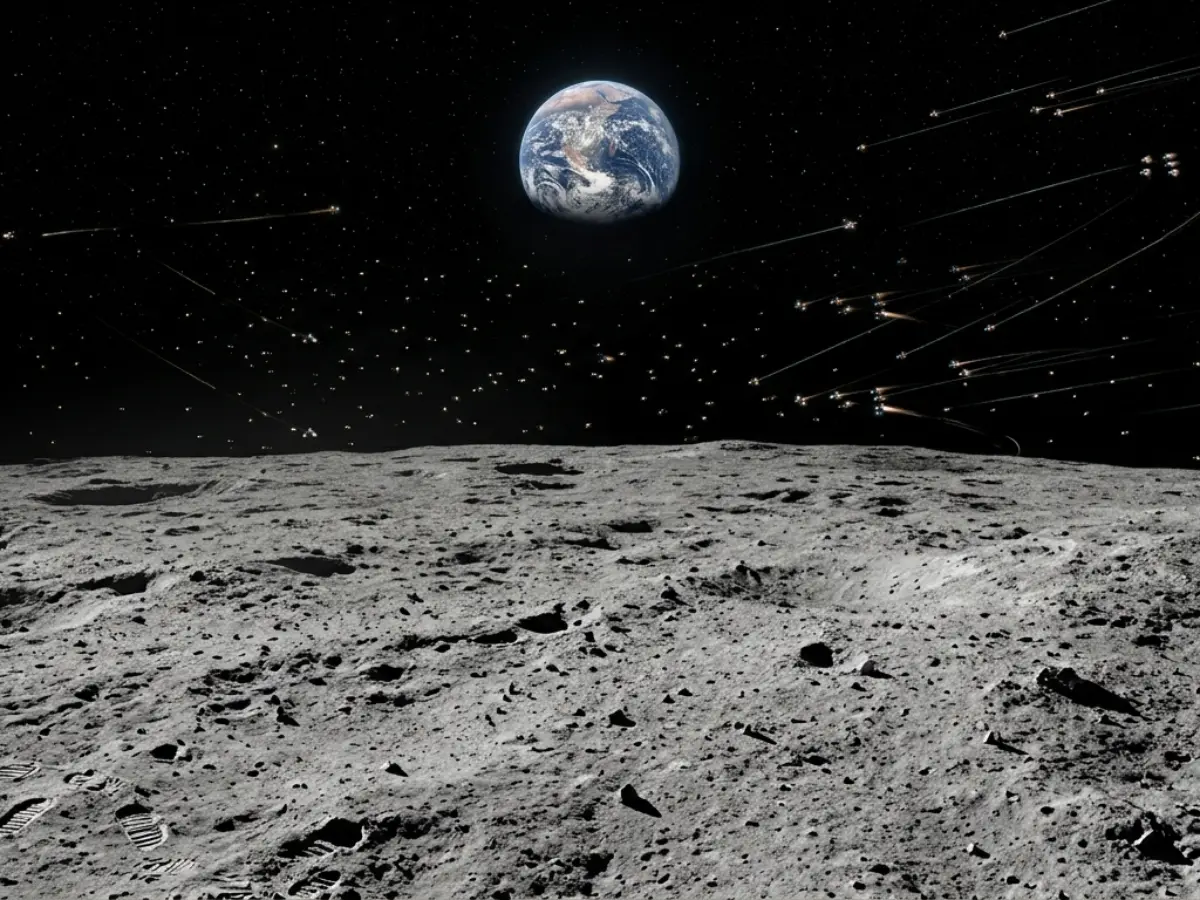
Scientists in Ukraine used a very fast camera to take pictures of the Moon and say they saw more than 20 strange dots moving near it.
Some of the dots looked like discs and were very big, maybe even 40 kilometers wide.
Some of them blinked in patterns, and two blinked at the same time even though they were far apart.
A few of the dots spun around, completing a full turn every three minutes.
The scientists think these dots could be machines or spacecraft that use the Moon as a base.
They even wonder if the objects could be making their own gravity.
But other scientists are not so sure.
They say the dots could just be things like satellites, camera glitches, or noise in the air.
The study has not been checked by other scientists yet.
So for now, nobody knows for sure what these strange dots really are.

Researchers at Ukraine's Main Astronomical Observatory reported detecting more than 20 unidentified aerial objects moving near and across the Moon during telescope sessions in 2025.
The objects were captured by a high-speed camera shooting 20 frames per second on a telescope in Vinarivka, in Ukraine's Kyiv region.
The team classified sightings as 'atmospheric' objects, which appeared stationary relative to the Moon, and 'continental' objects, which appeared to travel across the lunar surface.
Researchers calculated that some objects moved at 11 km/s (39,600 km/hr), measured up to roughly 40 km across, rotated every three minutes, and may use the Moon as a base.
The study has not been peer-reviewed or independently verified, and other scientists say the specks are likely optical artefacts, Earth-orbiting satellites, or atmospheric noise.
The study has not been peer-reviewed or independently verified, and other scientists say the specks are likely optical artefacts, Earth-orbiting satellites, or atmospheric noise.
- Who
- Researchers at Ukraine's Main Astronomical Observatory, including Boris Zhilyaev and his team.
- What
- Detected more than 20 unidentified aerial objects (UFOs) moving near and across the Moon in 2025.
- Where
- Vinarivka, in Ukraine's Kyiv region, where the telescope observations were carried out.
- When
- 2025, including observation sessions on August 16 and September 7, 2025.
- Why
- The objects remain unidentified; the researchers suggest they may show structured or technological behaviour and that the Moon could serve as a base for them.
Researchers' Interpretation
Scientific Skepticism
Nature of the objects
Researchers' Interpretation
The team suggests the objects' unusual movement, rotation, and synchronised flashing may indicate structured or technological behaviour, possibly alien spacecraft using the Moon as a base.
Scientific Skepticism
Other scientists argue that without multi-telescope distance measurements, the specks are far more likely to be optical artefacts, satellites in Earth orbit, or atmospheric noise.
Size and speed estimates
Researchers' Interpretation
Researchers calculated the objects could move at 39,600 km/hr, span up to roughly 40 km, and rotate every three minutes based on their own model.
Scientific Skepticism
Critics say these figures rest entirely on the team's unverified model, since the objects appeared as only tiny specks a few pixels across from Earth.
Credibility of the study
Researchers' Interpretation
The findings have attracted global attention and renewed public debate about whether humanity is alone in the universe.
Scientific Skepticism
The study has not been peer-reviewed or independently verified, and NASA and other space agencies say there is no verified evidence linking aerial phenomena to extraterrestrial technology.
Key facts
- Research institution
- Main Astronomical Observatory, Ukraine
- Objects detected
- More than 20
- Observation site
- Vinarivka, Kyiv region, Ukraine
- Camera speed
- 20 frames per second
- Reported speed
- 11 km/s (39,600 km/hr)
- Estimated size
- 15-25 miles across (about 40 km); ring-shaped objects 22-36 km across
- Flash duration
- 0.1 to 0.5 seconds
- Status
- Not peer-reviewed; not independently verified
Sources

Related news

SpaceX Falcon 9 Upper Stage Likely Crashes Into the Moon
NASA Orbiter Reveals 60-Foot Crater From SpaceX Rocket Impact

NASA Finds Earth Microbes Could Survive Near Moon’s South Pole

Mysterious Orb Over Middle East in Newly Released UFO Video
Stray SpaceX rocket believed to have slammed into Moon

Russia Vows Civil Aviation Safety Amid Ukraine Drone Warning

Germany Blames Russia for Leipzig Drone Attack, Europe Vows Response
Russian Strikes Cut Odesa Power as Kyiv Attacks Continue

Jaishankar to Visit Ukraine and Poland Amid Black Sea Tensions

Musk Reportedly Opposes Ukraine’s Starlink Drone Operations Inside Russia