

1 hr ago
NASA Curiosity Captures Martian Dawn Near Mount Sharp
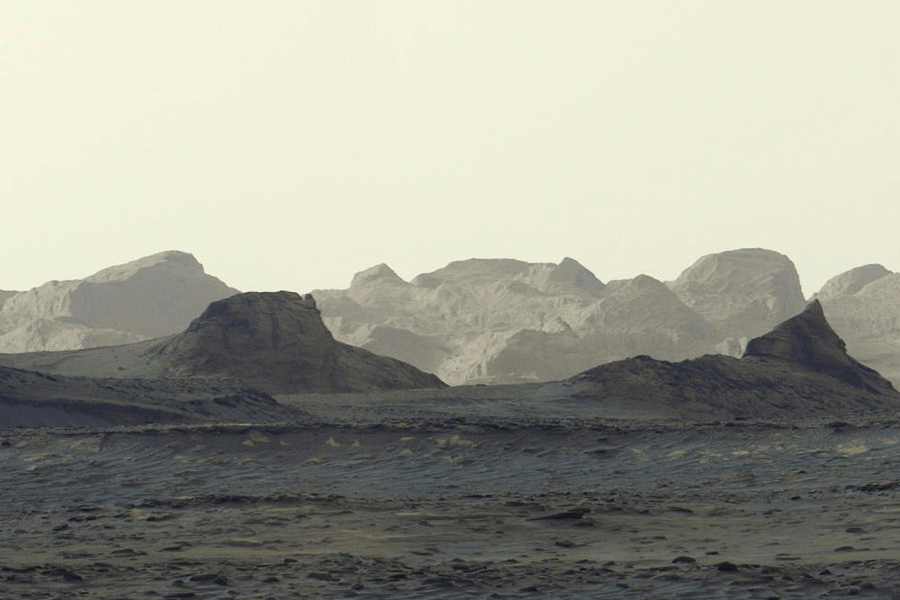
NASA shared a picture of sunrise on Mars taken by its Curiosity rover.
The image shows rough, jagged rocks on Mount Sharp.
Scientists call the ridges yardangs, and think wind made them by wearing down rock over a very long time.
The rock may have started as sand or ash that blew into the crater.
The layer probably formed about three billion years ago.
Curiosity has been climbing Mount Sharp since 2014 and has gained more than half a mile in height.
NASA hopes the rover will reach the yardangs in 2027 or 2028.
Curiosity will then study the rocks with its instruments.
The rover also investigates whether Mars once had conditions that could support tiny forms of life.

NASA released a Curiosity rover image taken about an hour after sunrise on Mars.
The image shows distant jagged ridges known as yardangs on Mount Sharp.
Scientists think the rock layer formed from windblown sediment, possibly sand or volcanic ash, later shaped by wind.
The yardang layer likely formed about 3 billion years ago and spans roughly 10 miles across Mount Sharp’s northwest.
NASA hopes Curiosity will reach the layer in 2027 or 2028; the rover has climbed more than 0.6 miles in elevation.
- Who
- NASA and its Curiosity rover; planetary scientist Ashwin Vasavada described the rock formations.
- What
- Curiosity captured a dawn image showing jagged yardang formations and a distinct rock layer.
- Where
- Mount Sharp in Gale Crater on Mars.
- When
- The photograph was taken about an hour after sunrise; NASA hopes Curiosity will reach the layer in 2027 or 2028.
- Why
- The image documents the landscape Curiosity is exploring; scientists plan to study the rock layer to learn about Mars's geological past.
Possible origins of the rock layer
Scientific interpretation
Material that formed the layer
Possible origins of the rock layer
The sediment may have been windblown sand.
Scientific interpretation
It may instead have been ash blown into Gale Crater by nearby volcanic activity; the articles describe both as possibilities.
How the layer relates to Mount Sharp
Possible origins of the rock layer
Mount Sharp consists of a continuous stack of geological layers recording the planet's past.
Scientific interpretation
Vasavada says the yardang layer does not appear to be part of that continuous stack; it was added later above an unconformity.
Key facts
- Rover
- Curiosity, a six-wheeled NASA rover
- Landing
- Curiosity landed in Gale Crater in 2012.
- Mount Sharp ascent
- The rover has climbed more than 0.6 miles (1 km) in elevation.
- Yardang layer age
- Estimated at about 3 billion years old.
- Layer span
- About 10 miles (16 km) across the northwestern reaches of Mount Sharp.
- Expected arrival
- NASA hopes Curiosity will reach the layer in 2027 or 2028.
- Image camera
- Mastcam
Quotes
Ashwin Vasavada
NASA planetary scientist and Curiosity project scientist
“The bright craggy peaks in the distance are a rock layer that is quite different in appearance from all the layers the rover has driven through so far. We think it once was wind-blown sediment, maybe sand or maybe even ash that blew into the crater from nearby volcanic activity. After the sediment hardened into rock, eons of wind carved up the rock layer into ridges called yardangs.”
 republicworld.com
 telegraphindia.com
“However, the yardang layer doesn't appear to be part of the continuous stack of layers that make up the layer-cake of Mount Sharp. It was added on a little later. It's above what geologists call an unconformity: a gap in time where previous layers eroded down before new layers were deposited on top.”
telegraphindia.com
Sources
Related news
NASA Finds Broad, Shallow Pits During Curiosity’s Mars Traverse
Rare Moon Crater Discovered in NASA Scan After 2024 Impact
Earth and Mars Formed Differently Despite Sharing Solar System Origins

Massive Uttarakhand Landslide Caught on Camera Amid Unsettled Weather

Indian Team Summits 20 Unclimbed Ladakh Peaks in 23 Days
Fresh Snow Covers Manali Peaks As Morning Sun Returns
Curiosity Rover Discovers Vast Honeycomb Landscape on Mars

Curiosity Entertainment Expands Leadership with New Execs
NASA Loses Contact With MAVEN Mars Orbiter
