1 hr ago
Supreme Court Signals No Criminal Case Over Unsing Vande Mataram

The Supreme Court is considering whether people must sing every part of Vande Mataram.
A new law gives the song protections similar to those for the national anthem.
Breaking the law could lead to prison, a fine or both in some situations.
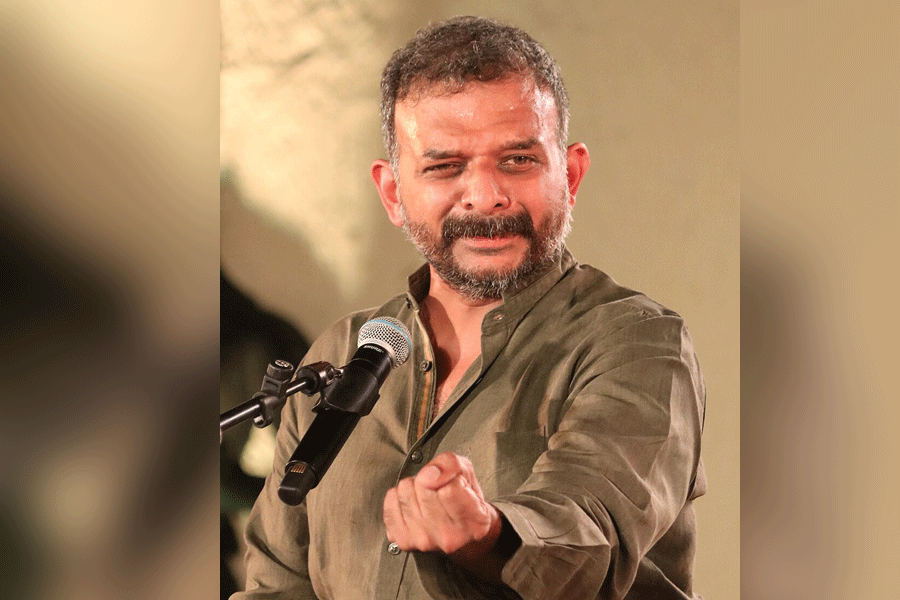
Singer T.M. Krishna says some of the later verses are religious and should not be forced on people.
The court referred to an older case about students who stood respectfully but did not sing the national anthem.
That case said people’s freedom of speech and religion must be respected.
The judges said they expect people who do not sing for religious reasons not to face criminal prosecution.
The Union government has been asked to respond within two weeks.
The court will examine the challenge before deciding the issue.

The Supreme Court said people who do not sing all six stanzas of Vande Mataram for religious reasons should not face criminal prosecution.
The court was hearing Carnatic singer T.M. Krishna’s challenge to the 2026 Prevention of Insults to National Honour Amendment Act.
The amended law gives Vande Mataram the same statutory protection as the national anthem and provides penalties of up to three years’ imprisonment, a fine or both.
Krishna also challenged government directions requiring all six stanzas to be sung at government, ceremonial and cultural events.
The bench said it would consider whether the right recognised in the 1986 Bijoe Emmanuel case protects people who decline to sing the remaining stanzas.
- Who
- The Supreme Court, Carnatic singer T.M. Krishna and the Union government are involved.
- What
- The court is reviewing a challenge to a law and government directions concerning the singing of all six stanzas of Vande Mataram.
- Where
- The matter was heard in New Delhi by the Supreme Court.
- When
- The hearing took place on Tuesday; the Union government must respond within two weeks.
- Why
- Krishna argues that the later stanzas are devotional and deity-invoking, and that forcing people to sing them under criminal penalties violates constitutional rights.
Individual Religious Freedom
National Song Protection
Whether all six stanzas should be compulsory
Individual Religious Freedom
T.M. Krishna argues that the later stanzas invoke Hindu goddesses and are devotional, non-secular and constitutionally problematic to impose under criminal sanction.
National Song Protection
The Union government has issued directions requiring all six stanzas to be sung at government, ceremonial and cultural occasions, while the amended law gives Vande Mataram statutory protection comparable to the national anthem.
Protection for refusing to sing
Individual Religious Freedom
Krishna relies on the Bijoe Emmanuel ruling, which recognised protection for people who stand respectfully but do not sing for reasons connected to freedom of speech and religion.
National Song Protection
The amended law criminalises intentionally preventing the singing of the national song or disrupting a gathering singing it; the government has been asked to respond to the challenge.
Key facts
- Petitioner
- Carnatic singer T.M. Krishna
- Law challenged
- The 2026 Prevention of Insults to National Honour Amendment Act
- Presidential assent
- August 6
- Maximum penalty
- Up to three years’ imprisonment, a fine or both
- Government directions
- All six stanzas must be sung at government, ceremonial and cultural occasions
- Earlier Supreme Court precedent
- The 1986 Bijoe Emmanuel judgment protected students who stood respectfully while declining to sing the national anthem
- Government response
- The Union government was asked to respond within two weeks
Quotes

Supreme Court bench
The bench comprising Chief Justice Surya Kant and Justices Joymalya Bagchi and V Mohana.
“We would expect that the law of the land, as declared by this court in Bijoe Emmanuel, will govern the act of the statute. The declaration of law in Bijoe Emmanuel has till now not been questioned.”
 thehansindia.com
“transforms what is unquestionably a contested historical symbol into a compelled orthodoxy”
thehansindia.com
Sources
Related news

Supreme Court Examines Penalties for Refusing to Sing Vande Mataram
Supreme Court Examines Challenge to Six-Stanza Vande Mataram Mandate

Supreme Court Protects Conscientious Objectors in Vande Mataram Case
Supreme Court Examines Vande Mataram Law Amid Heated Exchange

Why Jana Gana Mana and Vande Mataram Can Coexist
Karnataka High Court Hears Challenge to Vande Mataram Curbs