

2 hrs ago
Supreme Court Examines Challenge to Six-Stanza Vande Mataram Mandate

T M Krishna has asked India’s Supreme Court to review a rule about singing Vande Mataram.
The rule requires six stanzas to be sung in certain situations.
Krishna says the last four stanzas refer to Hindu deities.
He argues that forcing people to sing them could conflict with India’s secular values and religious freedom.
He also objects to criminal penalties connected with the rule.
The judges said Vande Mataram is the national song.
However, they may consider whether punishment for not singing it is allowed.
The case is linked to a wider political argument about how many stanzas should be sung.

The Supreme Court heard T M Krishna’s challenge to mandatory singing of six Vande Mataram stanzas.
The petition argues that the final four stanzas invoke Hindu deities and that compulsory singing violates India’s secular character.
Krishna also challenges the amendment bringing Vande Mataram under the Prevention of Insults to the National Honour Act.
The bench said Vande Mataram’s status as the national song is beyond doubt but may examine its penal consequences.
The case follows political disagreements over singing all six stanzas or only the first two at official events.
- Who
- Carnatic vocalist T M Krishna, represented by senior advocate S Murlaidhar, brought the challenge before a Supreme Court bench headed by Chief Justice Surya Kant.
- What
- The petition challenges the requirement to sing six stanzas of Vande Mataram and the amendment imposing penal consequences for related conduct.
- Where
- The matter was heard in the Supreme Court of India in New Delhi.
- When
- The Supreme Court heard the plea on Tuesday; the articles do not specify the calendar date.
- Why
- Krishna argues that the final four stanzas invoke Hindu deities and that compulsory singing, along with criminal penalties, violates secularism, personal liberty and religious freedom.
Challenge to the mandate
National-song status and official requirement
Compulsory singing
Challenge to the mandate
T M Krishna argues that requiring people to sing the final four stanzas violates the secular character of the nation and may infringe religious freedom.
National-song status and official requirement
The Supreme Court said Vande Mataram’s status as the national song is beyond doubt, while leaving the legality of criminal penalties open for examination.
Criminal penalties
Challenge to the mandate
The petition describes the amendment bringing Vande Mataram under the Prevention of Insults to the National Honour Act as arbitrary and a violation of personal liberty.
National-song status and official requirement
The Centre’s response has not yet been given; the bench indicated that it may examine the penal aspect under Articles 25 and 26.
Number of stanzas at official events
Challenge to the mandate
The petition challenges the requirement to sing all six stanzas, amid objections that the final four contain religious references.
National-song status and official requirement
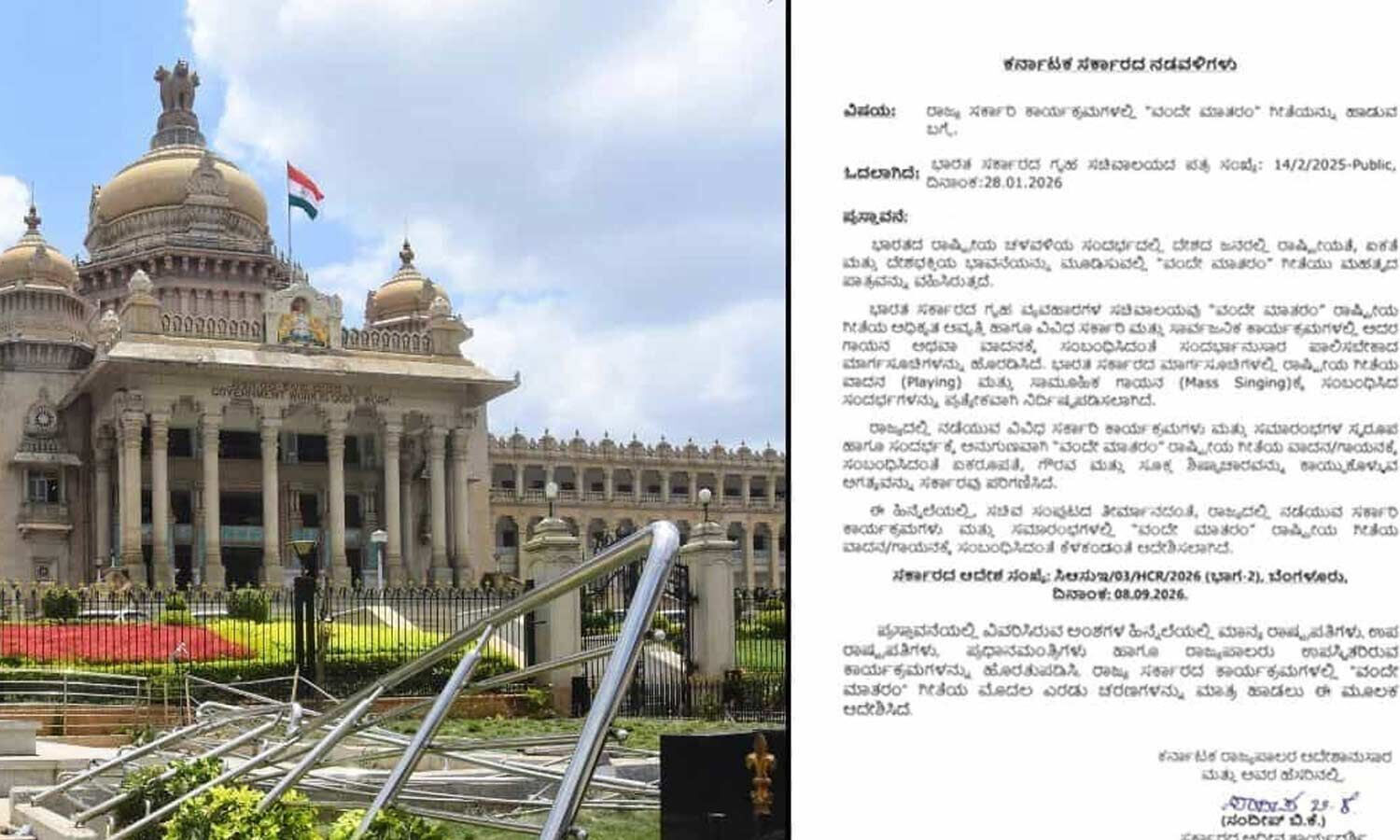
The Union Home Ministry directed that all six stanzas be sung before the National Anthem when both are played together, while Karnataka’s government has ordered only the first two at most of its programmes.
Key facts
- Petitioner
- Carnatic vocalist T M Krishna
- Respondent
- The Centre
- Challenged requirement
- Mandatory singing of six stanzas of Vande Mataram
- Constitutional provisions
- Articles 25 and 26, concerning freedom of religion
- Law involved
- Prevention of Insults to the National Honour Act
- Court’s preliminary view
- Vande Mataram’s status as the national song is beyond doubt
- Related political dispute
- Whether all six stanzas or only the first two should be sung at official and party programmes
Quotes

T M Krishna
Carnatic vocalist and petitioner challenging mandatory recitation of Vande Mataram
“The amendment to cover Vande Mataram under the Prevention of Insults to the National Honour Act is arbitrary and violates personal liberty, and furthers a majoritarian religious message”
 telegraphindia.com
“Four stanzas of Vande Mataram expressly invoke devotion to Hindu deities, and mandating the singing of those portions violates the secular character of the nation.”
telegraphindia.com
Justice Joymalya Bagchi
Supreme Court judge who commented on the applicability of the Bijoe Emmanuel ruling
“We would expect that the law of the land, as declared by this Court in Bijoe Emmanuel, will govern the act of the statute. The declaration of law in Bijoe Emmanuel has till now not been questioned”
telegraphindia.com
Sources

Related news
Karnataka Court Challenge Targets Two-Stanza Vande Mataram Order

Why Jana Gana Mana and Vande Mataram Can Coexist
Karnataka Vande Mataram Row Escalates Over Two-Stanza Limit
Karnataka Vande Mataram Dispute Escalates Over Two-Stanza Rule

Karnataka Limits Vande Mataram to Two Stanzas at Events

DK Shivakumar Reaffirms Congress Stand on Two Vande Mataram Stanzas

Crossword Book Awards 2026 Longlist Highlights Diverse Indian Writing

Eight New Books Revisit India's Past for Independence Day

T.M. Krishna questions symbolism behind hockey team's new saffron kits

TM Krishna Explores India's National Symbols in New Book
