1 week ago
UPSC GS-3 Practice Examines UPI Sustainability and AI Drug Discovery
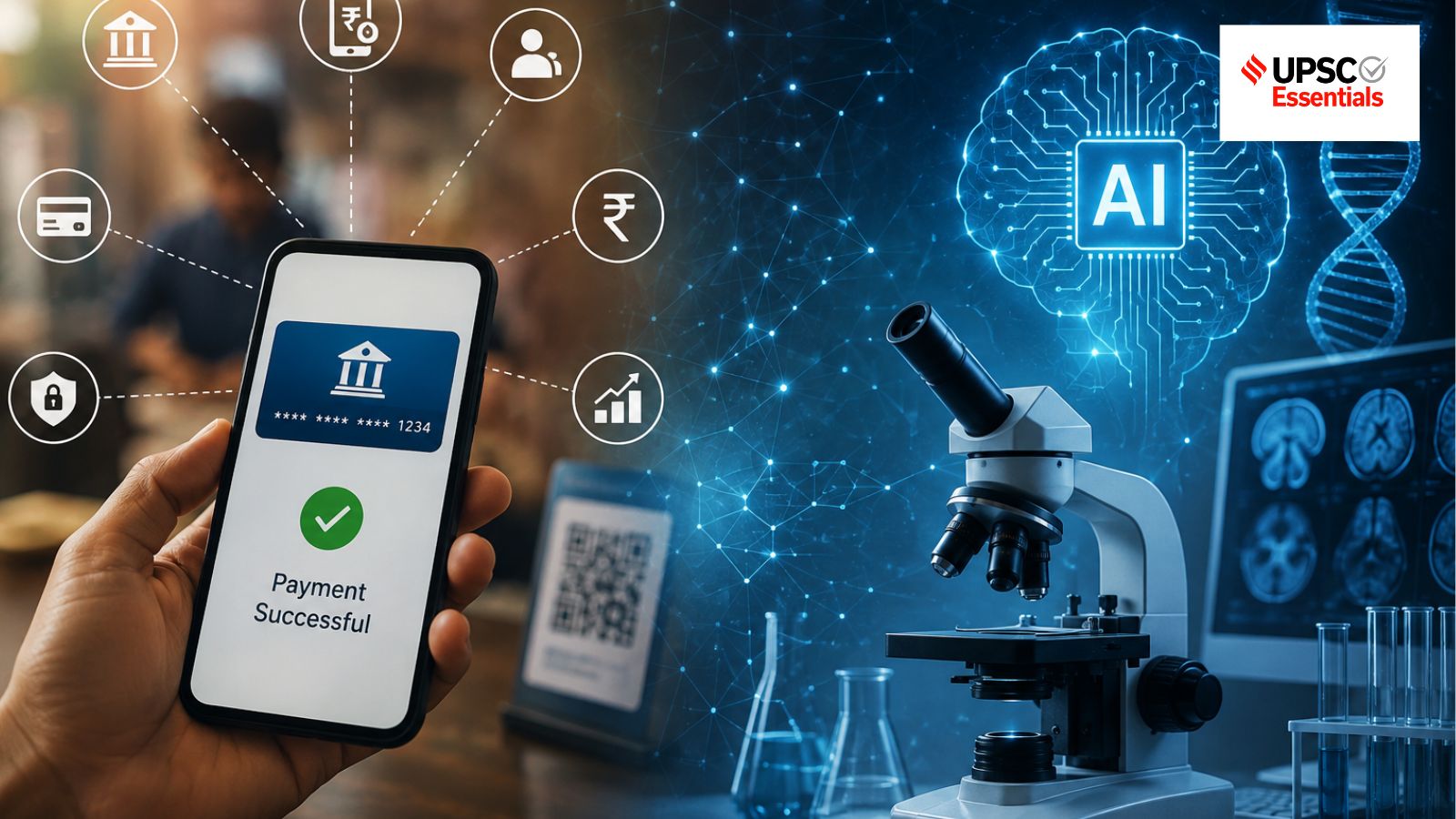
This article gives civil-service exam students two questions about technology and the economy.
The first asks why free UPI payments became so popular.
UPI makes it easy for people and small shops to send and receive money without paying a transaction fee.
However, banks and payment companies still spend money running and protecting the system.
The article asks how UPI can remain free for ordinary users while also being financially sustainable.
The second question is about using AI to find new medicines.
AI can examine many molecules quickly and suggest promising drug candidates.
But scientists must still test those candidates in laboratories, animals and people.
AI can help researchers, but it cannot replace medical testing or regulators.

UPI’s zero-cost access helped drive widespread adoption of digital payments, including among small businesses and individuals.
UPI reportedly has over 55 crore users and handled more than 24,000 crore transactions worth ₹314 lakh crore in 2025-26.
The zero-MDR model creates financial pressures for banks, payment providers and fintech firms that bear infrastructure and operational costs.
AI can narrow large drug-discovery searches, design molecules and predict properties such as toxicity and absorption.
AI-generated drug candidates still require laboratory testing, animal studies, clinical trials, regulatory approval and affordable access.
- Who
- UPSC Essentials and Indian Express are presenting two GS-3 answer-writing questions for civil-service aspirants.
- What
- The practice examines the adoption and financial sustainability of UPI and the potential and limitations of AI in drug discovery.
- Where
- The practice is presented through the UPSC Essentials initiative of The Indian Express.
- When
- The material is identified as Week 168; it also refers to UPI activity in 2025-26 and an August 2026 magazine.
- Why
- It is intended to help UPSC Civil Services Examination candidates prepare answers on digital finance, AI, biotechnology and healthcare innovation.
Adoption and Innovation
Sustainability and Safety
UPI pricing
Adoption and Innovation
Zero-cost access encourages low-value digital payments, expands participation among individuals and small businesses, and strengthens network effects.
Sustainability and Safety
Zero MDR creates a revenue-cost mismatch and may require a calibrated revenue model or continued government support to fund infrastructure, cybersecurity and expansion.
AI drug discovery
Adoption and Innovation
AI can reduce the search space, identify difficult-to-target proteins, design molecules and prioritise candidates more efficiently than a largely trial-and-error approach.
Sustainability and Safety
AI predictions may not reflect complex human biology, and candidates still require laboratory validation, animal studies, clinical trials and regulatory approval.
Healthcare AI governance
Adoption and Innovation
Data-driven tools may help identify disease-specific targets and support more personalised medicines, including for cancer and genetic illnesses.
Sustainability and Safety
Biased or incomplete data and AI’s black-box decision-making can undermine accuracy, trust, safety and regulatory compliance.
Key facts
- UPI launch
- UPI was launched in 2016.
- UPI users
- The article states that UPI has over 55 crore users.
- UPI transactions
- In 2025-26, UPI completed over 24,000 crore transactions worth ₹314 lakh crore.
- Digital transaction share
- The article states that UPI accounts for 86% of all digital transactions in India.
- MDR model
- Zero MDR makes payments attractive but leaves banks, payment providers and fintech firms bearing substantial operating and infrastructure costs.
- AI screening example
- In the GIPC1 study, about 40,000 molecules were narrowed to five possibilities, two of which were synthesised and tested.
- AI limitations
- The GIPC1 candidate had reached animal testing, but its safety and effectiveness in humans had not yet been established.
Sources
Related news

India’s UPI Revolution Faces Its Next Financial Test
India examines restoring MDR as UPI costs outpace support
India’s UPI Revolution Pushes Digital Payments Toward Cashlessness
Keep UPI Free by Funding It From Savings

India Should Fund UPI as Digital Public Infrastructure

India Must Preserve Zero MDR As UPI Expands Nationwide
UPI Accepted in 11 Countries, But Payments Vary
Axis Bank Adds Separate UPI Limits for Payment Categories

Credit Card Transactions Surge as Average Spending Falls in July
India Plans Agentic AI Payments Through Popular UPI Network

India’s Banking Summit Maps AI’s Responsible Financial Frontier