

1 week ago
North India Cotton Acreage Falls 23%, Punjab Hit Hardest
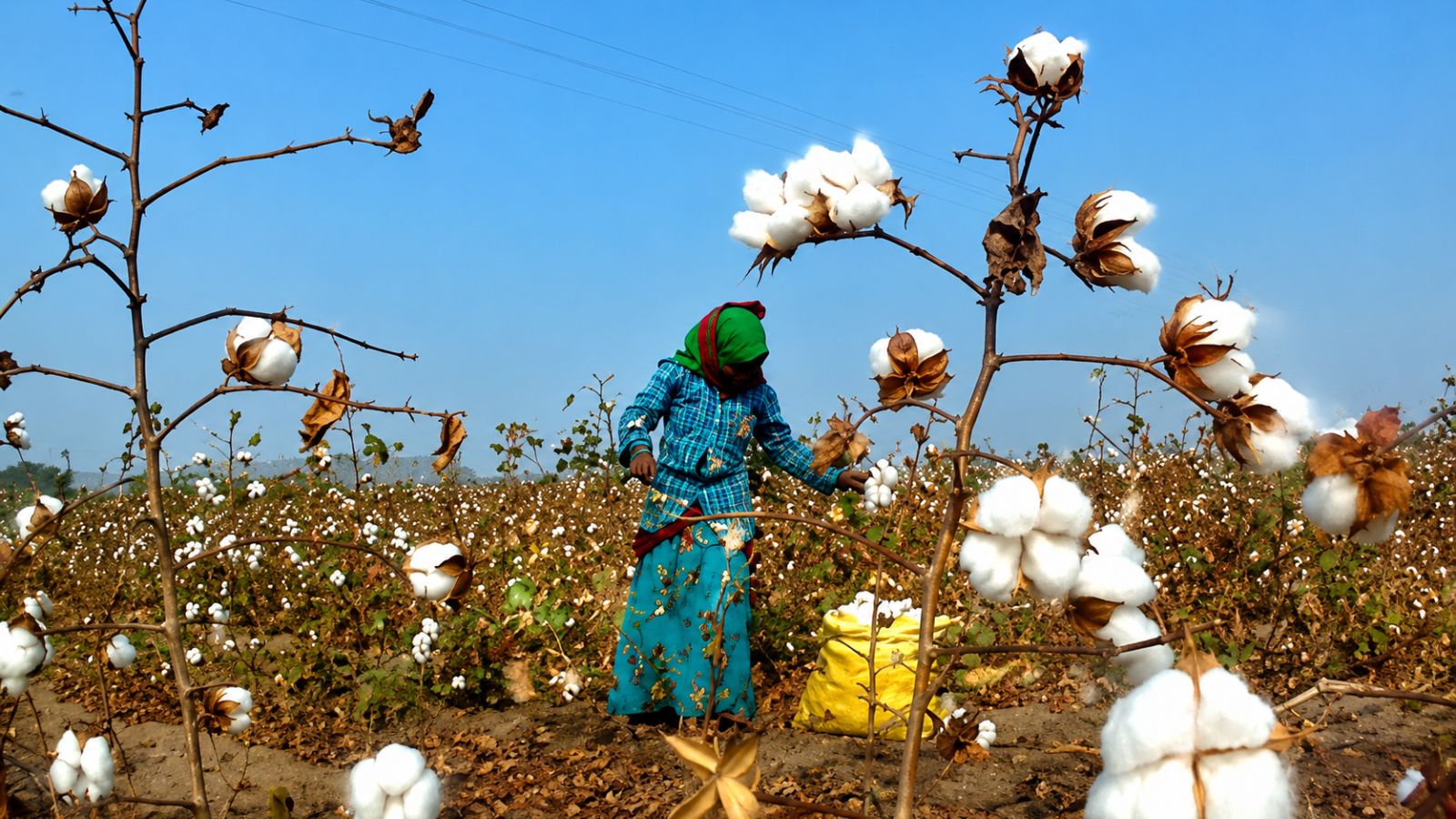
Cotton farming is shrinking in Punjab, Haryana and Rajasthan.
Together, these states planted about 23% less cotton this year than last year.
Punjab saw the biggest percentage drop, reaching its lowest cotton area ever at about 80,000 hectares.
Farmers say insects such as whiteflies and pink bollworms have damaged their crops.
They also say cotton now produces lower yields and leaves little profit after costs.
Paddy feels safer because farmers have assured procurement, market access and timely payments.
More irrigation has also made it easier for farmers in Punjab to grow paddy.
Officials in Haryana and Rajasthan say rain and monsoon conditions contributed to this year’s decline.
Punjab’s agriculture minister has said more central support is needed to encourage crop diversification and cotton farming.

Cotton acreage across Punjab, Haryana and Rajasthan fell from 11.83 lakh hectares to 9.09 lakh hectares this year.
Punjab recorded the steepest decline, with acreage dropping 37.5% to an all-time low of about 80,000 hectares.
Rajasthan remains the largest cotton-growing state among the three, despite an 18.5% fall to 5.34 lakh hectares.
Haryana’s cotton area declined by roughly 85,000 hectares to about 2.95 lakh hectares.
Farmers are shifting toward paddy because of pest risks, lower yields, rising costs and assured procurement.
- Who
- Farmers and officials in Punjab, Haryana and Rajasthan, along with Punjab Ginners’ Association president Bhagwan Bansal and Agriculture Minister Gurmeet Singh Khuddian.
- What
- Cotton acreage across the three northern states declined by 2.74 lakh hectares, or 23.2%, in one year.
- Where
- The main cotton-growing areas of Punjab, Haryana and Rajasthan, including Punjab’s Malwa belt, Haryana’s Hisar, Charkhi Dadri and Bhiwani, and Rajasthan’s Sri Ganganagar, Hanumangarh and Bhilwara areas.
- When
- The comparison covers last year and this year; the article also describes longer-term declines since the 2015 whitefly attack and pest infestations from 2021 onward.
- Why
- Pest attacks, falling yields, rising cultivation costs, market uncertainty, rain and monsoon conditions, and the greater income security offered by paddy.
Farmers and Cotton Industry View
Officials and Policy View
Main causes of the decline
Farmers and Cotton Industry View
Bhagwan Bansal and farmer Darbara Singh attribute the shift away from cotton to repeated whitefly and pink bollworm attacks, lower yields, high costs, market uncertainty and the stronger security of paddy procurement.
Officials and Policy View
Officials in Haryana and Rajasthan attribute a significant part of this year’s decline to rain and monsoon conditions.
What could restore cotton farming
Farmers and Cotton Industry View
The Punjab Ginners’ Association says farmers need better seed, effective pest control, higher yields, remunerative prices and a reliable market before they will return to cotton.
Officials and Policy View
Punjab Agriculture Minister Gurmeet Singh Khuddian has said the state is pursuing diversification away from paddy toward cotton and other crops, but greater support from the central government is needed.
Cotton versus paddy
Farmers and Cotton Industry View
Farmers say paddy offers assured procurement, an extensive mandi network, timely payments and free electricity, making it less risky than cotton.
Officials and Policy View
The state’s diversification effort seeks to promote cotton and other crops alongside efforts to reduce dependence on paddy.
Key facts
- Combined cotton area last year
- About 11.83 lakh hectares across Punjab, Haryana and Rajasthan.
- Combined cotton area this year
- About 9.09 lakh hectares.
- Overall decline
- 2.74 lakh hectares, or 23.2%, equivalent to about 6.77 lakh acres.
- Punjab acreage
- Fell from about 1.28 lakh hectares to 80,000 hectares, a 37.5% decline.
- Haryana acreage
- Fell from about 3.80 lakh hectares to 2.95 lakh hectares, a reduction of roughly 85,000 hectares.
- Rajasthan acreage
- Fell from approximately 6.55 lakh hectares to 5.34 lakh hectares, an 18.5% decline.
- Reported cotton yields in Punjab
- Declined from about 8–12 quintals per acre to roughly 5–7 quintals in many cases.
Quotes
Bhagwan Bansal
President of the Punjab Ginners’ Association
“Cotton has become a very risky crop. The whitefly attack devastated it in 2015, while pink bollworm caused further damage in 2021 and subsequent years. Farmers have lost faith because yields have fallen sharply.”
 indianexpress.com
“Earlier, cotton was the natural crop of this belt. But when irrigation became easily available and paddy offered assured procurement, farmers gradually started moving towards paddy.”
indianexpress.com
Sources
Related news
Punjab’s Crop Diversification Plan Falters as Rice Claims 92%
Punjab's paddy area hits all-time high of 32.76 lakh hectares
Dry Spell Threatens Cotton Yields Across Karimnagar District
Tea Auction Price Drop Worries Eastern India Planters

Haryana Plans 582 Village Knowledge Centres for Rural Services

UP Minister Visits Ankit Baliyan Family, Promises Strict Action

Congress Questions Haryana’s Falling Sex Ratio Despite Beti Bachao

Haryana Says Ayushman Bharat Health Services Continue Despite IMA Call

Private Hospitals Flag Ayushman Bharat Payment Delays and Claim Deductions
