

3 weeks ago
Data Centre Power Boom Sparks Rs 3,000 Crore Relief Plea
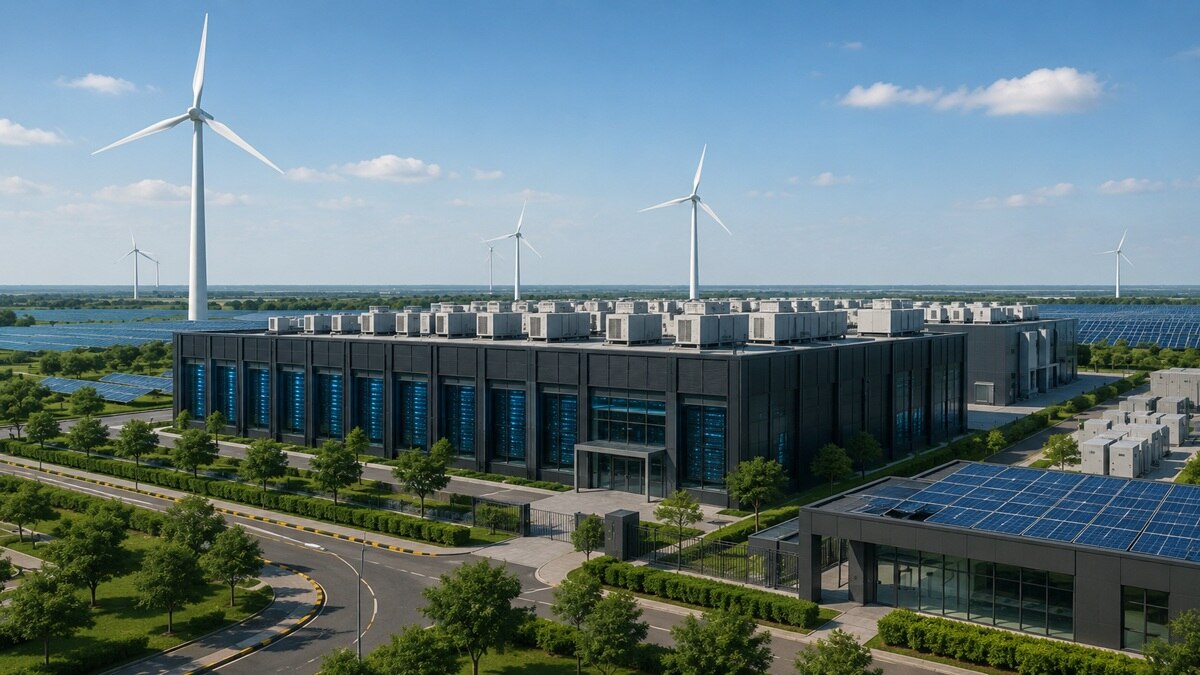
The power used by big computer buildings called data centres is growing very fast in India.
One company, Adani, asked a state regulator for permission to supply electricity to its own data centre park in Noida.
Earlier, Andhra Pradesh gave Google the first licence like this in India for a huge data centre hub.
Because building new power lines has been slow and payments have been late, renewable energy companies asked the government for help.
They want money to cover costs, a pause on loan payments, and more time to repay debts.
Around the world, big changes are happening too.
The United States will charge a 15% tax on polysilicon, a material used in solar panels, starting December 4.
China is taxing older solar technology and has asked solar makers to stop cutting prices too low.
India also noticed solar cell imports from Ethiopia suddenly jumped to $202 million and is checking whether the cells were really from China.
All these moves could change the price and supply of solar power parts in India in the coming months.

Adani Energy Solutions has asked the Uttar Pradesh Electricity Regulatory Commission for a parallel electricity distribution licence to serve a data centre park in Noida.
Renewable energy developers have sought a government relief package, cited as Rs 3,000 crore in the headline but Rs 30,000 crore and Rs 30 billion in the body, including bridge financing and loan moratoriums.
Andhra Pradesh issued India's first parallel distribution licence to Google for its 1 GW data centre hub in Visakhapatnam.
President Trump announced a 15% US tariff on polysilicon imports effective December 4, while China is taxing older silicon cell technology and curbing below-cost solar competition.
A government probe was ordered after solar PV cell imports from Ethiopia jumped from zero to $202 million in FY26, suspected of bypassing Chinese tariffs.
- Who
- Adani Energy Solutions, renewable energy developers, Google, the Indian government, and regulators such as the Uttar Pradesh Electricity Regulatory Commission.
- What
- A data centre-driven power demand boom has prompted renewable developers to seek government relief, private power distribution licences, and a probe into solar cell imports.
- Where
- India (Noida, Visakhapatnam, New Delhi), with global policy developments in the United States, China, and Germany.
- When
- Reported in the first week of August, with the US polysilicon tariff taking effect December 4 and Ethiopia imports recorded in FY26.
- Why
- Surging power demand from data centres and industry, delayed payments and stalled transmission projects, and shifting global solar supply chains.
Key facts
- Relief package sought
- Rs 3,000 crore (headline) / Rs 30,000 crore (body); up to Rs 30 billion
- Average daily energy consumption (first week of August)
- 5,237 MU
- Solar demand
- Peak 245 GW; non-peak 240 GW (up 7% year-on-year)
- Maximum power deficit
- 225 MW during non-solar hours; no deficit during solar hours
- US polysilicon tariff
- 15%, effective December 4, plus minimum prices on polysilicon and derivatives
- Ethiopia solar cell imports (FY26)
- $202 million, up from zero; 81% of all imports from Ethiopia
- SECI FDRE auction
- 1,000 MW at Rs 5.25 per kWh; minimum demand fulfilment of 90% peak, 80% off-peak, 90% annual
- Lithium price change
- Down 30% from May peak, hitting a five-month low
Sources
Related news

India’s Power Sector Faces Rising Demand and Nuclear Constraints
India’s Power Demand Surges as Data Centres Expand Grid Needs
India Plans 10 GW Polysilicon Incentives to Cut China Dependence
India on Track for Record 50 GW Solar Capacity

India’s Data Centre Capacity Could Triple by 2030

Indian Courts and Officials Face Detention, Speech Controversies

Sharma and Malik share halfway lead at Telangana Golconda Masters

Films Raise Awareness of Violence but Cannot End It

Teen Allegedly Gangraped on Moving Delhi Bus; Two Arrested

Allahabad High Court Quashes NSA Detention in Noida Protest Case
