1 week ago
India’s Manufacturing Boom Widens Trade Deficit Through Imported Inputs
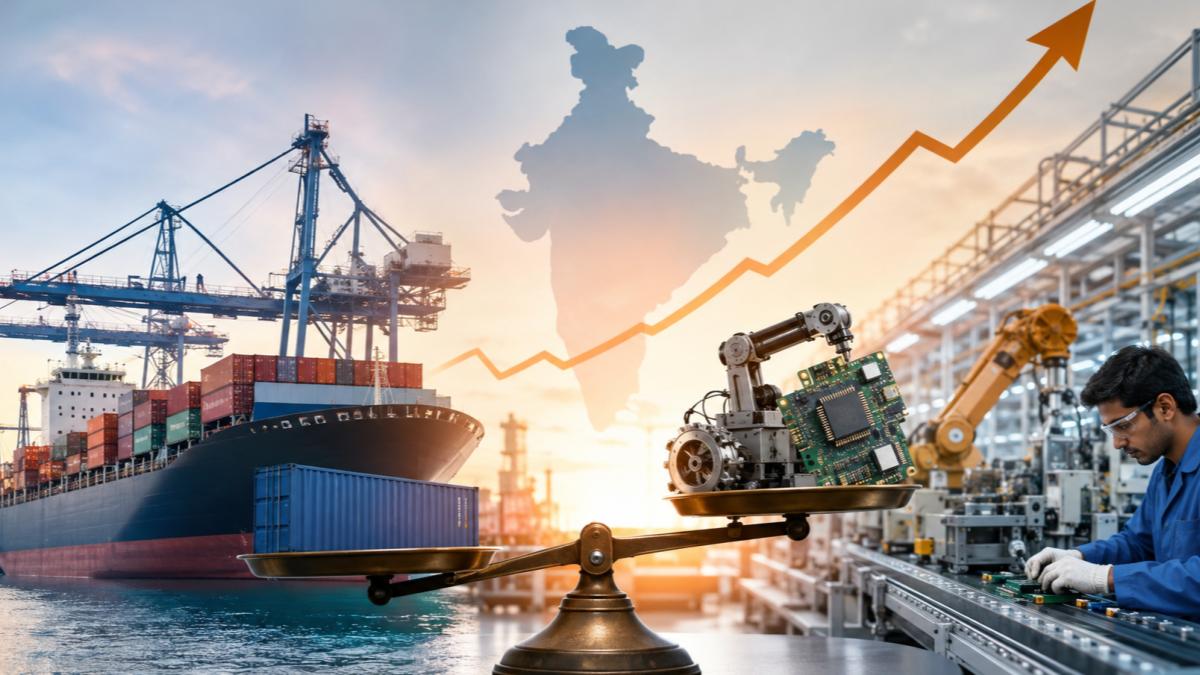
India is building more factories and exporting more manufactured products.
To build those factories, it must first buy machines, chips and electronic parts from other countries.
These purchases make imports rise quickly.
In July 2026, India’s imports grew faster than its exports, so its trade deficit became larger.
Electronics exports grew strongly, but electronics imports grew even faster.
This does not necessarily mean the manufacturing plan is failing.
It may show that companies are investing in future production.
The important question is whether India eventually makes more parts and equipment itself.
If it does, the country may need fewer imports for each product it exports.

India’s goods trade deficit reached nearly $32 billion in July 2026, a six-month high.
Merchandise imports rose 18% year-on-year to $76.2 billion, while exports increased 20% to $44.2 billion.
Capital goods imports climbed 25% year-on-year to $27.1 billion, led by electronics and machinery.
Electronics exports rose 57% year-on-year to $5.9 billion, but electronics imports increased 44% to $14.4 billion.
The widening deficit reflects factory-building costs, while longer-term benefits depend on stronger domestic supply chains and localisation.
- Who
- India, its manufacturers and overseas suppliers are involved.
- What
- India’s goods trade deficit widened as imports of capital goods, electronics and machinery outpaced export growth.
- Where
- India’s merchandise trade and manufacturing supply chains.
- When
- The main figures cover July 2026; additional figures cover the first four months of FY27.
- Why
- Companies are importing machinery, semiconductors and electronic inputs to build and expand manufacturing capacity, while domestic production of those inputs remains limited.
Investment-led interpretation
Structural-risk interpretation
Meaning of rising imports
Investment-led interpretation
Higher imports of machinery, electronics and capital goods may indicate that companies are installing equipment and expanding productive capacity.
Structural-risk interpretation
The same imports increase India’s near-term trade deficit and may show continued dependence on foreign machinery, chips and components.
Manufacturing exports
Investment-led interpretation
Strong growth in electronics and engineering exports suggests India’s manufacturing and export base is expanding.
Structural-risk interpretation
Rising final assembly exports do not necessarily deliver large net trade gains when imported inputs account for much of the product’s value.
Long-term outcome
Investment-led interpretation
Imported factories and equipment could help develop domestic suppliers, increase local value addition and reduce import intensity over time.
Structural-risk interpretation
Unless India localises components, industrial equipment and high-value electronic inputs, stronger exports could remain tied to a persistent import requirement.
Key facts
- July goods trade deficit
- Nearly $32 billion, a six-month high
- July merchandise exports
- $44.2 billion, up 20% year-on-year
- July merchandise imports
- $76.2 billion, up 18% year-on-year
- Capital goods imports
- $27.1 billion, up 25% year-on-year
- Electronics exports
- $5.9 billion, up 57% year-on-year
- Electronics imports
- $14.4 billion, up 44% year-on-year
- July services surplus
- $16.95 billion
Sources
Related news

India's July Exports Hit Record High as Trade Deficit Widens
India's exports surge 19.6% as trade deficit hits six-month high

India’s $214 Billion Non-Petroleum Trade Deficit Challenges Make in India

India's Merchandise Exports Hit Record High of $129.6 Billion
India's merchandise exports clock 19.6% growth in July despite headwinds

India’s Current Account Deficit Widens Marginally in April-June

Swara Bhasker’s Jauhar Remarks Revive Padmaavat’s Historical Debate

Young Government Bank Officer Reveals Salary, Benefits After 2.5 Years

India’s Dementia Crisis May Affect 16.9 Million Seniors by 2036

Five Student-Friendly Laptops Covering Every College Budget and Workload
Putin Faces Western Isolation While Russia Builds Non-Western Ties