2 hrs ago
AI, Robotics and the Human Future of Warfare
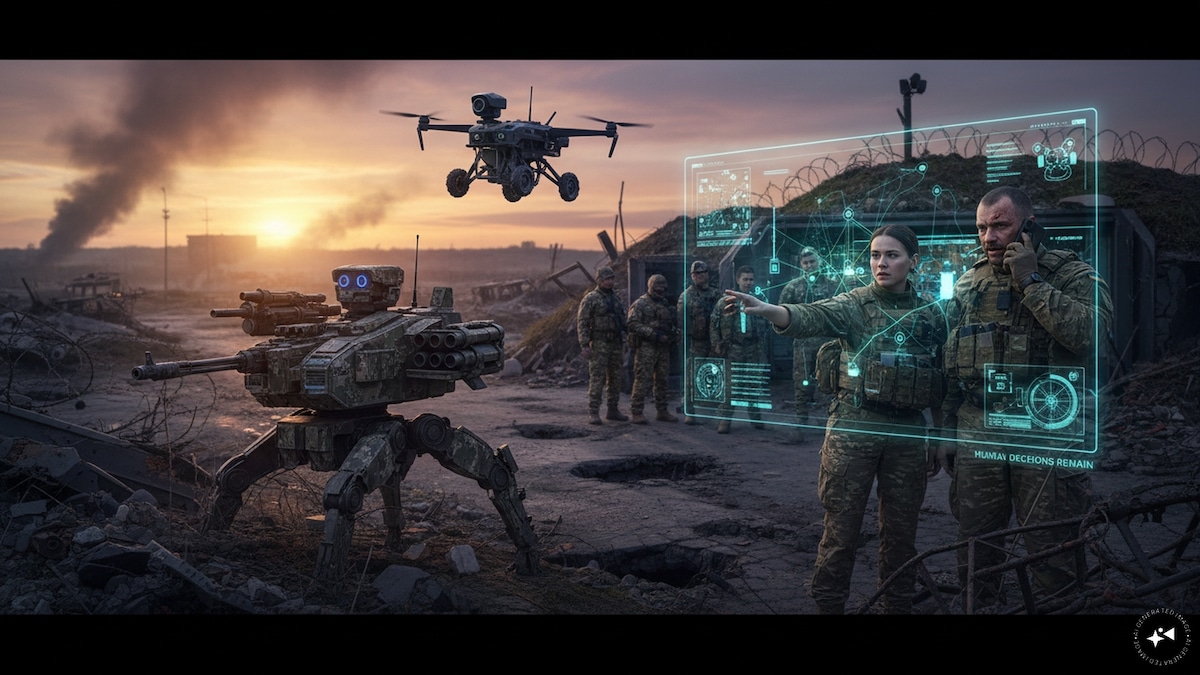
Armies are using more robots and computer programs in wars.
Some machines can watch borders, carry equipment or enter dangerous places instead of soldiers.
Ukraine has used ground robots and drones during its war with Russia.
China is testing robot dogs and wolves for tasks such as scouting and carrying supplies.
Israel is working with an autonomous drone system that can operate from a ground station.
AI programs can also combine information from satellites, cameras, radar and drones.
These technologies may let fewer soldiers supervise more machines.
However, people still need to decide the mission, manage risks and determine when force should be used.
The main debate is how much decision-making should be given to machines.

Militaries are using AI, sensors and robots to perform surveillance, logistics and hazardous battlefield tasks.
South Korea plans to reduce border guard-post troops from about 22,000 to 6,000 by 2040 using AI-enabled surveillance.
Ukraine has deployed unmanned ground vehicles and AI-enabled drones, while China is testing quadruped robots for military uses.
Israel, the United States and NATO are pursuing autonomous surveillance and AI systems that integrate battlefield data.
The technology may reduce routine manpower needs but increase demand for specialists and raise questions about human control over force.
- Who
- Militaries and defence organizations including Ukraine, China, Israel, the United States, NATO and South Korea.
- What
- They are developing and using AI-enabled drones, ground robots, quadruped robots, autonomous surveillance systems and AI data-integration tools.
- Where
- On battlefields including Ukraine, along the South Korean-North Korean border, and in military development and testing programs in China, Israel, the United States and NATO.
- When
- The developments are occurring now; the article cites South Korea's 2040 troop-reduction plan, Ukraine's 2023 approval of SkyKnight-2, NATO's 2025 acquisition of Maven, and an Israel-Starling collaboration announced in January 2026.
- Why
- To compensate for shrinking manpower, reduce soldiers' exposure to danger, process growing volumes of battlefield data and improve surveillance and decision-making.
Human Control and Caution
Greater Automation and Autonomy
Decision-making and use of force
Human Control and Caution
Humans should retain control over mission objectives, acceptable risks and decisions about when force is used; the article distinguishes autonomous flight from fully autonomous targeting.
Greater Automation and Autonomy
More autonomy could allow machines to continue missions when communications are disrupted and let one person supervise systems that previously required larger teams.
Military manpower
Human Control and Caution
Robots do not eliminate the need for people because systems require operators, engineers, maintainers and secure communications networks.
Greater Automation and Autonomy
AI and robotics can reduce the number of personnel needed for routine guard, surveillance, logistics and hazardous battlefield tasks.
Readiness of robotic systems
Human Control and Caution
Demonstrations of armed quadruped robots should not be treated as evidence of routine frontline deployment; reliability, energy use and unpredictable conditions remain challenges.
Greater Automation and Autonomy
Testing by China and battlefield use of unmanned systems in Ukraine indicate that robotics are already moving from laboratories and demonstrations into military operations.
Key facts
- South Korean plan
- Reduce troops assigned to border guard posts from about 22,000 to 6,000 by 2040, with AI-enabled surveillance taking over some duties.
- Ukraine ground robot
- The Droid TW 12.7 is a tracked unmanned vehicle equipped with a remotely operated heavy machine gun.
- SkyKnight-2
- An AI-enabled Ukrainian strike drone approved for military use in 2023, with a stated payload capacity of up to 2.5 kilograms.
- Pathfinder-X
- Starling lists more than three hours of forward-flight endurance and a one-way range of 160 kilometers; these are manufacturer specifications.
- Maven Smart System
- A Palantir-developed AI platform that combines military data to support analysts and commanders; NATO acquired it in 2025.
- Main workforce shift
- Automation may reduce routine guard and logistics roles while increasing demand for software, robotics, electronics, cybersecurity and data specialists.
Quotes
Maj Gen Sanjay Meston (Retd)
A retired Indian major general discussing military robotics and human-machine cooperation
“What militaries across the world will do is that they will blend them with their soldiers or the guards in such a manner that the control will be retained by them, but at the same time every robot will be able to take immediate spot decisions”
 CNBC TV 18
Sources
Related news
India's AI Arms Race Tests Readiness for Future Warfare
China accelerates push to put humanoid robots on battlefields

Humanoid Robots Near Borders Raise Questions About Human Control
UK and Ukraine Open Battlefield AI Partnership Amid War
Foundation Pitches Humanoid Robots for Border Patrol and War
US Army Disbands Specialized Drone Warfare Battalion

Russia Says U.S. Missile Deployment to Norway Undermines Arms Talks

Mecca Pact Faces Questions Over Scope And Strategic Coherence
EU Unveils Greenland Investment Plan Amid Trump’s Control Push
Putin Meets U.S. Envoys as Ukraine Peace Talks Stall