1 hr ago
China accelerates push to put humanoid robots on battlefields

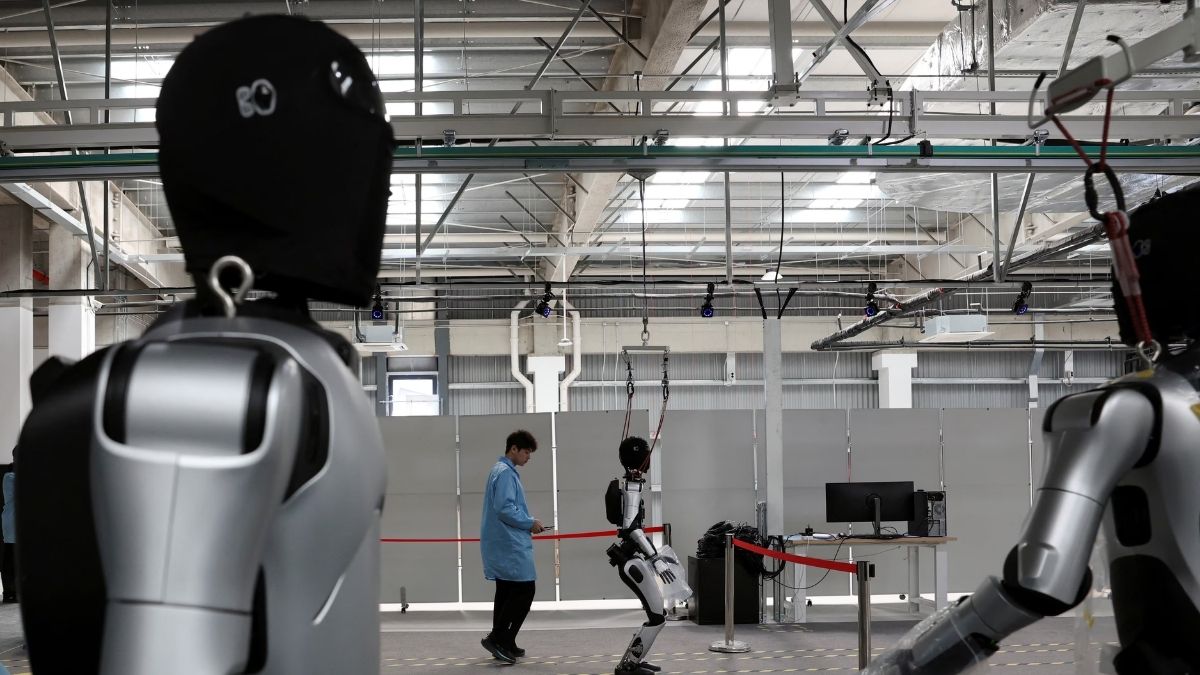
China is studying whether human-shaped robots could help soldiers in future wars.
The robots might explore dangerous places, carry supplies or enter buildings before human troops.
Researchers have tested robots in competitions and have requested equipment to train them.
One plan imagines six robots helping soldiers search an enemy-held building.
A Chinese defense company has also shown a robot that a human can control from far away.
However, today’s humanoid robots use a lot of energy and can fail in unpredictable places.
Experts say simpler robots with wheels, tracks or four legs may often be cheaper and easier to use.
Countries also need to decide how robots can follow the laws of war and avoid harming civilians.

China’s military is researching humanoid robots for reconnaissance, logistics, urban assaults and other battlefield roles.
A National University of Defense Technology study modeled six robots supporting troops in clearing enemy-held buildings within five to 10 years.
Military tenders sought humanoid robots, dexterous-operation systems and data-collection tools for training robotic perception.
Norinco’s Fuxi humanoid is designed for sentry duty, reconnaissance and patrols and can be remotely operated by a person.
Experts say the robots remain costly, energy-intensive and unreliable, while autonomous weapons raise legal and ethical concerns.
- Who
- China’s People’s Liberation Army, military research institutions, defense companies and robotics researchers; the United States Army is pursuing related capabilities.
- What
- China is accelerating research, procurement and testing of humanoid robots for possible military use, without evidence that an armed humanoid has entered an operational PLA unit.
- Where
- The research and testing described took place in China, including at the National University of Defense Technology in Xi’an.
- When
- The effort gained momentum in 2025 and 2026, following earlier military discussions in 2024.
- Why
- China is exploring robots that could perform dangerous missions, support troops in difficult terrain and reduce risks to human personnel.
Potential battlefield uses
Current limitations and risks
Military usefulness
Potential battlefield uses
Supporters say humanoids could enter dangerous buildings, tunnels and ship interiors, combine mobility with manipulation, and perform reconnaissance or other hazardous tasks alongside troops.
Current limitations and risks
Critics say humanoids are currently energy-intensive and unreliable outside controlled demonstrations; quadruped, tracked or wheeled robots may be cheaper and easier to deploy for simpler missions.
Autonomy and human control
Potential battlefield uses
Chinese military commentary and research envision robots moving from support roles toward primary combat, while remote operation could let humans control systems during missions.
Current limitations and risks
Autonomous systems may struggle to distinguish civilians, combatants, wounded fighters and surrendering personnel; experts and humanitarian officials say force decisions require human judgment and legal safeguards.
Future readiness
Potential battlefield uses
Chinese researchers and defense analysts say breakthroughs, lower costs and industrial-scale production could make humanoids widespread within five to 10 years.
Current limitations and risks
Researchers acknowledge unresolved problems in movement, perception and intelligence, and there is currently no evidence of an armed humanoid operating with a PLA unit.
Key facts
- Commercial position
- Chinese manufacturers accounted for about 95% of global humanoid shipments in 2025, according to BofA Global Research.
- Urban assault concept
- A 2025 National University of Defense Technology paper modeled six robots supporting two teams in clearing an enemy-held building.
- Procurement
- A May 2025 PLA tender sought a humanoid robot, installation and technical training.
- Training system
- A June budget document allocated about $300,000 for collecting and labeling camera, radar and motion data for humanoids.
- Defense-industry example
- Norinco’s Fuxi robot is described as capable of sentry duty, reconnaissance, patrols and dangerous tasks.
- Current limitation
- Reuters found no evidence that China has deployed an armed humanoid with an operational PLA unit.
- International comparison
- The United States Army launched a competition for militarized humanoid capabilities, including reconnaissance, security and obstacle clearing.
Quotes
Malcolm Davis
Senior analyst at the Australian Strategic Policy Institute
“Going where we don’t want humans to go is one of the most compelling reasons to develop robots in the first place. If losing a robot means avoiding the loss of a human life, then the robot can become expendable.”
 telegraphindia.com
“Their two hands and two feet could, in theory, combine mobility, climbing and manipulation.”
telegraphindia.com
Sources
Related news
China Pushes Humanoid Robots From Spectacle Toward Industrial Workforce

China’s Humanoid Robot Boom Races Ahead of Real-World Readiness

Chinese Humanoid Robots Break Human Records at Beijing Games

China’s Robot Advances Raise Questions About India’s LAC Readiness

China’s Humanoid Robot Boom Shows Progress, But Reliability Remains Uncertain
Foundation Pitches Humanoid Robots for Border Patrol and War

India’s Household Savings Shift From Banks Toward Markets

How We Disappeared Remembers Singapore’s Comfort Women

Global Cues, FII Flows and Oil to Drive Stocks
Foreign Investors Sell ₹8,731 Crore in Indian Equities