

1 hr ago
NASA Engineers Use “Big Bang” to Extend Aging Voyager Mission
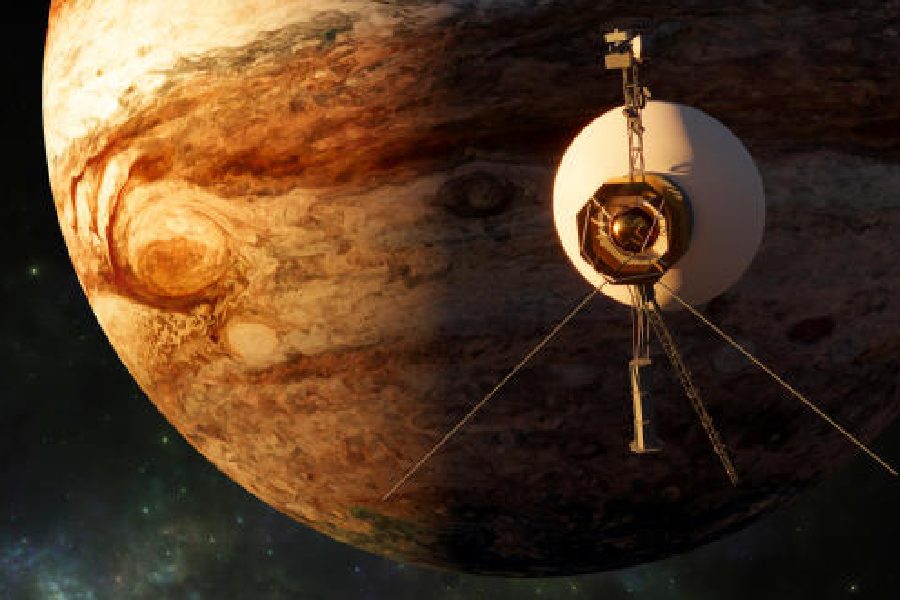
Voyager 1 and Voyager 2 are two very old spacecraft sent into space in 1977.
They are now farther from Earth than any other human-made objects.
Engineers at NASA still send them commands, but each message takes about two days to make the round trip.
The spacecraft are running out of electricity because their plutonium power sources are getting weaker.
Their fuel pipes can also clog, and their fuel can become too cold.
NASA engineers recently changed several electrical settings on Voyager 2 at the same time.
This “Big Bang” saved enough power to run about one or two lightbulbs.
The saved energy may allow Voyager 2 to keep working until around 2031.

NASA engineers performed a “Big Bang” power-saving operation on Voyager 2 last month.
The operation saved about 10 watts and could extend Voyager 2’s mission by roughly two years, into 2031.
Voyager 1 and Voyager 2 are about 16 billion and 13.3 billion miles from Earth, respectively.
Both probes face clogged fuel lines, freezing hydrazine and declining power from aging plutonium batteries.
Voyager 1 entered interstellar space in 2012, while Voyager 2 followed six years later.
- Who
- Engineers and mission managers at NASA’s Jet Propulsion Laboratory, including the Voyager mission team.
- What
- The team carried out a “Big Bang” reconfiguration of Voyager 2’s electrical systems to reduce power use.
- Where
- The engineering work was conducted at NASA’s Jet Propulsion Laboratory in California, while the spacecraft operate in interstellar space.
- When
- The operation was completed last month after tests in May and the following month; the Voyagers launched in 1977.
- Why
- To conserve power from the Voyagers’ aging plutonium batteries and keep the spacecraft collecting observations for as long as possible.
Key facts
- Launch year
- 1977
- Voyager 1 distance
- Almost 16 billion miles from Earth
- Voyager 2 distance
- About 13.3 billion miles from Earth
- Power saved
- About 10 watts
- Expected extension
- Roughly two additional years for Voyager 2, potentially into 2031
- Voyager 1 interstellar entry
- 2012
- Voyager 2 interstellar entry
- Six years after Voyager 1, in 2018
Quotes
Kareem Badaruddin
Voyager mission manager
“Every time I talk about Voyager, I kind of treat it like my parents. As a human gets older, they have all these problems. A spacecraft is similar. The older it gets, the more problems.”
 telegraphindia.com
“We’re like pirates. Nobody likes to be this close to the edge, but we’ve gotten quite comfortable with it, because it’s our only choice.”
telegraphindia.com

Suzanne Dodd
Voyager project manager since 2010
“There’s always that concern that it might not go correctly.”
telegraphindia.com
Sources
Related news
NASA Keeps Voyager 2 Alive With 'Big Bang' Power Swap
NASA Extends Voyager 2 Mission, Invites ISRO to Moon Base
Katalyst Spacecraft Reaches Failing Swift Observatory, Turns Away
Astronauts Remove Faulty ISS Antenna, Postpone Spare Installation
NASA Abandons Swift Telescope Rescue After Booster Mission Fails
NASA Abandons Mission to Save Swift Telescope from Earth Crash

Newsom's South Carolina Push, $1.7 Million Network Hint at 2028

Small Plane Crash Near Fresno Kills Two, Injures Two

Pistachio Popularity Grows as Water and Climate Risks Deepen

Indian National Charged in US Drug and Firearm Case
