

3 weeks ago
Indian EVs Outrun Tesla and BYD in Efficiency Ranking
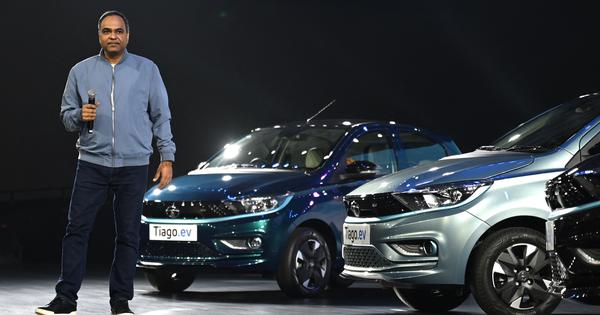
Some companies make electric cars, which run on batteries instead of gasoline.
Experts from a group called the International Council on Clean Transportation measured how much electricity these cars use.
They found that car companies from India are the most efficient at using energy.
Tata Motors, a car company in India, was the best in the world at this.
Another Indian company, called Mahindra, came in second.
Famous companies like Tesla and BYD came in third and fourth.
Being efficient means getting more travel from the same amount of electricity.
But Indian cars are still behind in other ways, like how fast they charge.
The government of India hopes that by 2030, many more people will drive electric cars.
This would help reduce pollution and the need to buy oil from other countries.

Tata Motors topped the ICCT's global ranking of the most energy-efficient battery EVs for 2025, averaging 106 Wh/km.
Indian automaker Mahindra ranked second at 113 Wh/km, ahead of Tesla (third) and BYD (fourth) among 22 major EV makers.
Average energy consumption across leading EVs stayed nearly flat at 131 Wh/km in 2025, with only eight manufacturers improving.
EVs make up less than 5% of new passenger vehicle sales in India versus 25% globally, and the government wants 30% by 2030.
Indian EVs still lag in charging and range: Tata Motors ranked last for charging speed and sixth from the bottom for driving range.
- Who
- Indian automakers Tata Motors and Mahindra, ranked ahead of Tesla and BYD in the International Council on Clean Transportation's efficiency ranking.
- What
- Indian carmakers produced the most energy-efficient battery EVs, with Tata Motors first at 106 Wh/km and Mahindra second at 113 Wh/km.
- Where
- The ranking covered 22 of the world's largest EV companies; the story centers on India's EV market and government policies.
- When
- In the International Council on Clean Transportation's 2025 efficiency ranking.
- Why
- India targets 30% electric passenger vehicle sales by 2030 to cut emissions, reduce oil imports, strengthen energy security, and expand domestic manufacturing.
Key facts
- Top-ranked EV maker
- Tata Motors (106 Wh/km)
- Second-ranked EV maker
- Mahindra (113 Wh/km)
- Ranking body
- International Council on Clean Transportation (ICCT)
- Manufacturers evaluated
- 22 of the largest EV companies globally
- Average EV energy consumption
- 131 Wh/km in 2025
- EV share of Indian car sales
- Under 5%, vs 25% globally
- India's 2030 EV target
- 30% of passenger vehicle sales
- India's petroleum consumption
- Fourth-largest, after China, the US, and Russia
Quotes

Amit Bhatt
India managing director of the International Council on Clean Transportation (ICCT)
““Play a crucial role in accelerating this momentum and help India move closer to its vision of achieving 30% EV sales by 2030.””
 scroll.in
Sources
Related news

Tata, Mahindra beat Tesla and BYD in EV efficiency ranking
Why India's EV Opportunity Could Be Bigger Than Investors Realise

India's EV sales likely to grow 55% annually through 2034

Gadkari Projects India’s EV Market at Rs 20 Lakh Crore

VinFast Becomes India's Fifth-Largest EV Maker in Seven Months
India’s Electric Car Sales Cross 2-Lakh Mark in Eight Months
Auto Industry Urges Shift From Make to Create in India
Car Sales Aug'26: Tata Leads Growth, Maruti Dominates Volume
Brokerages Favor Indian Auto Stocks as Truck Sales Surge

Auto stocks plunge despite strong August sales and demand outlook
Tata Motors Rises to No. 2 in India's PV Market
