1 week ago
India Warns Conflicts Threaten Global Food Security Beyond Battlefields
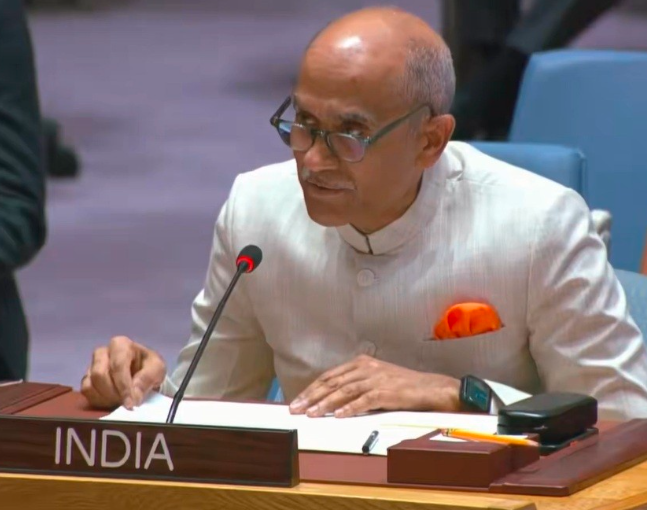
India told the United Nations Security Council that wars can harm food supplies far away from battlefields.
Fighting can disrupt ships, fuel, fertiliser and farming trade.
Countries that import much of their food can be hurt especially badly.
P Harish said the Council should help humanitarian supplies move safely and quickly.
He also said sanctions should not accidentally block food or farm trade.
Antonio Guterres named the Black Sea, Strait of Hormuz and Red Sea as serious trouble spots.
The United Nations has suggested a protected route through Hormuz for fertiliser and food ships.
The World Food Programme warned that shipping problems could make many more people food insecure.

India urged the United Nations Security Council to quickly reduce the humanitarian effects of conflicts on food supplies.
P Harish said wars disrupt energy markets, fertiliser supplies, maritime transport, humanitarian logistics and agricultural trade.
Import-dependent developing countries face disproportionate risks when conflicts interrupt trade routes and supply chains.
Antonio Guterres identified the Black Sea, Strait of Hormuz and Red Sea as major pressure points for food and commodity flows.
The United Nations proposed a protected Hormuz corridor and vessel-verification system, while the World Food Programme warned that maritime disruptions could push tens of millions more people into food insecurity.
- Who
- India, represented by Permanent Representative P Harish; United Nations Secretary-General Antonio Guterres; and the World Food Programme.
- What
- They warned that conflicts and maritime disruptions are threatening global food security and called for humanitarian and trade-protection measures.
- Where
- At the United Nations Security Council; the affected routes include the Black Sea, Strait of Hormuz and Red Sea.
- When
- Tuesday, August 25, during a United Nations Security Council open debate.
- Why
- Conflicts and related restrictions are disrupting energy, fertiliser, shipping, humanitarian logistics and agricultural trade.
Key facts
- Debate topic
- “Food Under Fire: The Security Council's Role in Mitigating Global and Local Food Crises”
- India’s representative
- P Harish, India’s Permanent Representative
- Most vulnerable countries
- Developing nations with high import dependency are particularly exposed to disrupted trade routes and supply chains.
- Key disruption points
- The Black Sea, Strait of Hormuz and Red Sea
- Hormuz trade figures
- The Strait of Hormuz handles a fifth of global oil supplies and a third of world fertiliser trade, according to Antonio Guterres.
- Proposed response
- A time-bound protected corridor through Hormuz for fertilisers, foodgrains and related raw materials.
- Vessel monitoring
- A United Nations Office for Project Services-led task force has developed a system to register and verify fertiliser vessels.
- India’s food-security measures
- The National Food Security Act provides subsidised food grains, while PM-KISAN provides direct benefit transfers to more than 110 million farming households.
Quotes

Antonio Guterres
United Nations Secretary-General
“The Council's immediate priority should be to mitigate the humanitarian consequences of conflict. This requires facilitating safe, rapid and unimpeded humanitarian access, supporting de-confliction arrangements.”
 wionews.com
 deccanchronicle.com
“This time-bound confidence-building effort would focus initially on fertilisers and related raw materials, but with the ability to be extended to other products”
deccanchronicle.com
Carl Skau
Acting Director of the World Food Programme
“serious disruptions to maritime trade now threaten to push tens of millions more people into food insecurity.”
deccanchronicle.com
Sources
Related news
India Urges UN Action to Protect Critical Sea Lanes
India's weak monsoon may add to global food inflation

PM Modi Warns of Weaponisation of Fuel, Fertilisers and Medicines

Ukraine, India Discuss Restoring Black Sea Freedom of Navigation
India Ends Wheat Export Curbs After Three Years

Saudi Arabia Says Iranian Tanker Attack Killed Two Sailors
U.S.-Iran Exchange Escalates Across Middle East, Markets Slide
Trump Aides Seek Quiet Iran War Before Midterm Elections
US Warns Middle East Travelers Amid Escalating Iran-Linked Tensions

Indian Stocks Slide as Oil, Conflict and Yields Rise